
Biolaw

Biolaw

Erick Valdés

157,35 €
IVA incluido
Consulta disponibilidad
Editorial:
Springer Nature B.V.
Año de edición:
2021
Materia
Ética y filosofía moral
ISBN:
9783030718220

Selecciona una librería:

  • Librería Samer Atenea
  • Librería Aciertas (Toledo)
  • Kálamo Books
  • Librería Perelló (Valencia)
  • Librería Elías (Asturias)
  • Donde los libros
  • Librería Kolima (Madrid)
  • Librería Proteo (Málaga)

This book configures a consistent epistemology of biolaw that distinguishes itself from bioethics and from a mere set of international instruments on the regulation of biomedical practices.  Such orthodox intellection has prevented biolaw from being understood as a new branch of law with legally binding force, which has certainly dwindled its epistemological density. Hence, this is a revolutionary book as it seeks to deconstruct the history of biolaw and its oblique epistemologies, which means not accepting perennial axioms, and not seeing paradigms where only anachronism and anomaly still exist. It is a book aimed at validity, but also at solidity because the truth of biolaw has never been told before. In that sense, it is also a revealing text. The book shapes biolaw as an independent and compelling branch of law, with a legally binding scope, which boosts the effectiveness of new deliberative models for legal sciences, as well as it utterly reinforces hermeneutical and epistemological approaches, in tune with the complexity of disturbing legal scenarios created by biomedical sciences’ latest applications. This work adeptly addresses the origins of the European biolaw and its connections with American bioethics. It also analyses different biolaw’s epistemologies historically developed both in Europe and in the United States, to finally offer a new conception of biolaw as a new branch of law, by exploring its theoretical and practical atmospheres to avoid muddle and uncertainty when applied in biomedical settings. This book is suitable for academics and students of biolaw, law, bioethics, and biomedical research, as well as for professionals in higher education institutions, courts, the biomedical industry, and pharmacological companies. 

Artículos relacionados

  • Ka Ab Ba Building The Lighted Temple
    Dr Terri R. Nelson / Dr Terri RNelson
    The book KaAbBa Building The Lighted Temple/Metaphysical Keys to the Tree of Life draws a circle that is inclusive of the Afrikan origin of the Ancient Kemetic/Egyptian wisdom. It reveals the undeniable root and link of Ancient Africa to all the religious systems that would develop worldwide. This book is explosive in its power to convey the meaning of KaAbBa, the Medu Neter  (...
    Disponible

    37,41 €

  • Technoethics and the Evolving Knowledge Society
    Rocci Luppicini
    Recently, there has been a major push to rediscover the ethical dimension of technology across the sciences, social sciences, and humanities. Technoethics and the Evolving Knowledge Society: Ethical Issues in Technological Design, Research, Development, and Innovation examines human processes and practices connected to technology embedded within social, political, and moral sph...
  • Kant
    Immanuel Kant
    Kant’s Groundwork of the Metaphysics of Morals is one of the most important works in modern moral philosophy. It belongs beside Plato, Aristotle, Machiavelli, and Hobbes. Here Kant sets out to articulate and defend the Categorical Imperative - the fundamental principle that underlies moral reasoning - and to lay the foundation for a comprehensive account of justice and human vi...
  • On the Duty of Civil Disobedience
    HENRY DAVID THOREAU
    Civil Disobedience argues that citizens should not permit their governments to overrule their consciences, and that they have a duty to avoid allowing their acquiescence to enable the government to make them the agents of injustice. Thoreau was motivated in part by his disgust with slavery and the Mexican-American War, but the sentiments he expresses here are just as pertinent ...
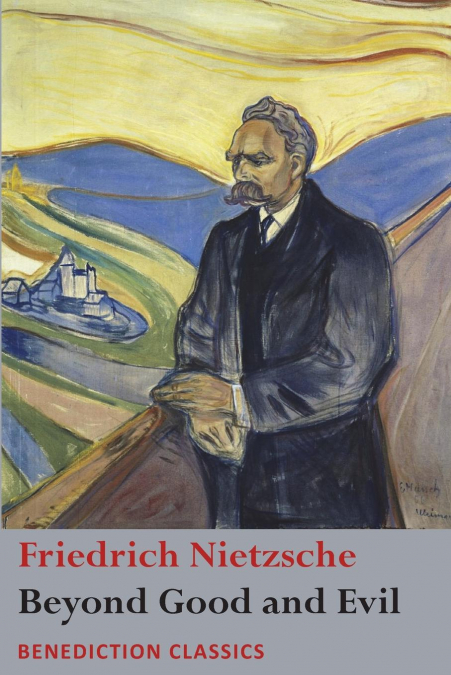
  • Beyond Good and Evil
    Friedrich Nietzsche
    Nietzsche, though primarily a philosopher, wrote widely on art, philology, history, religion, tragedy, culture, and science.  In 1886, at the height of his powers, he published Beyond Good and Evil.  Here he examines much of the best of human thought--dogmatic philosophy, Judeo-Christian morality, science and democracy – and finds it lacking.  Rejecting “slave-morality” he pres...
  • Beyond Good and Evil
    Friedrich Nietzsche
    Nietzsche, though primarily a philosopher, wrote widely on art, philology, history, religion, tragedy, culture, and science.  In 1886, at the height of his powers, he published Beyond Good and Evil.  Here he examines much of the best of human thought--dogmatic philosophy, Judeo-Christian morality, science and democracy – and finds it lacking.  Rejecting “slave-morality” he pres...
    Disponible

    9,99 €

Otros libros del autor

  • Biolaw
    Erick Valdés
    This book configures a consistent epistemology of biolaw that distinguishes itself from bioethics and from a mere set of international instruments on the regulation of biomedical practices.  Such orthodox intellection has prevented biolaw from being understood as a new branch of law with legally binding force, which has certainly dwindled its epistemological density. Hence, thi...
    Disponible

    158,70 €