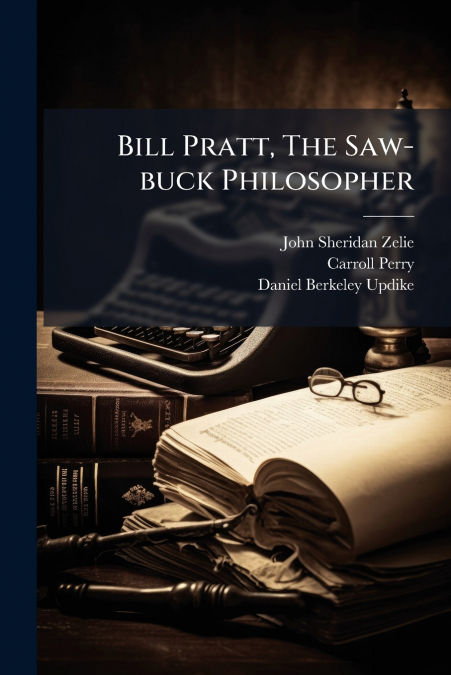
Carroll Perry / John Sheridan Zelie / Daniel Berkeley Updike
 Librería Samer Atenea
 Kálamo Books
 Librería Elías (Asturias)
 Librería Kolima (Madrid)
 Librería Proteo (Málaga)
'Bill Pratt, The Saw-buck Philosopher' is an appreciation of the life, public services, and speeches of Bill Pratt, a figure who ministered to the entertainment and edification of Williams College students for over half a century. Written by John Sheridan Zelie, Carroll Perry, and Daniel Berkeley Updike, this work celebrates Pratt’s unique role as a campus icon and informal philosopher.The book delves into Pratt’s contributions to the college community, exploring his wit, wisdom, and the enduring impact he had on generations of students. It offers a glimpse into a bygone era of higher education and the importance of figures who, through their character and presence, enriched the lives of those around them. This biography serves as a tribute to a man whose influence extended far beyond the classroom, leaving a lasting legacy at Williams College.This work has been selected by scholars as being culturally important, and is part of the knowledge base of civilization as we know it. This work was reproduced from the original artifact, and remains as true to the original work as possible. Therefore, you will see the original copyright references, library stamps (as most of these works have been housed in our most important libraries around the world), and other notations in the work.This work is in the public domain in the United States of America, and possibly other nations. Within the United States, you may freely copy and distribute this work, as no entity (individual or corporate) has a copyright on the body of the work.As a reproduction of a historical artifact, this work may contain missing or blurred pages, poor pictures, errant marks, etc. Scholars believe, and we concur, that this work is important enough to be preserved, reproduced, and made generally available to the public. We appreciate your support of the preservation process, and thank you for being an important part of keeping this knowledge alive and relevant.