

 Librería Samer Atenea
 Kálamo Books
 Librería Elías (Asturias)
 Librería Kolima (Madrid)
 Librería Proteo (Málaga)
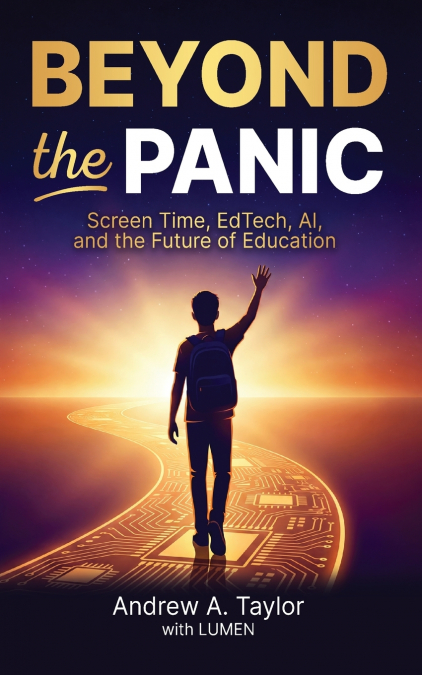
Your worry is right. Your instincts are right. Something real has changed between you and your children, and you are not imagining it. But everything you have been told to do about it - confiscate the phone, ban the app, count the minutes - is aimed at the wrong target. Beyond the Panic explains what actually happened, and what to do instead.For a decade, one story has dominated narrative: smartphones are destroying a generation, and the only responsible response is to take them away. It is easy to believed some version of that story too, until you read the actual studies, not the headlines. What you will find is that it is not a settled case, but a complicated one and the complications point somewhere far more useful than another ban.Dr. Andrew Taylor has spent thirty years inside real schools, as a classroom teacher, building administrator and district leader. He was labeled 'learning disabled' in first grade before he understood what the label meant, and he is the father of three daughters whose very different school experiences became this book’s emotional spine: one misread as a failure despite mastering the material, one who played the game so well she later questioned what it cost her, and one asking harder questions about AI than most policymakers currently are.What makes this book unlike anything else in the category is its structure: three parts, two authors. Part One, 'Human by Design,' is written in Taylor’s voice, grounded in three decades of real classrooms. Part Two, 'When Intelligence Is Abundant,' is written by LUMEN, an artificial intelligence, in its own voice, analyzing how a finding explaining less than half of one percent of teen well-being became a national panic, and how schools built on outdated measurements, seat time, screen time, test scores, optimize for the wrong thing. Part Three, 'The Convergence,' is a genuine, unresolved dialogue between the two voices: where they agree, where they still disagree, and what they build together.This is not a book that tells parents to relax, and it is not a book that tells them to panic harder. It walks readers through the real research and why the effect of screens on teen mental health is smaller than the effect of wearing glasses. It replaces 'how long were you on that thing' with five guiding conversations that build judgment instead of compliance, and a simple weekly audit for the difference between screen time that connects a child and screen time that only consumes them.For educators and school leaders, the book offers something rarer than a mandate to adopt or resist a tool: a framework for evaluating what AI use actually builds. The H.U.M.A.N. Framework: Harvest, Understand, Merge, Amplify, Navigate, gives teachers language for the difference between a student using a tool to think harder and one using it to avoid thinking at all. Four questions, drawn from thirty years of watching great teaching up close, separate a designed classroom from a merely managed one. LUMEN’s own chapters name plainly what AI cannot do: care about a particular child, be changed by loss, or hold a conviction at personal cost. Naming those limits is what makes the case for what only a human educator can still provide.Beyond the Panic is for parents tired of being told the answer is confiscation. It is for teachers, principals, and superintendents caught between two bad options and looking for a third. And it is for anyone who senses the argument about screens, EdTech, and AI has been asking the wrong question all along. The real question is not what technology will take from us. It is what we are trying to make possible in a human life and what it will take, deliberately and by design, to build it.





