Inicio > Matemáticas y ciencia > Física > Física de la relatividad > Beyond the Einstein Addition Law and its Gyroscopic Thomas Precession
Beyond the Einstein Addition Law and its Gyroscopic Thomas Precession

Beyond the Einstein Addition Law and its Gyroscopic Thomas Precession

A.A. Ungar

133,10 €
IVA incluido
Disponible
Editorial:
Springer Nature B.V.
Año de edición:
2001
Materia
Física de la relatividad
ISBN:
9781402003530
133,10 €
IVA incluido
Disponible

Selecciona una librería:

  • Librería Samer Atenea
  • Librería Aciertas (Toledo)
  • Kálamo Books
  • Librería Perelló (Valencia)
  • Librería Elías (Asturias)
  • Donde los libros
  • Librería Kolima (Madrid)
  • Librería Proteo (Málaga)

Evidence that Einstein’s addition is regulated by the Thomas precession has come to light, turning the notorious Thomas precession, previously considered the ugly duckling of special relativity theory, into the beautiful swan of gyrogroup and gyrovector space theory, where it has been extended by abstraction into an automorphism generator, called the Thomas gyration. The Thomas gyration, in turn, allows the introduction of vectors into hyperbolic geometry, where they are called gyrovectors, in such a way that Einstein’s velocity additions turns out to be a gyrovector addition. Einstein’s addition thus becomes a gyrocommutative, gyroassociative gyrogroup operation in the same way that ordinary vector addition is a commutative, associative group operation. Some gyrogroups of gyrovectors admit scalar multiplication, giving rise to gyrovector spaces in the same way that some groups of vectors that admit scalar multiplication give rise to vector spaces. Furthermore, gyrovector spaces form the setting for hyperbolic geometry in the same way that vector spaces form the setting for Euclidean geometry. In particular, the gyrovector space with gyrovector addition given by Einstein’s (Möbius’) addition forms the setting for the Beltrami (Poincaré) ball model of hyperbolic geometry. The gyrogroup-theoretic techniques developed in this book for use in relativity physics and in hyperbolic geometry allow one to solve old and new important problems in relativity physics. A case in point is Einstein’s 1905 view of the Lorentz length contraction, which was contradicted in 1959 by Penrose, Terrell and others. The application of gyrogroup-theoretic techniques clearly tilt the balance in favor of Einstein.

Artículos relacionados

  • Differential Geometrical Theory of Statistics
    This Special Issue "Differential Geometrical Theory of Statistics" collates selected invited and contributed talks presented during the conference GSI'15 on "Geometric Science of Information" which was held at the Ecole Polytechnique, Paris-Saclay Campus, France, in October 2015 (Conference web site: http://www.see.asso.fr/gsi2015). ...
    Disponible

    100,70 €

  • Física 1
    HUGO MEDINA GUZMAN
    El contenido de temas de la Física General que son desarrollados en este texto se ajusta al programa de estudios de la PUCP. El desarrollo de cada tema incluye ejemplos bienseleccionados que son desarrollados con un detalle muy esmerado. Al final de cada capítulose incluye un conjunto de preguntas y problemas propuestos; se incluye las respuestas.Algunos problemas plantean conf...
    Disponible

    11,39 €

  • METHODS IN FIELD THEORY (B/H)
    BALIAN R / J ZINN-JUSTIN R BALIAN
    This book is one of the most important reference books in Field Theory with permanent value. To enable wider access by students, researchers and libraries of developing countries, this valuable volume has been reprinted and is sold at a much lower price than before. ...
  • HYDRODYNAMIC SCALES OF INTEGRABLE MANY-BODY SYSTEMS
    Herbert Spohn / SPOHN HERBERT
    This book provides a broad introduction to integrable systems with many degrees of freedom. Within a much larger orbit, discussed are models such as the classical Toda lattice, Calogero fluid, and Ablowitz-Ladik discretized nonlinear Schrödinger equation. On the quantum mechanical side, featured are the Lieb-Liniger delta-Bose gas and the quantum Toda lattice. As a genuinely no...
  • POINT GROUPS, SPACE GROUPS, CRYSTALS...
    MIRMAN R / R MIRMAN
    This book is by far the most comprehensive treatment of point and space groups, and their meaning and applications. Its completeness makes it especially useful as a text, since it gives the instructor the flexibility to best fit the class and goals. The instructor, not the author, decides what is in the course. And it is the prime book for reference, as material is much more li...
  • YANG-BAXTER EQUATION IN... (V10)
    JIMBO MICHIO / MICHIO JIMBO
    This volume will be the first reference book devoted specially to the Yang-Baxter equation. The subject relates to broad areas including solvable models in statistical mechanics, factorized S matrices, quantum inverse scattering method, quantum groups, knot theory and conformal field theory. The articles assembled here cover major works from the pioneering papers to classical Y...

Otros libros del autor

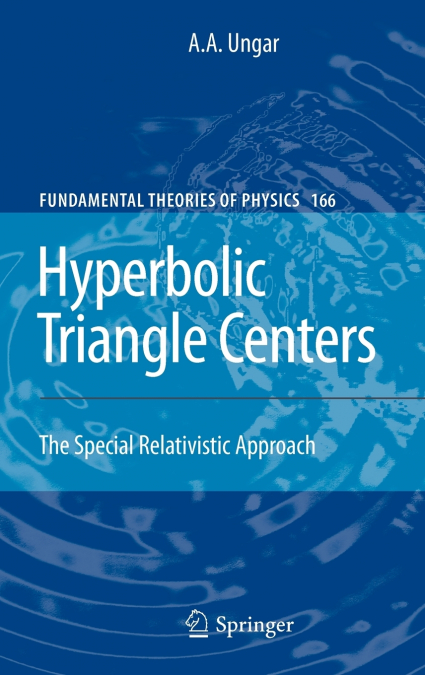
  • Hyperbolic Triangle Centers
    A.A. Ungar
    After A. Ungar had introduced vector algebra and Cartesian coordinates into hyperbolic geometry in his earlier books, along with novel applications in Einstein’s special theory of relativity, the purpose of his new book is to introduce hyperbolic barycentric coordinates, another important concept to embed Euclidean geometry into hyperbolic geometry. It will be demonstrated that...