
Inicio > Economía, finanzas, empresa y gestión > Empresa y gestión > Gestión y técnicas de gestión > Bestimmung des optimalen Produktionsprogrammes in Industriebetrieben
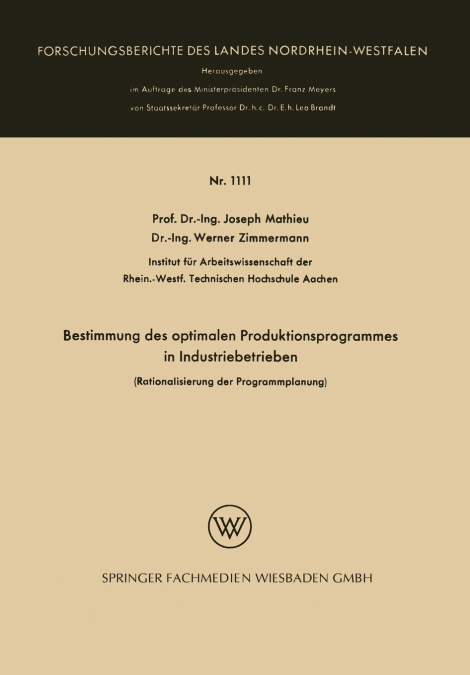
Bestimmung des optimalen Produktionsprogrammes in Industriebetrieben

Bestimmung des optimalen Produktionsprogrammes in Industriebetrieben

Joseph Mathieu

74,25 €
IVA incluido
Disponible
Editorial:
Springer Nature B.V.
Año de edición:
1962
Materia
Gestión y técnicas de gestión
ISBN:
9783663062264
74,25 €
IVA incluido
Disponible

Selecciona una librería:

  • Librería Samer Atenea
  • Librería Aciertas (Toledo)
  • Kálamo Books
  • Librería Perelló (Valencia)
  • Librería Elías (Asturias)
  • Donde los libros
  • Librería Kolima (Madrid)
  • Librería Proteo (Málaga)

Ziel jeder Produktion ist die wirtschaftliche Erstellung von Giitern und Dienst­ leistungen, d. h. die Erstellung nach dem okonomischen Prinzip. Dies besagt, daB mit geringstmoglichem Aufwand ein bestimmter Erfolg, die Kostenmini­ mierung, oder aber mit gegebenen Mitteln der groBtmogliche Erfolg, die Erfolgs­ maximierung, erzielt werden solI. Die Verbesserung der Produktivitat, Wirt­ schaftlichkeit und Rentabilitat einer Unternehmung und das Anstreben von optimalen, also kostenminimalen bzw. gewinnmaximalen Produktionsyerhalt­ nissen sind deshalb stets Gegenstand der Bemiihungen der Unternehmensleitung. In den letzten Jahren suchte man, insbesondere unter dem EinfluB der Vollbe­ schaftigung, diesem Ziel durch Rationalisierung des Produktionsprozesses durch­ aus mit Erfolg naher zu kommen. In der vorliegenden Untersuchung solI nun ein Weg aufgezeigt werden, wie schon durch die Rationalisierung des Produktionsprogrammes, also die Wahl eines optimalell Produktionsprogrammes, gallz erhebliche Verbesserungen der Produktivitat und Rentabilitat erzielt werden konnen. Bei der Planung des Produktionsprogrammes, der insbesondere bei V ollbeschaftigung eine groBe Bedeutung zukommt, geht es im wesentlichen um die Beantwortung folgender Fragen: 1. Was solI produziert werden? Welche Erzeugnisse sollen bevorzugt produziert bzw. welche sollen wegen ihres niedrigen Gewinnbeitrages nur in Sonderfallen hergestellt werden? 2. Wieviel solI produziert werden? In welchen Mengen konnen die einzelnen bevorzugten Produkte sowohl hinsichtlich der beschrankten Kapazitat des Maschinenparkes und der Ar­ beitskrafte als auch hinsichtlich der nur begrenztenAufnahmefahigkeit des Absatzmarktes erzeugt werden? 3. Wie solI produziert werden? Auf welchen Maschinen bzw.

Artículos relacionados

  • Cases on Management and Organizational Behavior in an Arab Context
    Khoury
    In the era of globalization and ease of international connectivity and business interactions, professionals from all over the world benefit from having a well-rounded view of business culture and organizational practice at the regional level. Cases on Management and Organizational Behavior in an Arab Context provides a presentation of teaching cases emphasizing the positive and...
  • Climate Change, Supply Chain Management and Enterprise Adaptation
    Costas P. Pappis / Costas PPappis
    Mounting scientific evidence shows that Earth’s climate is dramatically changing due to the greenhouse emissions caused by human activities, notably by burning fossil fuels for energy production and transport. Climate Change, Supply Chain Management and Enterprise Adaptation: Implications of Global Warming on the Economy aims to provide one among many diverse responses to a gro...
  • # BUSINESS SAVVY PM tweet Book01
    Cinda Voegtli
    Does your job require you to manage projects? If yes, wouldn’t you like to be described as a project manager who is a successful, influential and respected leader of important efforts in the organization? Now if that already sounds like you, great! But if not, what you need to get there is known as ’business savvy.’Business savvy does not mean a bagful of academic credentials, ...
    Disponible

    22,55 €

  • Advanced Topics in Global Information Management Volume 2
    Felix Tan
    ...
  • Managing Business with SAP
    Linda Lau
    ...
  • Advances in Electronic Business, Volume I
    ...

Otros libros del autor