 Librería Samer Atenea
 Kálamo Books
 Librería Elías (Asturias)
 Librería Kolima (Madrid)
 Librería Proteo (Málaga)
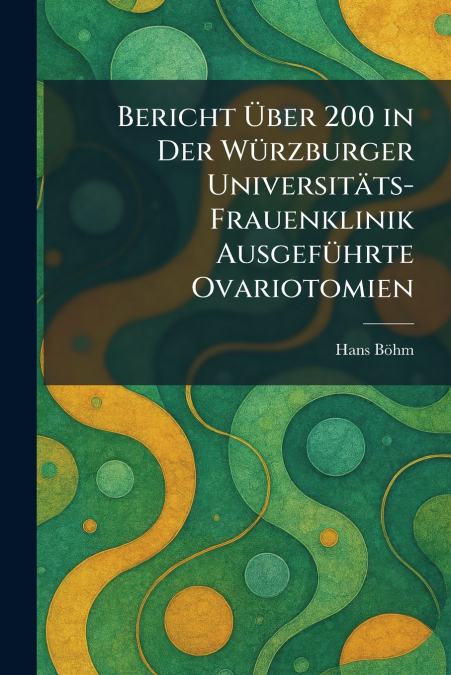
'Bericht Ãber 200 in Der Würzburger Universitäts-Frauenklinik Ausgeführte Ovariotomien' ist eine detaillierte medizinische Abhandlung, die eine umfassende Analyse chirurgischer Eingriffe an den Eierstöcken in der ersten Hälfte des 20. Jahrhunderts bietet. Das Werk dokumentiert und evaluiert 200 Ovariotomien, die an der renommierten Würzburger Universitäts-Frauenklinik durchgeführt wurden, und liefert wertvolle statistische sowie klinische Einblicke in die gynäkologische Praxis jener Zeit.In dieser wissenschaftlichen Auswertung werden Indikationen, Operationstechniken und Heilungsverläufe akribisch festgehalten. Hans Böhm untersucht die Erfolgsraten und Komplikationen der Eingriffe, wodurch die Schrift zu einem wichtigen Zeitzeugnis der operativen Gynäkologie wird. Für Medizinhistoriker und Fachleute bietet dieser Bericht eine fundierte Datenbasis über die Entwicklung chirurgischer Standards und die medizinische Versorgung von Frauen. Das Buch veranschaulicht den Fortschritt der Chirurgie und die Spezialisierung der Frauenheilkunde an einer der führenden deutschen Institutionen der 1920er Jahre.This work has been selected by scholars as being culturally important, and is part of the knowledge base of civilization as we know it. This work was reproduced from the original artifact, and remains as true to the original work as possible. Therefore, you may see the original copyright references, library stamps (as most of these works have been housed in our most important libraries around the world), and other notations in the work.This work is in the public domain in the United States of America, and possibly other nations. Within the United States, you may freely copy and distribute this work, as no entity (individual or corporate) has a copyright on the body of the work.As a reproduction of a historical artifact, this work may contain missing or blurred pages, poor pictures, errant marks, etc. Scholars believe, and we concur, that this work is important enough to be preserved, reproduced, and made generally available to the public. We appreciate your support of the preservation process, and thank you for being an important part of keeping this knowledge alive and relevant.