
Inicio > Matemáticas y ciencia > Química > Química física > Beitrage Zum Studium Der Kupferelektrolyse in Kupferchlorurhaltigen Elektrolyten
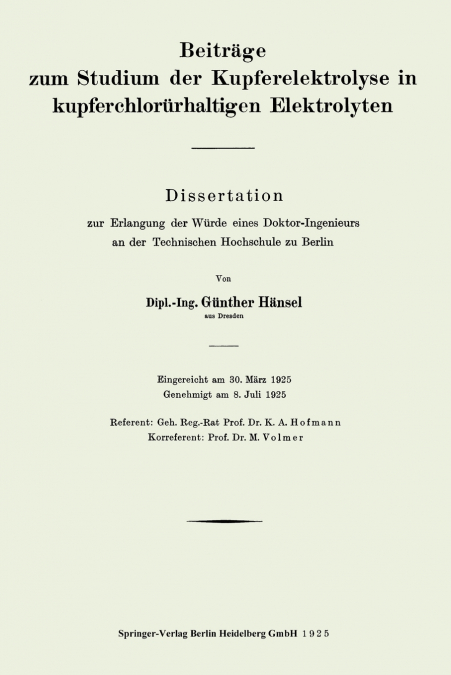
Beitrage Zum Studium Der Kupferelektrolyse in Kupferchlorurhaltigen Elektrolyten

Beitrage Zum Studium Der Kupferelektrolyse in Kupferchlorurhaltigen Elektrolyten

Gunter Hansel

61,70 €
IVA incluido
Disponible
Editorial:
Springer Nature B.V.
Año de edición:
1925
Materia
Química física
ISBN:
9783662278185
61,70 €
IVA incluido
Disponible

Selecciona una librería:

  • Librería Samer Atenea
  • Librería Aciertas (Toledo)
  • Kálamo Books
  • Librería Perelló (Valencia)
  • Librería Elías (Asturias)
  • Donde los libros
  • Librería Kolima (Madrid)
  • Librería Proteo (Málaga)

Die Raffination des Kupfers auf elektrolytischem Wege findet seit Jahren aus­ gedehnte Verwendung im Großbetrieb und hat das hüttenmännische Verfahren größ­ tenteils verdrängt, da das Elektrolytkupfer das Hüttenraffinadkupfer an Reinheit (99,95% gegen 99,6%) weit übertrifft. Die Elektrolyse wird in schwefelsaurer Kupfer­ P sulfatlösung ausgeführt und lie art das Kupfer in glatten und dichten Platten. Im Laufe der Jahre ist das elektrolytische Raffinationsverfahren technisch so vervoll­ kommnet worden, daß man es wohl als das beste elektrolytische Verfahren des Groß­ betriebes ansehen kann. An Versuchen hat es nicht gefehlt, eine möglichst große Kupfermenge unter dem Aufwande der geringsten Energie abzuschneiden. Ein Weg, diesem Ziel näherzu­ kommen, bietet die Verwendung eines kupferchlorürhaltigen Elektrolyten. Nach dem Faradayschen Gesetz ist während der Elektrolyse zum Lösen oder Abscheiden eines Metalles für ein GmmmäquivlJ,lent stets die Elektrizitätsmenge von 96 500 Coulombs oder 96 500 Amperesekunden = 26,8 Amperestunden erforder­ lich. Da bei der Elektrolyse in Kupfersulfatlösung das Kupferion in der zweiwertigen Form vorliegt - das Atomgewicht des Kupfers ist 63,57 - so werden durch 26,8 Amperestunden 31,785 g Cu oder durch 1 Amperestunde 1,186 g Cu an der Kathode abgeschieden. Arbeitet man hingegen mit einem kupferchlorürhaltigen Elektrolyten, der das Kupfer in der ersten Wertigkeitsstufe gelöst enthält, so wird durch 1 Amperestunde 2,372 g Cu abgeschieden, d. h. die Elektrizitätsmenge zur Abscheidung von Kupfer ist in diesem Falle nur halb so groß als bei der Elektrolyse aus Kupfersulfatlösung.
Artículos relacionados

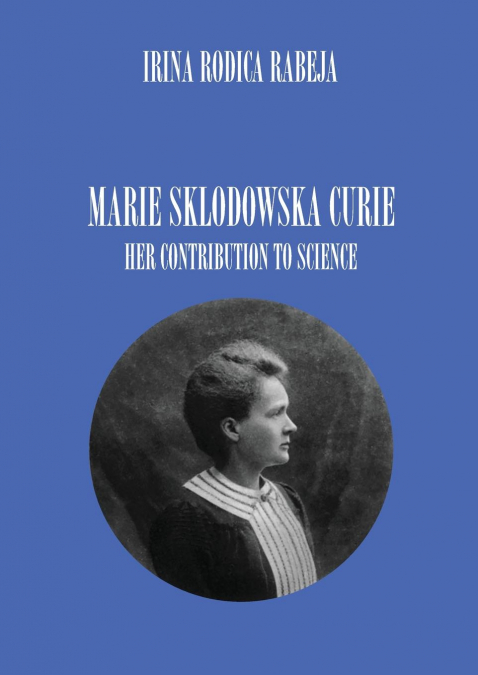
  • MARIE SKLODOWSKA CURIE
    Irina Rodica Rabeja
    Marie Sklodowska Curie (7 November 1867 – 4 July 1934) was one of the greatest scientific minds that brought a fundamental contribution in science opening the door to the understanding/knowledge of the structure of the atom in the 20th century.                 Marie Sklodowska Curie’s hypothesis that the spontaneous emission of powerful rays by some chemical elements, emission ...
    Disponible

    89,28 €

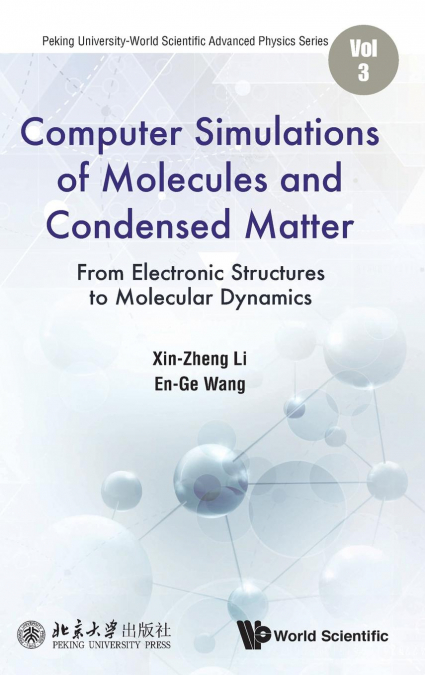
  • COMPUTER SIMULATIONS OF MOLECULES AND CONDENSED MATTER
    En-Ge Wang / LI XIN-ZHENG / Xin-Zheng Li / XIN-ZHENG LI & EN-GE WANG
    This book provides a relatively complete introduction to the methods used in computational condensed matter. A wide range of electronic structure theories are introduced, including traditional quantum chemistry methods, density functional theory, many-body perturbation theory, and more. Molecular dynamics simulations are also discussed, with extensions to enhanced sampling and ...
  • APPLIED THEORETICAL ORGANIC CHEMISTRY
    DEAN J TANTILLO / TANTILLO DEAN J
    This book provides state-of-the-art information on how studies in applied theoretical organic chemistry are conducted. It highlights the many approaches and tools available to those interested in using computational chemistry to predict and rationalize structures and reactivity of organic molecules. Chapters not only describe theoretical techniques in detail, but also describe ...
  • ELECTROANALYTICAL METHODS
    S Rani
    'Electroanalytical Methods' is a pivotal text that offers a comprehensive exploration of electrochemistry and its numerous applications across a wide array of scientific disciplines, including earth science, life science, physical science, biochemistry, and pharmaceutical chemistry. This book is an invaluable resource for chemistry graduates, underlining the increasing necessit...
    Disponible

    18,75 €

  • Advances in the Preparation, Properties and Application of Polyurethane, Cellulose and Their Composites
    Due to their excellent properties, polyurethane, cellulose and their composites have become widely used in previously unimagined areas. Given the fast-increasing consumption in recent years, the demand for advanced polyurethane- and cellulose-based composites is rapidly growing. Accordingly, this Special Issue seeks to showcase research papers, short communications and review a...
  • QUANTUM FIELD THEORY
    PORTER RICHARD N / RICHARD N PORTER
    This introduction to quantum field theory (QFT) is written by a physical chemist for physical chemists, chemical physicists, and other non-physicists with knowledge of quantum theory but who want to explore ways in which they might use the power of QFT in their investigations. This book starts where many graduate courses in quantum theory that are offered to chemistry students ...