Before the Collapse

Before the Collapse

Ugo Bardi

41,49 €
IVA incluido
Disponible
Editorial:
Springer Nature B.V.
Año de edición:
2019
Materia
Historia natural
ISBN:
9783030290375
41,49 €
IVA incluido
Disponible

Selecciona una librería:

  • Librería Samer Atenea
  • Librería Aciertas (Toledo)
  • Kálamo Books
  • Librería Perelló (Valencia)
  • Librería Elías (Asturias)
  • Donde los libros
  • Librería Kolima (Madrid)
  • Librería Proteo (Málaga)

Nobody has to tell you that when things go bad, they go bad quickly and seemingly in bunches. Complicated structures like buildings or bridges are slow and laborious to build but, with a design flaw or enough explosive energy, take only seconds to collapse. This fate can befall a company, the stock market, or your house or town after a natural disaster, and the metaphor extends to economies, governments, and even whole societies. As we proceed blindly and incrementally in one direction or another, collapse often takes us by surprise. We step over what you will come to know as a 'Seneca cliff', which is named  after the ancient Roman philosopher, Lucius Annaeus Seneca, who was the first to observe the ubiquitous truth that growth is slow but ruin is rapid. Modern science, like ancient philosophy, tell us that collapse is not a bug; it is a feature of the universe. Understanding this reality will help you to see and navigate the Seneca cliffs of life, or what Malcolm Gladwell called 'tipping points.' Efforts to stave off collapse often mean that the cliff will be even steeper when you step over it. But the good news is that what looks to you like a collapse may be nothing more than the passage to a new condition that is better than the old.This book gives deeper meaning to familiar adages such as 'it’s a house of cards', 'let nature take its course', 'reach a tipping point', or the popular Silicon Valley expression, 'fail fast, fail often.' As the old Roman philosopher noted, 'nothing that exists today is not the result of a past collapse', and this is the basis of what we call 'The Seneca Strategy.' This engaging and insightful book will help you to use the Seneca Strategy to face failure and collapse at all scales, to understand why change may be inevitable, and to navigate the swirl of events that frequently threaten your balance and happiness. You will learn:How ancient philosophy and modern science agree that failure and collapse are normal features of the universePrinciples that help us manage, rather than be managed by, the biggest challenges of our lives and times Why technological progress may not prevent economic or societal collapseWhy the best strategy to oppose failure is not to resist at all costsHow you can 'rebound' after collapse, to do better than before, and to avoid the same mistakes.


Artículos relacionados

  • Florida
    Kathryn Abbey Hanna
    This colorful and exciting of Florida is in two parts: the historical land of Spanish galleons, Seminole Indians, and the Confederacy; second, the modern state with its land booms, resorts, and tourist attractions. This revised edition contains information on flood control and other contemporary problems.Originally published in 1941.A UNC Press Enduring Edition -- UNC Press End...
    Disponible

    76,46 €

  • Social Life in the Insect World
    J. Henri Fabre / JHenri Fabre
    Fabre had many scholarly achievements. He was a popular teacher, physicist, chemist and botanist. However, he is probably best known for his findings in the field of entomology, the study of insects, and is considered by many to be the father of modern entomology. Much of his enduring popularity is due to his marvelous teaching ability and his manner of writing about the lives ...
  • Blood, Water, Wind, and Stone
    Lori Howe
    Wyoming is the least-populated state in America, and it is filled with long, silent stretches of prairie, mountains that see snowfall every month of the year, and a red desert filled with sand dunes and the fossilized past. It is perhaps this vastness and isolation which urge us to stop and contemplate our place in this landscape—and what we have to offer to its care.While Wyom...
    Disponible

    18,51 €

  • The Tail of the Salamander
    Mark T Wright
    A heartwarming, true story of accomplished architect and urban planner Mark T. Wright’s quest to restore and preserve a North Carolina stream. Along the way, he experiences unexpected personal growth, transformation and revelation about the things most important in life. It is a compelling story of hope for the future, a father’s respect of nature, and love for his children. ...
    Disponible

    23,99 €

  • Calling Wild Places Home
    Laura Waterman
    Poignant and vulnerable essays that weave together seemingly disparate themes of wild places and mountain stewardship, books and reading, and building a new life after loss.'This is some of the finest writing in Laura Waterman’s long and distinguished career. Anyone who values the history of conservation, or the gnarled wilds of the Northeast, or the complexities of the human s...
    Disponible

    26,15 €

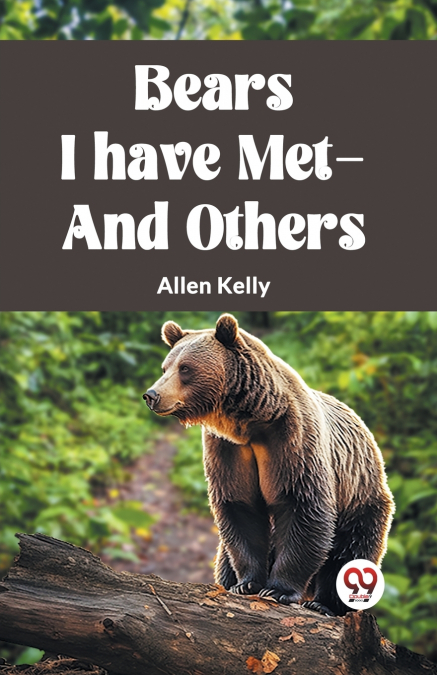
  • BEARS I HAVE MET-AND OTHERS
    Allen Kelly
    'Bears I Have Met-And Others' by using Allen Kelly unfolds as a charming exploration of nature, journey, and the profound connections between the human and animal worlds. Kelly, an amazing storyteller, weaves a tapestry of encounters with bears and other creatures, immersing readers inside the untamed beauty of the wild. In this literary masterpiece, Kelly goes past recounting ...
    Disponible

    12,26 €

Otros libros del autor

  • The Seneca Effect
    Ugo Bardi
    The essence of this book can be found in a line written by the ancient Roman Stoic Philosopher Lucius Annaeus Seneca: 'Fortune is of sluggish growth, but ruin is rapid'. This sentence summarizes the features of the phenomenon that we call 'collapse,' which is typically sudden and often unexpected, like the proverbial 'house of cards.' But why are such collapses so common, and w...
  • The Limits to Growth Revisited
    Ugo Bardi
    Foreword1. Introduction2. The story of 'The Limits to Growth'3. Of models and simulations4. System dynamics modeling5. Modeling the real world: whaling in 19th century6. World modeling by system dynamics7. Criticism to 'The Limits to Growth'8. Mineral Resources as Limits to Growth9. Technological Progress and Limits to Growth10. The Political Debate11. The Return of World Mode...
    Disponible

    92,72 €