 Librería Samer Atenea
 Kálamo Books
 Librería Elías (Asturias)
 Librería Kolima (Madrid)
 Librería Proteo (Málaga)
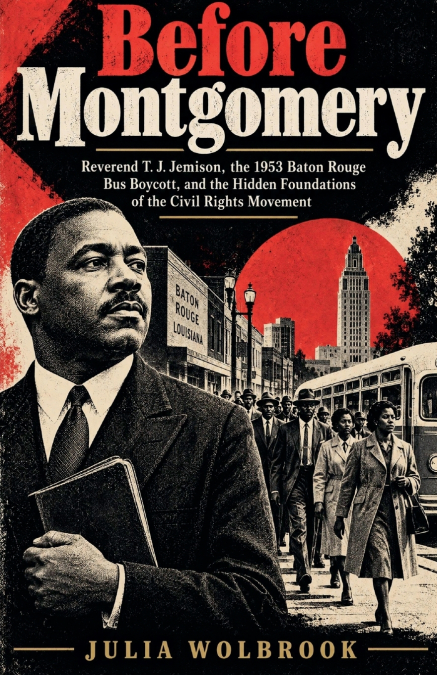
Two years before Rosa Parks, one preacher in Louisiana had already stopped the buses.Ask most Americans where the Civil Rights Movement began, and they will say Montgomery, December 1955. But in June 1953, in Baton Rouge, a young minister named Theodore Jemison stood on the steps of his church, watched bus after bus roll by with Black riders crowded into the back and empty seats up front, and decided he’d seen enough. Within days, a city’s Black community had stayed off the buses and brought a transit company to the edge of bankruptcy.Almost no one remembers.Before Montgomery restores the missing chapter. It follows Jemison from his childhood in a family of Baptist leaders, through college classrooms where professors quietly handed their students the ideas of Gandhi, Thoreau, and the great Black protest tradition, to the Baton Rouge radio studio where he called his community to stand together. It shows how he turned carpools into a movement, how a gas station owner sold fuel at cost, how women built a phone tree that kept a boycott alive, and how even the paperboys had a part to play. And it reveals what happened next: when Martin Luther King Jr. faced the same crisis in Montgomery, he picked up the phone and called Jemison.But this is more than the story of one boycott. Drawing on testimony, oral history, and fresh research, the book asks the questions that headlines never answered:Why were so many of the movement’s leaders ministers?How did faith, money, education, and community trust combine to make ordinary people fearless?What did the movement’s success cost, and who was left behind?The answers reveal a hidden architecture behind the freedom struggle, built generation by generation, in pulpits, classrooms, and kitchens, long before the cameras arrived.For readers of Parting the Waters, The Warmth of Other Suns, and Stride Toward Freedom, this is a vivid, deeply human history of the man who went first, and of the foundations that made everything after possible.The road to Montgomery ran through Baton Rouge. It’s time we followed it.