 Librería Samer Atenea
 Kálamo Books
 Librería Elías (Asturias)
 Librería Kolima (Madrid)
 Librería Proteo (Málaga)
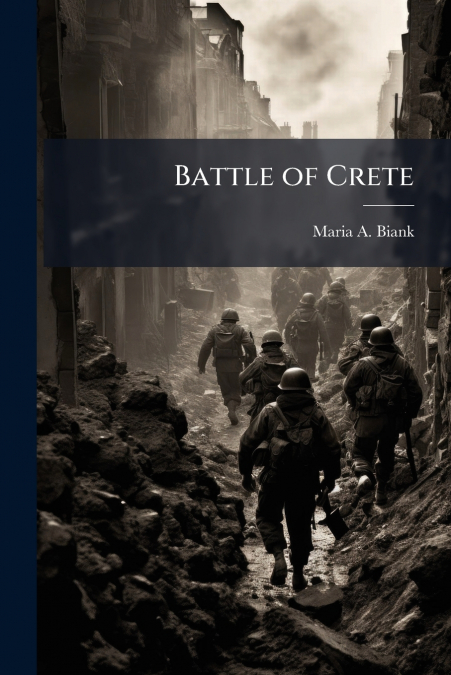
As Adolf Hitler conquered most of the European continent in 1939-1941, the small island of Crete in the Mediterranean Sea became vital to future operations in the Mediterranean region for both the Axis and Allied powers. If the Allies controlled Crete, their air and sea superiority would not allow the Germans a strategic military foothold in the region. For the Germans, Crete would secure the Aegean Sea for Axis shipping, loosen Great Britain’s grasp in the eastern Mediterranean Sea and provide air bases to launch offensives against British forces in Egypt. Therefore, the central research question is: Did the results of the German campaign in Crete justify its execution? The operational results of the German campaign in Crete and the strategic advantages gained from its success did not justify the execution of the battle. Although Germany’s conquest of Crete achieved all of the strategic advantages, Hitler did not accomplish the strategic objectives set forth at the beginning of the campaign. Crete was not used as a staging base from which to engage the British in offensive operations against the Suez Canal or North Africa. German losses to the highly trained air corps were staggering and Hitler never again employed parachutists on a large-scale airborne operation. Future war efforts were deprived of this elite, highly mobile striking force. Hitler did not capitalize on the hard fought victory in Crete by using the island as a stepping-stone, ultimately controlling the eastern Mediterranean region because he was hypnotized by the invasion of Russia.This work has been selected by scholars as being culturally important, and is part of the knowledge base of civilization as we know it. This work was reproduced from the original artifact, and remains as true to the original work as possible. Therefore, you will see the original copyright references, library stamps (as most of these works have been housed in our most important libraries around the world), and other notations in the work.This work is in the public domain in the United States of America, and possibly other nations. Within the United States, you may freely copy and distribute this work, as no entity (individual or corporate) has a copyright on the body of the work.As a reproduction of a historical artifact, this work may contain missing or blurred pages, poor pictures, errant marks, etc. Scholars believe, and we concur, that this work is important enough to be preserved, reproduced, and made generally available to the public. We appreciate your support of the preservation process, and thank you for being an important part of keeping this knowledge alive and relevant.