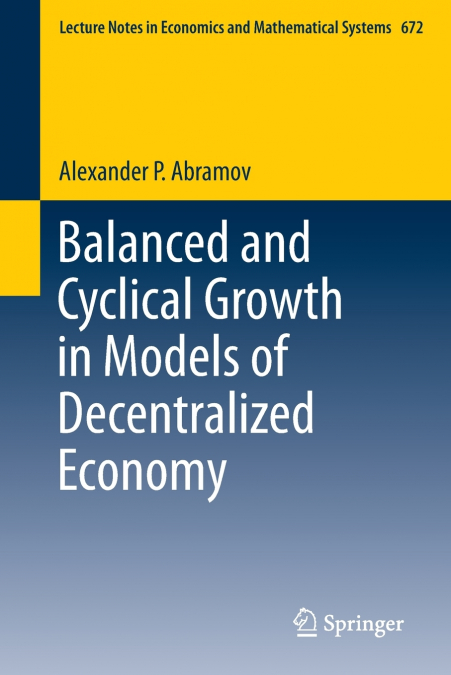
Balanced and Cyclical Growth in Models of Decentralized Economy

Balanced and Cyclical Growth in Models of Decentralized Economy

Alexander P. Abramov / Alexander PAbramov

66,68 €
IVA incluido
Disponible
Editorial:
Springer Nature B.V.
Año de edición:
2014
Materia
Economía del desarrollo y economías emergentes
ISBN:
9783319079165
66,68 €
IVA incluido
Disponible

Selecciona una librería:

  • Librería Samer Atenea
  • Librería Aciertas (Toledo)
  • Kálamo Books
  • Librería Perelló (Valencia)
  • Librería Elías (Asturias)
  • Donde los libros
  • Librería Kolima (Madrid)
  • Librería Proteo (Málaga)

This book is devoted to the study of dynamical models of decentralized economic systems. The models considered are based on the Leontief simple dynamic model with various mechanisms for decentralized planning and management. Branches of the economic system are treated as fully independent economic agents that plan their work according to their own purposes. It is shown that the lack of coordination between economic agents leads to a limit cycle for some economic indicators. Conversely, the exchange of information between the economic agents enables a move toward balanced growth. These results are generalized for the model with dynamics of the productive assets and for the model with the final consumption. The analysis also considers a problem of endogenous technological progress in a decentralized economy. The appendix includes a short review of non-negative matrices. The book offers a valuable resource for mathematical economists and graduate students specializing in mathematical economics.
Artículos relacionados

  • Business Innovation, Development, and Advancement in the Digital Economy
    Oncioiu
    Digital technologies maintain an important tool in today’s business economy. As the economy continues to change, businesses seek out solutions in order to enhance and develop their organization. Business Innovation, Development, and Advancement in the Digital Economy highlights the competitive advantages on the emerging digital economy. Bringing together the classic economy the...
  • Green Technology Applications for Enterprise and Academic Innovation
    Ezendu Ariwa
    In the age of corporate responsibility, green technology and sustainability continue to grip the consciousness of business and academic institutions. However, development of appropriate business-driven green applications requires an awareness of best practices of the green agenda. Green Technology Applications for Enterprise and Academic Innovation addresses the importance of g...
  • Bridging the Gap Between Growth Theory and Policy in Asia
    Rup Singh / Tatla Dar Singh
    Although economic growth is amongst the oldest of debates in Economics, there has been little advancement in growth theory since the classic works of Solow. As such, clear-cut answers to the context-specific determinants of growth, especially for developing countries, are rare. Bridging the Gap Between Growth Theory and Policy in Asia: An Extension of the Solow Growth Model add...
  • Comparative Economics and Regional Development in Turkey
    Bryan Christiansen / MMustafa Erdoğdu
    The rise of globalization has affected the ways in which nations maintain sustainable development and economic prosperity. Certain countries, such as Turkey, have evolved into a place of particular importance in the changing global economy. As such, it has become more important than ever to better understand the crucial role of such nations on an international scale. Comparativ...
  • Global Perspectives on Trade Integration and Economies in Transition
    Vasily Erokhin
    In the era of globalization, foreign trade has an immense impact upon modern economies. To succeed in the global marketplace, sustainable development in trade practices is an imperative goal for countries to reach. Global Perspectives on Trade Integration and Economies in Transition is an authoritative reference source for the latest research on the dynamics of transitional eco...
  • The African Union and New Strategies for Development in Africa
    The early twenty-first century witnessed remarkable attempts by Africa’s political leadership to promote regional integration as a means of fast-tracking economic progress, facilitating peace and security, consolidating democratic gains, and promoting the general welfare of the African people. The transition of the Organization of Unity (OAU) to the African Union (AU), as well ...