 Librería Samer Atenea
 Kálamo Books
 Librería Elías (Asturias)
 Librería Kolima (Madrid)
 Librería Proteo (Málaga)
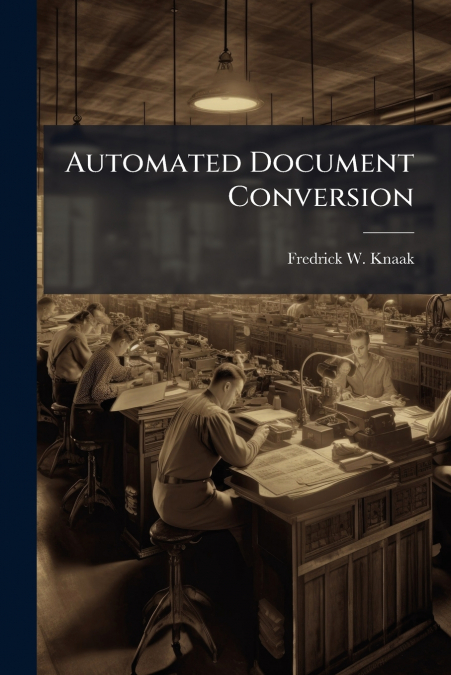
Technological advances in our workplaces have made electronic documents pervasive throughout the USAF, DOD, and civilian world. Managers are recognizing the need to establish electronic document management systems to handle these diverse forms of documents. Unfortunately, they have been faced with essentially 'reinventing the wheel,' when it comes to determining which types of paper-based documents are best suited to conversion to an electronic format. There is also a lack of clearly identifiable cost factors associated with automated document conversion (ADC) for managers to use when conducting an economic analysis of a potential imaging application. This thesis addresses the problem of developing a practical solution to identify cost and mission effective ADC applications, and the primary cost factors associated with ADC, both tangible and intangible. While the researcher offers no statistically significant findings, valuable information is presented which helps managers identify ADC applications which will provide the most mission impact for their precious resources. It also provides an understanding of the tangible and intangible benefits of an ADC project, as identified by experts in the document imaging field. Additional 'lessons learned' are related by the experts which provides information valuable to managers considering this technology for solving their own business problems.This work has been selected by scholars as being culturally important, and is part of the knowledge base of civilization as we know it. This work was reproduced from the original artifact, and remains as true to the original work as possible. Therefore, you will see the original copyright references, library stamps (as most of these works have been housed in our most important libraries around the world), and other notations in the work.This work is in the public domain in the United States of America, and possibly other nations. Within the United States, you may freely copy and distribute this work, as no entity (individual or corporate) has a copyright on the body of the work.As a reproduction of a historical artifact, this work may contain missing or blurred pages, poor pictures, errant marks, etc. Scholars believe, and we concur, that this work is important enough to be preserved, reproduced, and made generally available to the public. We appreciate your support of the preservation process, and thank you for being an important part of keeping this knowledge alive and relevant.