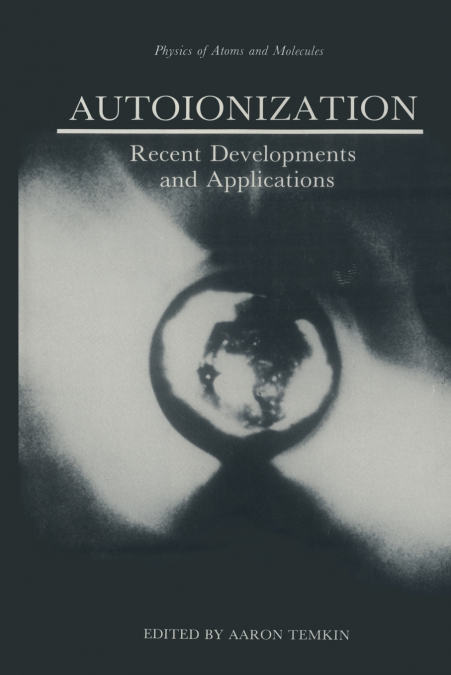

Autoionization

Autoionization

Aaron Temkin

66,35 €
IVA incluido
Disponible
Editorial:
Springer Nature B.V.
Año de edición:
2012
Materia
Física atómica y molecular
ISBN:
9781468448795
66,35 €
IVA incluido
Disponible

Selecciona una librería:

  • Librería Samer Atenea
  • Librería Aciertas (Toledo)
  • Kálamo Books
  • Librería Perelló (Valencia)
  • Librería Elías (Asturias)
  • Donde los libros
  • Librería Kolima (Madrid)
  • Librería Proteo (Málaga)

About five years ago, Professor P. G. Burke asked me to edit a sequel to an earlier book-Autoionization: Theoretical, Astrophysical, and Laboratory Experimental Aspects, edited by A. Temkin, Mono Book Corp. , Baltimore, 1966. Because so much time had gone by and so much work had been done, the prospect of updating the 1966 volume seemed out of the question. In 1965 the phenomenon of autoionization, although long known, was just starting to emerge from a comparatively intuitive stage of understanding. Three major developments characterized that development: In solar (astro-)physics, Alan Burgess (1960) had provided the resolution of the discrepancy of the temperature of the solar corona as observed versus that deduced from ionization balance calculations, by including the process of dielectronic recombination in the calculation; Madden and Codling (1963) had just performed their classic experiment revealing spectroscopically sharp lines in the midst of the photoionization continuum of the noble gases; and Feshbach (1962) had developed a theory with the explicit introduction of projection operators, which for the first time put the calculation of auto­ ionization states on a firm theoretical footing. There were important additional contributions made at that time as well; nevertheless, without going into further detail, we were able to include in our 1966 volume, in spite of its modest size, a not too incomplete survey of the important developments at that time. To do the equivalent now would be virtually impossible.
Artículos relacionados

  • LECT ON QUANTUM MECH (2ND ED-V1)
    BERTHOLD-GEORG ENGLERT / ENGLERT BERTHOLD-GEORG
    Basic Matters is a first introduction to quantum mechanics that does not assume any prior knowledge of the subject. The emphasis is on the general structure as the necessary foundation of any understanding. Starting from the simplest quantum phenomenon, the Stern-Gerlach experiment with its choice between two discrete outcomes, and ending with one-dimensional continuous systems...
  • LECT ON QUANTUM MECH (2ND ED-V2)
    BERTHOLD-GEORG ENGLERT / ENGLERT BERTHOLD-GEORG
    Basic Matters is a first introduction to quantum mechanics that does not assume any prior knowledge of the subject. The emphasis is on the general structure as the necessary foundation of any understanding. Starting from the simplest quantum phenomenon, the Stern-Gerlach experiment with its choice between two discrete outcomes, and ending with one-dimensional continuous systems...
  • LECT ON QUANTUM MECH (2ND ED-V3)
    BERTHOLD-GEORG ENGLERT / ENGLERT BERTHOLD-GEORG
    Basic Matters is a first introduction to quantum mechanics that does not assume any prior knowledge of the subject. The emphasis is on the general structure as the necessary foundation of any understanding. Starting from the simplest quantum phenomenon, the Stern-Gerlach experiment with its choice between two discrete outcomes, and ending with one-dimensional continuous systems...
  • LECT ON QUANTUM MECH (2ND ED-V1)
    BERTHOLD-GEORG ENGLERT / ENGLERT BERTHOLD-GEORG
    Basic Matters is a first introduction to quantum mechanics that does not assume any prior knowledge of the subject. The emphasis is on the general structure as the necessary foundation of any understanding. Starting from the simplest quantum phenomenon, the Stern-Gerlach experiment with its choice between two discrete outcomes, and ending with one-dimensional continuous systems...
    Disponible

    57,66 €

  • LECT ON QUANTUM MECH (2ND ED-V2)
    BERTHOLD-GEORG ENGLERT / ENGLERT BERTHOLD-GEORG
    Basic Matters is a first introduction to quantum mechanics that does not assume any prior knowledge of the subject. The emphasis is on the general structure as the necessary foundation of any understanding. Starting from the simplest quantum phenomenon, the Stern-Gerlach experiment with its choice between two discrete outcomes, and ending with one-dimensional continuous systems...
    Disponible

    57,79 €

  • LECT ON QUANTUM MECH (2ND ED-V3)
    BERTHOLD-GEORG ENGLERT / ENGLERT BERTHOLD-GEORG
    Basic Matters is a first introduction to quantum mechanics that does not assume any prior knowledge of the subject. The emphasis is on the general structure as the necessary foundation of any understanding. Starting from the simplest quantum phenomenon, the Stern-Gerlach experiment with its choice between two discrete outcomes, and ending with one-dimensional continuous systems...
    Disponible

    57,79 €