Inicio > Sociedad y ciencias sociales > Política y gobierno > Relaciones internacionales > Authoritarian Regionalism in the World of International Organizations
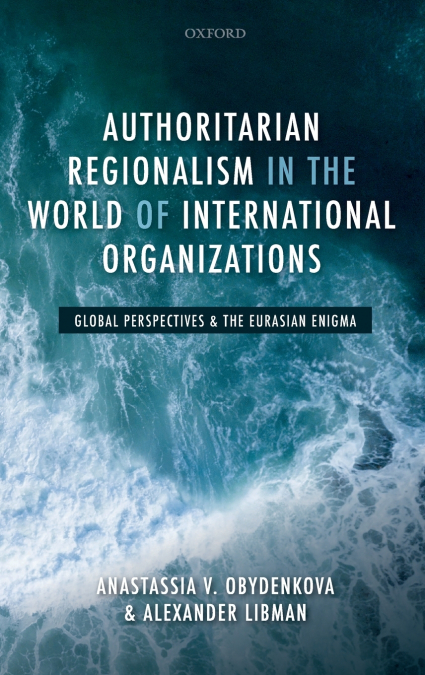
Authoritarian Regionalism in the World of International Organizations

Authoritarian Regionalism in the World of International Organizations

Alexander Libman / Anastassia V. Obydenkova

166,94 €
IVA incluido
Consulta disponibilidad
Editorial:
Oxford University Press
Año de edición:
2019
Materia
Relaciones internacionales
ISBN:
9780198839040

Selecciona una librería:

  • Librería Samer Atenea
  • Librería Aciertas (Toledo)
  • Kálamo Books
  • Librería Perelló (Valencia)
  • Librería Elías (Asturias)
  • Donde los libros
  • Librería Kolima (Madrid)
  • Librería Proteo (Málaga)

The interconnection between international organizations (IOs) membership and democratization has become a topic of intense debate. However, the main focus of the literature so far has been on IOs created by democratic states and comprised mostly of democracies, for examples the European Union. In contrast to existing studies, this book focuses on another group of regional IOs, referred to as ’non-democratic IOs’ which are organizations founded by autocracies. How do these newly emerged organizations interrelate and interact with the outside world? How do they counteract and confront the danger of democratization in their own member states and neighboring states? This book aims to address these questions by developing a new theory of authoritarian regionalism, and by combining both quantitative and qualitative analysis to test it. The quantitative analysis uses a large dataset of all regional organizations worldwide for the post-World War II period, with the aim of defining historical trends in development and the modification of regionalism over the last seven decades (1945-2015). Qualitative analysis refines and develops the argument by looking at the case of post-Soviet Eurasia. The book uncovers a new type of regionalism - ’authoritarian regionalism’ and traces its historical roots as well as its implications for modern politics. The book is the first attempt to systematically investigate the functioning and the impact of authoritarian regionalism as a new phenomenon as well as its implications for democratization world-wide. The book contributes to the theory of regionalism, international organizations, studies of autocracies, foreign policy, and democratization world-wide.

Artículos relacionados

  • Realism in Practice
    The purpose of this book is to appraise the current relevance and validity of realism as an interpretative tool in contemporary International Relations. All chapters of the book are animated by a theoretical effort to define the conceptual aspects of realism and attempt to establish whether the tradition still provides the necessary conceptual tools to scholars.The chapters add...
    Disponible

    20,36 €

  • Predicting gender violence in India
    Shritha K Vasudevan
    In this provocative new book, Shritha Vasudevan argues that feminist international relations (IR) theory has inadvertently resulted in a biased worldview, the very opposite of what feminist IR set out to try to rectify. This book contests theoretical presumptions of Western feminist IR and attempts to reformulate it in contexts of non-Western cultures. Vasudevan deftly utilizes...
  • Contemporary security issues in Africa
    Isiaka Alani Badmus / Lere Amusan
    In volume, an emerging generation of African scholars examines specific states in Africa where instability is the order of the day. Considerations of African instability are highly relevant in today’s world, where one examines the types of regimes that were put in place after the Cold War and their effects on Africa. Multiparty systems introduced in Africa, rather than bringing...
  • Chronicles of the first and second chechen wars
    Ilya Milyukov
    Presented by Russian author and attorney Ilya Milyukov, Chronicles of the First and Second Chechen War presents the main events of the First (1994-1996) and Second (1999-2009) Wars in Chechnya, Russia’s deadliest conflicts since World War II. The First War began in December 1994 and lasted for one year and nine months, ending in August 1996. There were two major urban battles -...
  • Political instability in Africa
    Isiaka Alani Badmus / Lere Amusan
    This book offers broad-gauged analyses of the causes, nature, and changing patterns of armed conflict in Africa as well as the reasons for these patterns. It also situates conflicts that have been haunting the African continent since the time of decolonization within the various theoretical schools such as 'new war,' 'economic war,' 'neo-patrimonial,' and 'globalization.' It be...
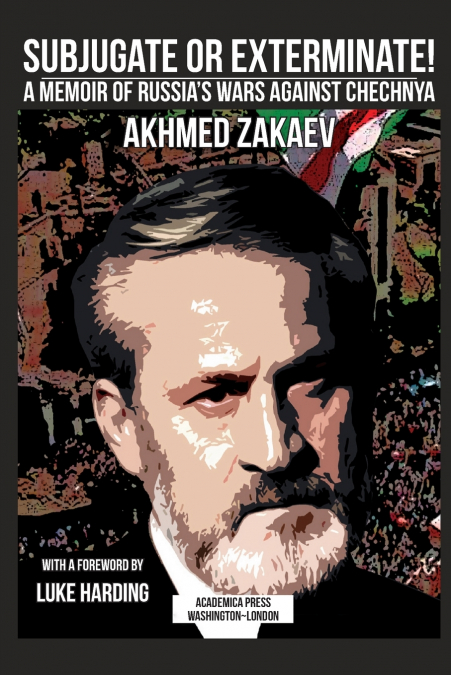
  • Subjugate or exterminate!
    Akhmed Zakaev / Arch Tait
    Foreword by Luke HardingAkhmed Zakaev is a symbol of the indomitable will of the Chechen nation. In this important memoir, he tells the story of the Chechen struggle as he experienced it, describing the conflict in human terms and providing a detailed documentary record of little known or badly understood events that will be of benefit to historians for generations to come.- Da...
    Disponible

    41,63 €