 Librería Samer Atenea
 Kálamo Books
 Librería Elías (Asturias)
 Librería Kolima (Madrid)
 Librería Proteo (Málaga)
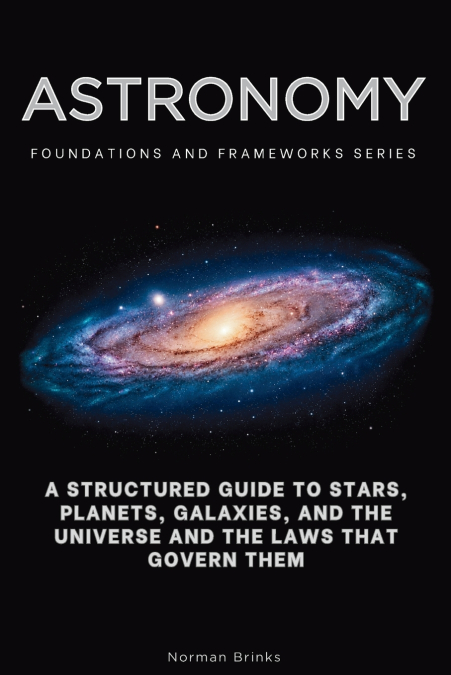
Astronomy makes sense once you know how light and gravity work. This book explains the night sky, the Sun, stars, galaxies, and the expanding universe using the same physical laws you can test on Earth. Ten chapters move outward from what you can see on a clear night to the edge of the observable cosmos. Each step builds on the one before, so the reasoning behind every measurement stays clear and you never have to memorize facts without knowing where they came from. Chapter 8 on relativity sits right before galaxies and cosmology because the last two chapters depend on it. The book covers: - Celestial coordinates, constellations, the seasons, lunar phases, and solar and lunar eclipses - Kepler’s three laws and Newton’s gravity - Blackbody radiation, spectral lines, and the Doppler effect, the tools that reveal a star’s temperature, makeup, and motion from light alone - Telescope aperture, resolution, and observing in radio, infrared, and X-ray light - The Sun’s layers, the proton-proton chain, and the 11-year sunspot cycle - How the solar system formed, with the rocky worlds, gas and ice giants, comets, dwarf planets, and the Kuiper Belt - Exoplanet detection by transit and radial velocity, plus habitable zones and the search for life beyond Earth - Parallax, magnitudes, spectral classes, and the Hertzsprung-Russell diagram - Star birth, red giants, white dwarfs, supernovae, and pulsars - Special and general relativity, black holes, and gravitational waves - Galaxy types, quasars, rotation curves, and the evidence for dark matter - Hubble’s law, the Big Bang, the cosmic microwave background, inflation, and dark energy Equations arrive with plain explanations and worked examples using real numbers, so arithmetic and scientific notation carry you through. Summary tables collect related facts in one place for quick review. Each chapter closes with questions that ask you to apply ideas, and example responses at the back let you check your reasoning. A historical timeline, a glossary of terms, full references, and recommended readings round out the volume. Written for: - College students in an introductory course - High school students heading into earth and space science - Adult readers teaching themselves the science of space, with no physics background required - Teachers who want a clear companion text The material reaches current discoveries, including James Webb Space Telescope results, the first image of the Milky Way’s central black hole, and more than 6,000 confirmed exoplanets. You will finish able to read the sky, explain why an infrared telescope spotted a galaxy seen 290 million years after the Big Bang, tell why Betelgeuse glows red while Rigel burns blue-white, and understand how the iron in your blood formed inside a star that died before the Sun was born. Step outside on a clear night after the first chapter, and the sky will look different.