 Librería Samer Atenea
 Kálamo Books
 Librería Elías (Asturias)
 Librería Kolima (Madrid)
 Librería Proteo (Málaga)
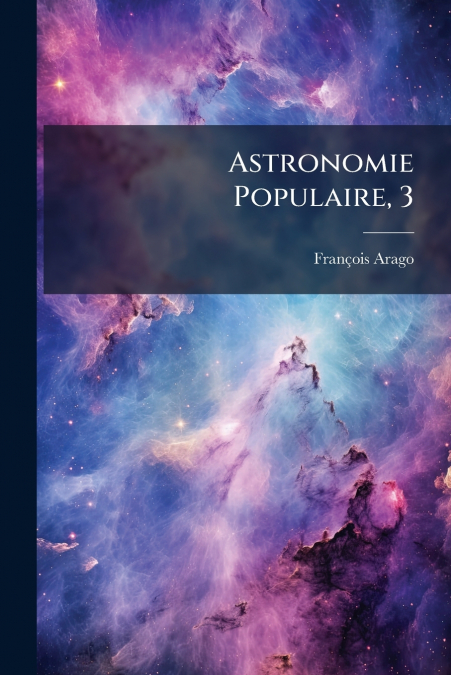
Astronomie Populaire, 3 by François Arago is a captivating exploration of astronomy written for a general audience. This volume presents a detailed yet accessible overview of the celestial world, reflecting the state of astronomical knowledge in the 19th century. Arago’s clear explanations and engaging style made astronomy understandable and fascinating for readers of all backgrounds. This work covers a range of topics, from planetary movements to the nature of stars, and includes historical context, offering insights into the evolution of astronomical thought. As part of a series designed to popularize science, this book remains valuable for its historical perspective and its ability to convey the wonders of the universe in an approachable manner. It is a testament to Arago’s skill as a communicator and his passion for making science accessible to everyone.This work has been selected by scholars as being culturally important, and is part of the knowledge base of civilization as we know it. This work was reproduced from the original artifact, and remains as true to the original work as possible. Therefore, you will see the original copyright references, library stamps (as most of these works have been housed in our most important libraries around the world), and other notations in the work.This work is in the public domain in the United States of America, and possibly other nations. Within the United States, you may freely copy and distribute this work, as no entity (individual or corporate) has a copyright on the body of the work.As a reproduction of a historical artifact, this work may contain missing or blurred pages, poor pictures, errant marks, etc. Scholars believe, and we concur, that this work is important enough to be preserved, reproduced, and made generally available to the public. We appreciate your support of the preservation process, and thank you for being an important part of keeping this knowledge alive and relevant.