Frederick A. Aprim / Frederick AAprim
 Librería Samer Atenea
 Kálamo Books
 Librería Elías (Asturias)
 Librería Kolima (Madrid)
 Librería Proteo (Málaga)
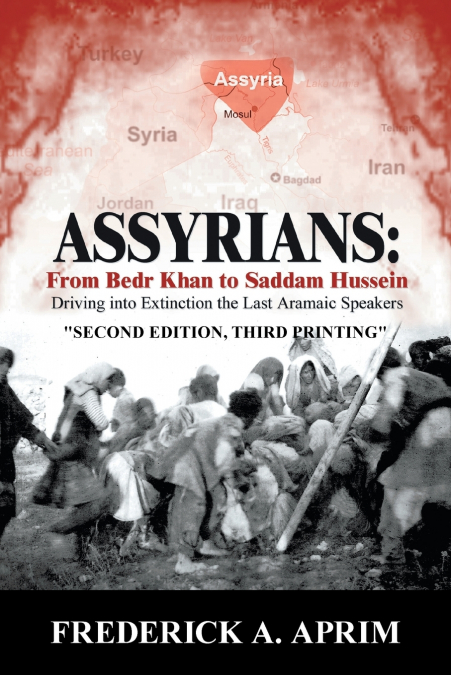
Throughout the Christian Era, the Assyrians havefaced an immense tragedy through persecution,oppression, and massacres. The Assyrian tragedy inMesopotamia continued intermittently during theSassanid Persians (A.D. 226 - 637), Seljuk Turksinvasion of the eleventh century, Mongols invasionin 1258, Tamerlane’s destruction that began in 1394,the Saffavid Persians in early sixteenth century andduring the rule of the Ottoman Turks since themiddle of the sixteenth century. Throughout thenineteenth and early twentieth centuries, Turks andKurds committed numerous massacres against theAssyrian Christians in their secluded mountains ofnorthern Mesopotamia and in Tur Abdin regionin modern southeastern Turkey. As the OttomanEmpire entered WWI, it declared jihad (holy war)against its Christian subjects. Backed by Kurds, theTurkish army invaded northwestern Persia (Iran) andcommitted further atrocities against the Assyrianrefugees who fled the Ottoman territories and againstAssyrians of Persia as well. The jihad transformedinto an ethnic genocide against the Assyrians thatwas perpetrated by the Turkish state and Kurdishwarlords. This genocide continues to this very daydue to the policies of the Kurds in northern Iraq,southeastern Turkey, and northeastern Syria. TheAssyrians lost two-thirds of their population andmost of their homelands in northern Mesopotamiaduring WWI alone. Since the creation of themodern Middle Eastern states after the partition ofthe Ottoman Empire post WWI, the Assyrians havefaced and continue to face a systematic Arabization,Turkification, and Kurdification policies by Pan-Arab governments, Pan-Turkish governments, andby Kurdish political parties. Hundreds of thousandsof Assyrians have fled their homelands seekingshelter in Europe, United States, and Australia.Furthermore, the rise of fundamentalism in theMiddle East is posing another serious threat to thesurvival of the remaining Assyrians and to otherChristian communities in the Middle East.FOREWORDAfter the establishment of Islam as a state religion in the Fertile Crescent by the eighth century,the ferocious attacks by the Timurids, plundering the region as they descended from CentralAsia in the fourteenth century, drove many Christian Aramaic speakers who did not convert to Islam into the mountains of the Taurus, Hakkari, and the Zagros for shelter. Others remained in their ancestral villages on the Mosul (Nineveh) Plain only to face heavy pressure to assimilate into Arab culture. The greatest catastrophe to visit the Assyrians in the modern period was the genocide committed against them, as Christians, during the Great War. From the Assyrian renaissance experienced when, miraculously, they became the objects of Western Christian missionary educational and medical efforts, the Assyrians fell into near oblivion. Shunned by the Allies at the treaties that ended WWI and after, Assyrians drifted into Diaspora, destructive denominationalism, and fierce assimilation tendencies as exercised by chauvinistic Arab, Persian and Turkish state entities. Today they face the growing clout of their old enemies and neighbors, the Kurds, another Muslim ethnic group that threatens to control power, demand assimilation, and offer to engulf Assyrians as the price for continuing to live in the ancient Assyrian homeland. As half of the world’s last Aramaic-speaking population has arrived inunwanted Diaspora, some voices are making an impact, including that of Frederick Aprim.-Eden Naby, PhDAFGHANISTAN: MULLAH, MARX AND MUJAHID (Westview, 2002)THE ASSYRIAN EXPERIENCE (Harvard College Library, 1999)