
Inicio > Lenguas > Lingüistica > Aspects of Split Ergativity
Aspects of Split Ergativity

Aspects of Split Ergativity

Jessica Coon

65,31 €
IVA incluido
Disponible
Editorial:
Oxford University Press
Año de edición:
2013
Materia
Lingüistica
ISBN:
9780199858736
65,31 €
IVA incluido
Disponible

Selecciona una librería:

  • Librería Samer Atenea
  • Librería Aciertas (Toledo)
  • Kálamo Books
  • Librería Perelló (Valencia)
  • Librería Elías (Asturias)
  • Donde los libros
  • Librería Kolima (Madrid)
  • Librería Proteo (Málaga)

In languages with aspect-based split ergativity, one portion of the grammar follows an ergative pattern, while another shows a 'split.' In this book, Jessica Coon argues that aspectual split ergativity does not mark a split in how case is assigned, but rather, a split in sentence structure. Specifically, the contexts in which we find the appearance of a nonergative pattern in an otherwise ergative language involve added structure--a disassociation between the syntactic predicate and the stem carrying the lexical verb stem. The book begins with an analysis of split person marking patterns in Chol, a Mayan language of southern Mexico. Here appearance of split ergativity follows naturally from the fact that the progressive and the imperfective morphemes are verbs, while the perfective morpheme is not. The fact that the nonperfective morphemes are verbs, combined with independent properties of Chol grammar, results in the appearance of a split. This book further surveys aspectual splits in a variety of unrelated languages and offers an explanation for the universal directionality of split ergativity: in splits, ergativity is always retained in the perfective aspect. Following Laka’s (2006) proposal for Basque, Coon proposes that the cross-linguistic tendency for imperfective aspects to pattern with locative constructions is responsible for the biclausality which causes the appearance of a nonergative pattern. Building on Demirdache and Uribe-Etxebarria’s (2000) prepositional account of spatiotemporal relations, Coon proposes that the perfective is never periphrastic--and thus never involves a split--because there is no preposition in natural language that correctly captures the relation of the assertion time to the event time denoted by the perfective aspect.
Artículos relacionados

  • User-Centered Computer Aided Language Learning
    Giorgos Zacharia / Panayiotis Zaphiris
    ...
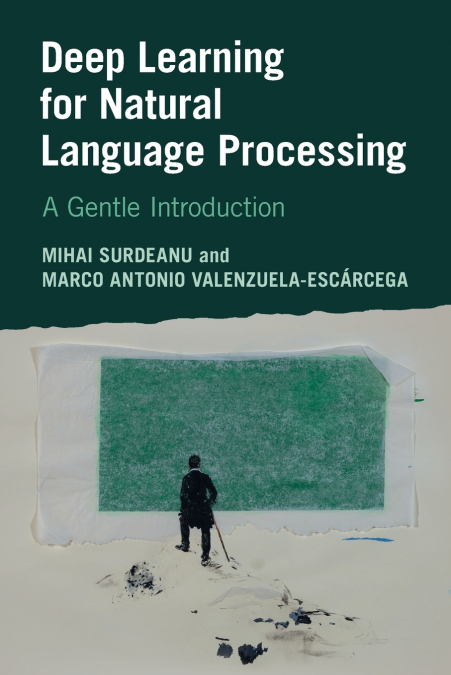
  • Deep Learning for Natural Language Processing
    Marco Antonio Valenzuela-Escárcega / Mihai Surdeanu
    ...
    Disponible

    47,60 €

  • Deep Learning for Natural Language Processing
    Marco Antonio Valenzuela-Escárcega / Mihai Surdeanu
    ...
  • Lecciones sobre espinosa medrano
    Luis Jaime Cisneros Vizquerra
    La obra de Juan de Espinosa Medrano, apodado en su tiempo «El Lunarejo» (c. 1629-1688), fue uno de los mayores focos de interés académico de Luis Jaime Cisneros (1921-2011). En 1980 aparecieron sus primeros trabajos dedicados a estudiar los textos capitales de Espinosa Medrano (el Apologético en favor de don Luis de Góngora, la Panegírica declamación por la protección de las ci...
    Disponible

    17,63 €

  • Lyre Book
    Matthew Kilbane
    Redefines modern lyric poetry at the intersection of literary and media studies.In The Lyre Book, Matthew Kilbane urges literary scholars to consider lyric not as a genre or a reading practice but as a media condition: the generative tension between writing and sound. In addition to clarifying issues central to the study of modern poetry--including its proximity to popular song...
    Disponible

    50,84 €

  • Translation-mediated Communication in a Digital World
    David Ashworth / Minako O’Hagan
    The Internet is accelerating globalization by exposing organizations and individuals to global audiences. This in turn is driving teletranslation and teleinterpretation, new types of multilingual support, which are functional in digital communications environments. The book describes teletranslation and teleinterpretation by exploring a number of key emerging contexts for langu...
    Disponible

    45,19 €