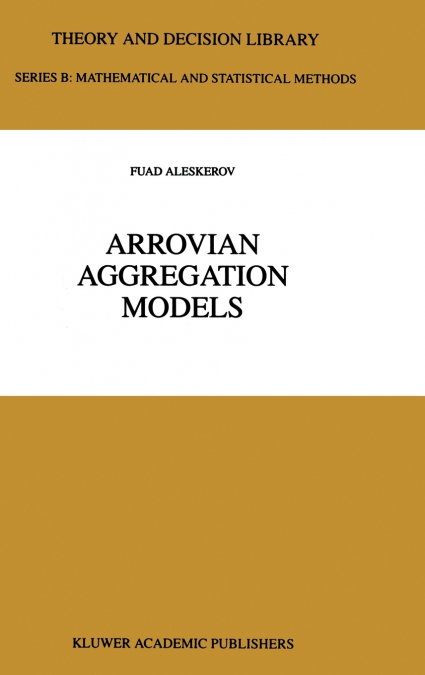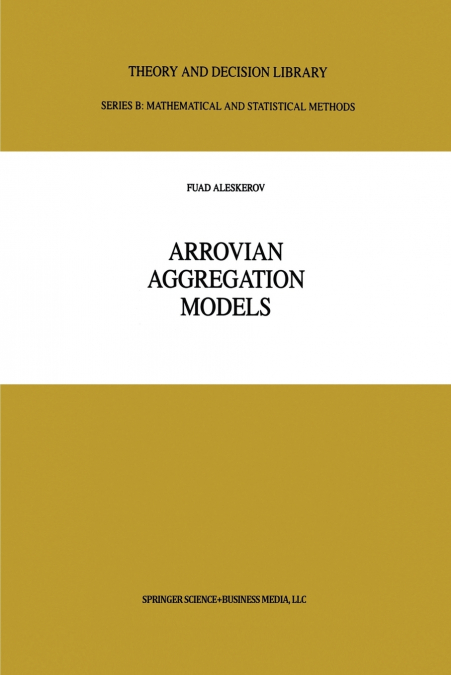

Arrovian Aggregation Models

Arrovian Aggregation Models

Fuad T. Aleskerov

134,07 €
IVA incluido
Disponible
Editorial:
Springer Nature B.V.
Año de edición:
2010
Materia
Microeconomía
ISBN:
9781441950796
134,07 €
IVA incluido
Disponible

Selecciona una librería:

  • Librería Samer Atenea
  • Librería Aciertas (Toledo)
  • Kálamo Books
  • Librería Perelló (Valencia)
  • Librería Elías (Asturias)
  • Donde los libros
  • Librería Kolima (Madrid)
  • Librería Proteo (Málaga)

Aggregation of individual opinions into a social decision is a problem widely observed in everyday life. For centuries people tried to invent the `best’ aggregation rule. In 1951 young American scientist and future Nobel Prize winner Kenneth Arrow formulated the problem in an axiomatic way, i.e., he specified a set of axioms which every reasonable aggregation rule has to satisfy, and obtained that these axioms are inconsistent. This result, often called Arrow’s Paradox or General Impossibility Theorem, had become a cornerstone of social choice theory. The main condition used by Arrow was his famous Independence of Irrelevant Alternatives. This very condition pre-defines the `local’ treatment of the alternatives (or pairs of alternatives, or sets of alternatives, etc.) in aggregation procedures. Remaining within the framework of the axiomatic approach and based on the consideration of local rules, Arrovian Aggregation Models investigates three formulations of the aggregation problem according to the form in which the individual opinions about the alternatives are defined, as well as to the form of desired social decision. In other words, we study three aggregation models. What is common between them is that in all models some analogue of the Independence of Irrelevant Alternatives condition is used, which is why we call these models Arrovian aggregation models. Chapter 1 presents a general description of the problem of axiomatic synthesis of local rules, and introduces problem formulations for various versions of formalization of individual opinions and collective decision. Chapter 2 formalizes precisely the notion of `rationality’ of individual opinions and social decision. Chapter 3 deals with the aggregation model for the case of individual opinions and social decisions formalized as binary relations. Chapter 4 deals with Functional Aggregation Rules which transform into a social choice function individual opinions defined as choice functions. Chapter 5 considers another model &endash; Social Choice Correspondences when the individual opinions are formalized as binary relations, and the collective decision is looked for as a choice function. Several new classes of rules are introduced and analyzed.
Artículos relacionados

  • Optimal Transport Methods in Economics
    Alfred Galichon
    Optimal Transport Methods in Economics is the first textbook on the subject written especially for students and researchers in economics. Optimal transport theory is used widely to solve problems in mathematics and some areas of the sciences, but it can also be used to understand a range of problems in applied economics, such as the matching between job seekers and jobs, the de...
  • Structural Econometric Modeling in Industrial Organization and Quantitative Marketing
    Ali Hortaçsu / Joonhwi Joo
    A concise and rigorous introduction to widely used approaches in structural econometric modeling Structural econometric modeling specifies the structure of an economic model and estimates the model’s parameters from real-world data. Structural econometric modeling enables better economic theory-based predictions and policy counterfactuals. This book offers a primer on recent de...
  • Identity Economics
    George A. Akerlof / Rachel E. Kranton
    How identity influences the economic choices we makeIdentity Economics provides an important and compelling new way to understand human behavior, revealing how our identities-and not just economic incentives-influence our decisions. In 1995, economist Rachel Kranton wrote future Nobel Prize-winner George Akerlof a letter insisting that his most recent paper was wrong. Identity,...
    Disponible

    28,26 €

  • Economic Foundations of Symmetric Programming
    Quirino Paris
    ...
  • Profit Theory and Capitalism
    Mark Obrinsky
    The pursuit of profit by business motivates the capitalist economic system. Understanding profits, therefore, especially the source of profits, is essential to an understanding of capitalism. Mark Obrinsky claims that there has never been an adequate profit theory in mainstream economics. To find the source of profits, he argues, one needs to look beyond ownership of the produc...
    Disponible

    31,88 €

  • The Medieval Super-Companies
    Edwin S. Hunt / Edwin SHunt
    ...

Otros libros del autor

  • Arrovian Aggregation Models
    Fuad T. Aleskerov
    Aggregation of individual opinions into a social decision is a problem widely observed in everyday life. For centuries people tried to invent the `best’ aggregation rule. In 1951 young American scientist and future Nobel Prize winner Kenneth Arrow formulated the problem in an axiomatic way, i.e., he specified a set of axioms which every reasonabl...