 Librería Samer Atenea
 Kálamo Books
 Librería Elías (Asturias)
 Librería Kolima (Madrid)
 Librería Proteo (Málaga)
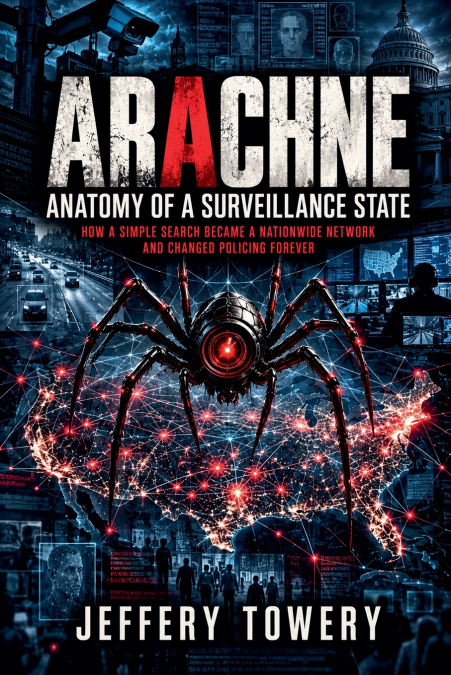
A stolen car in 1967. A police officer in New York. A database in Boston.The question was simple: Is this car stolen?The answer arrived in ninety seconds.That moment marked the beginning of something much larger.In Arachne: Anatomy of a Surveillance State, Jeffery Towery traces how decades of reasonable solutions to real investigative problems gradually connected into a nationwide information environment capable of seeing, identifying, linking, analyzing, and acting across jurisdictions.Criminal-history databases. Fingerprint systems. Fusion centers. Facial recognition. Automated license-plate readers. Commercial location data. Financial intelligence. Data brokers. Artificial intelligence. Predictive systems. Natural-language analytical tools.None of these technologies appeared all at once. None required a secret architect.Each solved a problem.Then the solutions connected.Drawing on documented government programs, oversight reports, statutes, court decisions, procurement records, and emerging AI capabilities, Arachne examines how separate databases, sensors, agencies, authorities, and analytical systems can begin functioning as parts of a larger investigative network-even when no single institution controls the whole.The result is not a simple story about technology being good or bad.Modern information systems can find missing people, connect serial crimes, expose trafficking networks, identify fraud, solve crimes across jurisdictions, and help investigators locate evidence that once would have remained invisible.But the same architecture can also magnify error, obscure accountability, expand surveillance through association, weaken traditional jurisdictional boundaries, and allow information collected for one purpose to influence decisions made for another.The critical question is therefore not whether government should connect information.It must.The question is what happens when the ability to connect information becomes easier than the ability to govern its use.Towery distinguishes carefully between what exists today, what current technology makes possible, and what future integration makes probable. Rather than arguing that the United States has already become a fully realized surveillance state, Arachne asks a more important question:What would one look like if it emerged gradually-and would we recognize it before the web was complete?Written for law-enforcement professionals, lawyers, judges, policymakers, civil-liberties advocates, technologists, researchers, and ordinary citizens, Arachne is both an anatomy of modern investigative power and a framework for governing it.The web does not require a spider.It only requires connections.