

 Librería Samer Atenea
 Kálamo Books
 Librería Elías (Asturias)
 Librería Kolima (Madrid)
 Librería Proteo (Málaga)
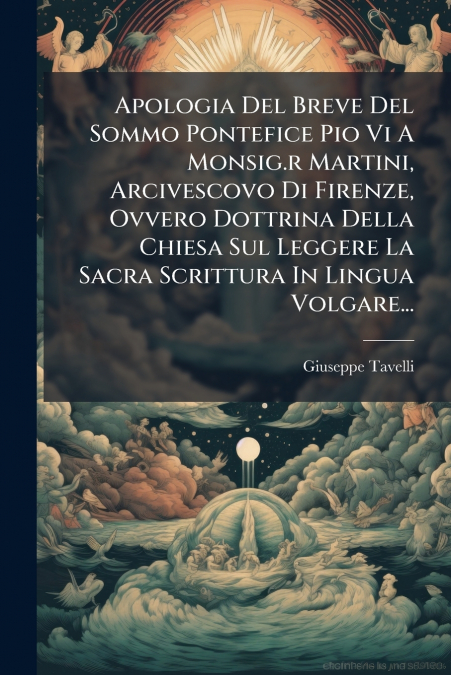
Apologia Del Breve Del Sommo Pontefice Pio Vi A Monsig.r Martini, Arcivescovo Di Firenze, Ovvero Dottrina Della Chiesa Sul Leggere La Sacra Scrittura In Lingua Volgare... is a defense of Pope Pius VI’s brief concerning the reading of Sacred Scripture in the vernacular. Authored by Giuseppe Tavelli, this work delves into the Catholic Church’s doctrine on biblical interpretation and accessibility. The book addresses the arguments surrounding the use of vernacular languages in reading the Bible, presenting a theological justification for the Church’s position. It offers valuable insights into the historical context of religious debates during the pontificate of Pius VI and the role of Archbishop Martini in Florence. A crucial text for understanding Catholic teachings on Scripture and its engagement with contemporary linguistic and cultural shifts.This work has been selected by scholars as being culturally important, and is part of the knowledge base of civilization as we know it. This work was reproduced from the original artifact, and remains as true to the original work as possible. Therefore, you will see the original copyright references, library stamps (as most of these works have been housed in our most important libraries around the world), and other notations in the work.This work is in the public domain in the United States of America, and possibly other nations. Within the United States, you may freely copy and distribute this work, as no entity (individual or corporate) has a copyright on the body of the work.As a reproduction of a historical artifact, this work may contain missing or blurred pages, poor pictures, errant marks, etc. Scholars believe, and we concur, that this work is important enough to be preserved, reproduced, and made generally available to the public. We appreciate your support of the preservation process, and thank you for being an important part of keeping this knowledge alive and relevant.





