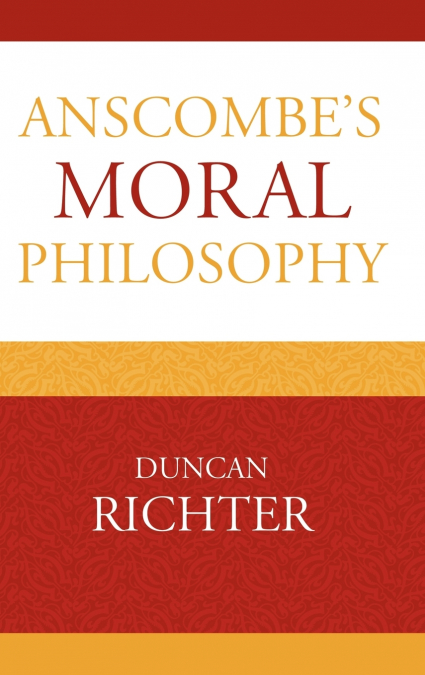

Anscombe’s Moral Philosophy

Anscombe’s Moral Philosophy

Anscombe's Moral Philosophy

Duncan Richter

73,73 €
IVA incluido
Disponible
Editorial:
Bloomsbury Publishing plc
Año de edición:
2010
Materia
Ética y filosofía moral
ISBN:
9780739138854
73,73 €
IVA incluido
Disponible

Selecciona una librería:

  • Librería Samer Atenea
  • Librería Aciertas (Toledo)
  • Kálamo Books
  • Librería Perelló (Valencia)
  • Librería Elías (Asturias)
  • Donde los libros
  • Librería Kolima (Madrid)
  • Librería Proteo (Málaga)

G.E.M. Anscombe (1919-2001) was one of the most important, outspoken, and misunderstood philosophers of the twentieth century. More than anyone else she revived virtue ethics and the philosophy of action. She was also almost alone in publicly opposing Oxford University’s decision to award an honorary degree to President Truman. She regarded his decision to authorize bombing Hiroshima and Nagasaki as murderous. Some liberals admire her for this stand, but conservatives also admire her for her opposition to abortion, contraception, and same-sex marriage. Clearly her values were not those of her times. This led her to reflect on the differences, producing such works as Modern Moral Philosophy, in which she rejected all modern theories of ethics. In this paper she coins the term ’consequentialism’ to describe the dominant view, which she rejects, that what matters morally is the results of what one does. Put crudely, the ends can justify the means. If enough lives can be saved by targeting civilians, then civilians should be targeted. Against this, Anscombe insisted that certain actions are forbidden, which prompted her interest in the nature of action and its relation to a person’s character. Whether one agrees with her or not, these are all issues that continue to be relevant and on which Anscombe’s views are always strong and intelligently defended. Her presentation of these views, unfortunately, is often dense, and they are often badly misunderstood even by some very able minds. Anscombe’s Moral Philosophy clarifies what Anscombe thought about ethics, showing how her different ideas connect and how she supported them. It also evaluates her reasoning, showing that it is stronger in some parts than in others. The five main chapters of the book deal in turn with her work on military ethics (including the so-called doctrine of double effect), her rejection of consequentialism, her attack on the modern, atheist notion of moral obligation, her analysis of intention and its relevance for ethics, and her controversial ideas about sex.
Artículos relacionados

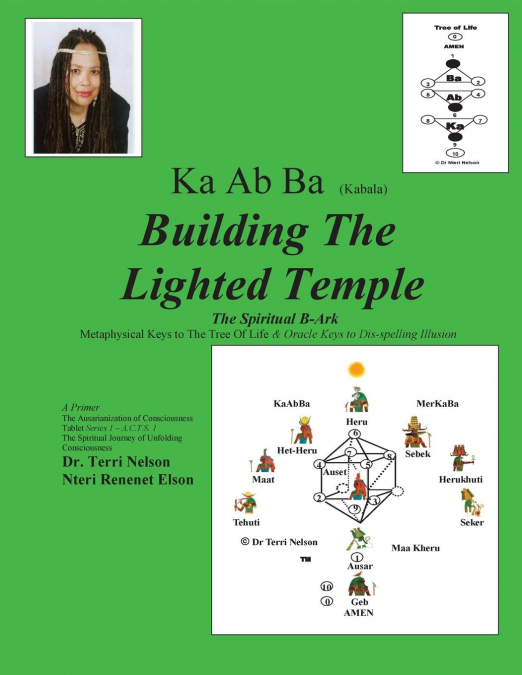
  • Ka Ab Ba Building The Lighted Temple
    Dr Terri R. Nelson / Dr Terri RNelson
    The book KaAbBa Building The Lighted Temple/Metaphysical Keys to the Tree of Life draws a circle that is inclusive of the Afrikan origin of the Ancient Kemetic/Egyptian wisdom. It reveals the undeniable root and link of Ancient Africa to all the religious systems that would develop worldwide. This book is explosive in its power to convey the meaning of KaAbBa, the Medu Neter  (...
    Disponible

    37,41 €

  • Technoethics and the Evolving Knowledge Society
    Rocci Luppicini
    Recently, there has been a major push to rediscover the ethical dimension of technology across the sciences, social sciences, and humanities. Technoethics and the Evolving Knowledge Society: Ethical Issues in Technological Design, Research, Development, and Innovation examines human processes and practices connected to technology embedded within social, political, and moral sph...
  • Kant
    Immanuel Kant
    Kant’s Groundwork of the Metaphysics of Morals is one of the most important works in modern moral philosophy. It belongs beside Plato, Aristotle, Machiavelli, and Hobbes. Here Kant sets out to articulate and defend the Categorical Imperative - the fundamental principle that underlies moral reasoning - and to lay the foundation for a comprehensive account of justice and human vi...
  • On the Duty of Civil Disobedience
    HENRY DAVID THOREAU
    Civil Disobedience argues that citizens should not permit their governments to overrule their consciences, and that they have a duty to avoid allowing their acquiescence to enable the government to make them the agents of injustice. Thoreau was motivated in part by his disgust with slavery and the Mexican-American War, but the sentiments he expresses here are just as pertinent ...
  • Beyond Good and Evil
    Friedrich Nietzsche
    Nietzsche, though primarily a philosopher, wrote widely on art, philology, history, religion, tragedy, culture, and science.  In 1886, at the height of his powers, he published Beyond Good and Evil.  Here he examines much of the best of human thought--dogmatic philosophy, Judeo-Christian morality, science and democracy – and finds it lacking.  Rejecting “slave-morality” he pres...
  • Beyond Good and Evil
    Friedrich Nietzsche
    Nietzsche, though primarily a philosopher, wrote widely on art, philology, history, religion, tragedy, culture, and science.  In 1886, at the height of his powers, he published Beyond Good and Evil.  Here he examines much of the best of human thought--dogmatic philosophy, Judeo-Christian morality, science and democracy – and finds it lacking.  Rejecting “slave-morality” he pres...
    Disponible

    9,99 €

Otros libros del autor

  • Wittgenstein Versus Anscombe on How to Live
    Duncan Richter
    Ludwig Wittgenstein (1889-1951) and Elizabeth Anscombe (1919-2001) are two of the most interesting and influential philosophers of the twentieth century, and their lives intersected in various ways. Anscombe was Wittgenstein’s friend and student, chosen by him to be his translator and editor, but the two had very different views on ethics and religion. Anscombe was a devout Cat...
  • Wittgenstein’s Tractatus
    Duncan Richter
    First published in 1921, Ludwig Wittgenstein's Tractatus Logico-Philosophicus is one of the most influential—and one of the most obscure—philosophical works of the twentieth century. Duncan Richter’s new translation of and commentary on the Tractatus help the reader understand the text and directs the reader to relevant secondary literature. To avoid imposing any particular...
    Disponible

    54,25 €

  • Historical Dictionary of Wittgenstein’s Philosophy
    Duncan Richter
    This second edition of Historical Dictionary of Wittgenstein's Philosophy covers the history of this philosophy through a chronology, an introductory essay, and an extensive bibliography. The dictionary section has over 300 cross-referenced entries on every aspect of his work. ...
  • Anscombe’s Moral Philosophy
    Duncan Richter
    G.E.M. Anscombe (1919-2001) was one of the most important, outspoken, and misunderstood philosophers of the twentieth century. More than anyone else she revived virtue ethics and the philosophy of action. She was also almost alone in publicly opposing Oxford University’s decision to award an honorary degree to President Truman. She regarded his decision to authorize bombing Hir...
  • A to Z of Wittgenstein’s Philosophy
    Duncan Richter
    Ludwig Wittgenstein (1889-1951) was undoubtedly one of the most important philosophers of the 20th century, and perhaps of any century. He was also a fascinating, charismatic, and irritating man. His philosophical ability was recognized almost immediately by Bertrand Russell, and during his lifetime his work influenced first logical positivism and then ordinary language philoso...
    Disponible

    63,76 €

  • Wittgenstein at His Word
    Duncan Richter
    Wittgenstein’s work is notoriously difficult to understand and, at least superficially, deals almost exclusively with obscure and technical problems in logic and the philosophy of language. He once asked rhetorically: "What is the use of philosophy ... if it does not improve your thinking about the important questions of everyday life?". This book explains how Wittgenstein’s id...