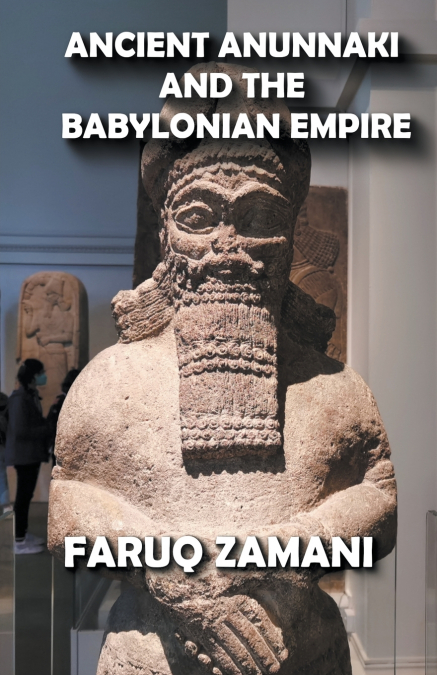

Ancient Anunnaki and the Babylonian Empire

Ancient Anunnaki and the Babylonian Empire

FARUQ ZAMANI

21,43 €
IVA incluido
Disponible
Editorial:
Draft2Digital
Año de edición:
2022
Materia
Historia antigua: hasta c. 500 e. c.
ISBN:
9798201964887
21,43 €
IVA incluido
Disponible

Selecciona una librería:

  • Librería Samer Atenea
  • Librería Aciertas (Toledo)
  • Kálamo Books
  • Librería Perelló (Valencia)
  • Librería Elías (Asturias)
  • Donde los libros
  • Librería Kolima (Madrid)
  • Librería Proteo (Málaga)

The earliest history of Babylon is little known. Among the many cities flourishing in southern Iraq, the town first appears in texts in the third millennium BC. Until the last century of the third millennium, few references existed to Babylon; however, offerings made to the temple of Enlil in Nippur during this period (when Babylon was part of an empire ruled by Ur) suggest a city already of some size and wealth. From relative obscurity in the middle of the 18th century BC, Babylon emerged as the political center of southern Mesopotamia. It held this position almost continuously for the next 1,400 years.Near Baghdad, around 85 kilometers south of the Euphrates, is the site of Babylon. The area is located north of the great alluvial plain of southern Iraq, a landscape of silts deposited by the Tigris and Euphrates into a vast rift created by tectonic movement as the Arabian plate slips beneath the neighboring Eurasian plate. In addition to defining modern-day Iraq’s northern and eastern boundaries, the Taurus and Zagros mountain ranges were created by the same collision. As a result, Mesopotamia encompasses several environmental zones, but Babylon itself is found in the flat alluvial plain in southern Iraq. In addition to containing one of the world’s earliest cities3, the table is subject to several significant environmental constraints that have shaped human settlements since long before the foundation of Babylon. Rain-fed agriculture is beyond the reach of this area due to its high temperatures. Despite the little precipitation this part of Iraq receives, it is uneven and unreliable: the bulk of a season’s rain can fall in a single downpour, damaging crops as severe droughts.4 Human habitation is dependent on the two great rivers, and the permanent settlement requires irrigation. Upon establishment, However, on the levees of canals, such a system could benefit from the rich alluvial soils and support highly productive agriculture. In explaining the region’s early urbanization and accompanying economic development, many contend that the region’s ability to produce large agricultural surpluses played a significant role, though in what way is hotly contested. Herodotus was undoubtedly impressed. As a grain-bearing country, Assyria [meaning Mesopotamia] is the richest globally, he writes in his description of the fifth century BC. Figs, grapes, olives, or other fruit trees are not grown there, but the grain fields tend to produce crops two hundredfold and three hundredfold in exceptional years. At least three inches wide are the wheat and barley blades. Millet and sesame grow to an astonishing size, as I know, but those who have not visited Babylon have refused to believe even what I have already described as its fertility. Sesame oil is the only oil they use, and date palms, most of which bear fruit, provide them with food, wine, and honey.
Artículos relacionados

  • Iron Age Societies in the Severn-Cotswolds
    Tom Moore
    The central theme of this study is an examination of the processes of change in Iron Age social organisation and identity on a regional scale using the Severn-Cotswolds area in England as a case study. It aims to provide a coherent narrative of the period in the region based on the wealth of current data now available, providing a basic storyboard against which future studies c...
    Disponible

    144,57 €

  • Somewhere Beyond The Sea Les îles bretonnes (France)
    The Seminar on the Archaeology of Western France, which focused on the islands of Brittany, was held on 1 April 2014 at the University of Rennes 1. The desire to organize this seminar arose spontaneously from the dynamism which currently animates archaeological research on island spaces of the western seaboard of France. Indeed, the seminar took place during a pivotal period of...
    Disponible

    86,11 €

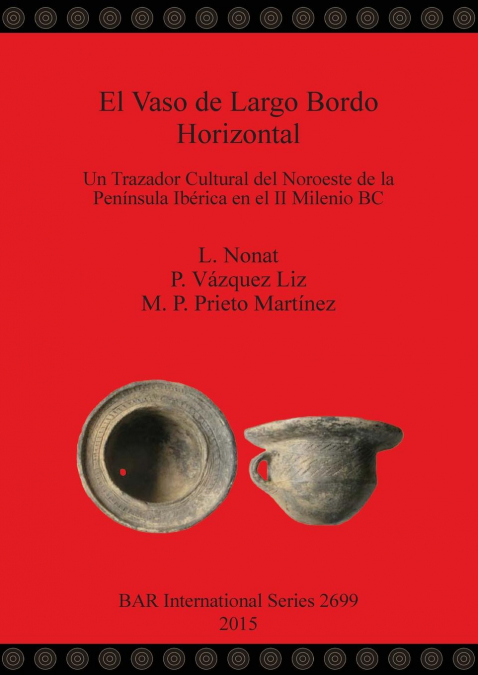
  • El Vaso de Largo Bordo Horizontal
    L. Nonat / LNonat / M. P. Prieto Martínez / MPPrieto Martínez / P. Vázquez Liz / PVázquez Liz
    In this paper the authors study a specific type of pottery from the northwest Iberian Peninsula, known as the Wide Horizontal Rim (WHR) vessel. One of its distinctive aspects is precisely the fact that it is exclusively found in this region, which now comprises the Spanish region of Galicia and northern Portugal, as far south as the River Duero. This type of pottery, of which t...
    Disponible

    115,71 €

  • A Connecting Sea
    Stašo Forenbaher
    This book includes papers stemming from a session at the EAA conference held in Zadar in September 2007.                          ...
    Disponible

    79,97 €

  • The Roman Pottery Production Site at Wickham Barn, Chiltington, East Sussex
    Chris Butler / Malcolm Lyne
    The excavations undertaken at Chiltington in East Sussex revealed two Roman pottery kilns, as well as remains from prehistory and from medieval period.The kilns are well documented, and all the finds were examined and catalogued. Three phases were identified. The pottery produced on the site indicate a strong New Forest influence. ...
    Disponible

    55,62 €

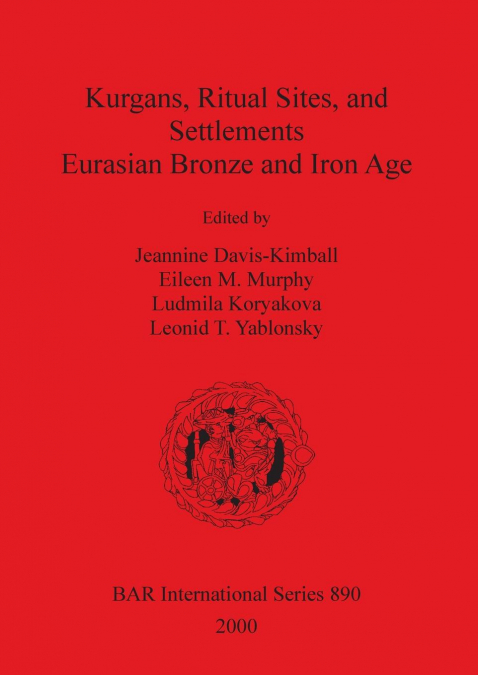
  • Kurgans, Ritual Sites, and Settlements
    Edited by: Jeannine Davis-Kimball, Eileen M. Murphy, Ludmila Koryakova and Leonid T. YablonskyThis richly illustrated volume adds immensely to the small but growing corpus of Eurasian Archaeology published in the English language. Comprised of thirty articles, the authors have focused on the Bronze Age, continuing to include the first millennium BC Early Iron Age, with a termin...
    Disponible

    158,26 €

Otros libros del autor

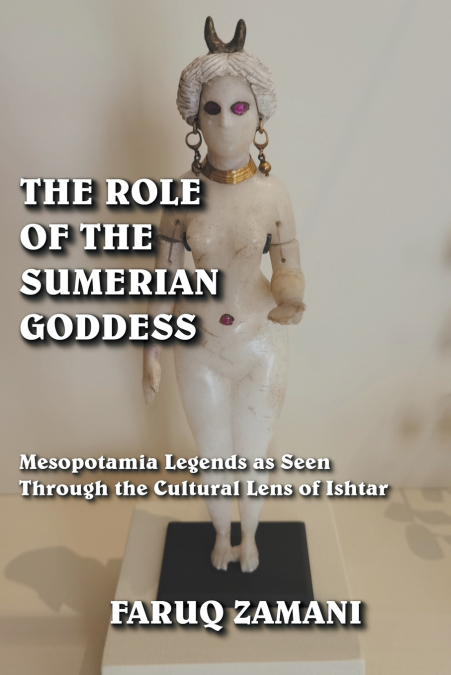
  • The Role of the Sumerian Goddess
    FARUQ ZAMANI
    The Sumerian people once inhabited the region near the Persian Gulf, known as Iraq. Greeks called this country Mesopotamia, which means the land between the rivers, as the Euphrates and Tigris, rising in Anatolia, flowed through Syria and Iraq before discharging into the Persian Gulf. ’Simurrum’ is the name given to the northern region by the Semitic peoples later, like the wor...
    Disponible

    49,68 €

  • Mesopotamia and the Legends of Gilgamesh
    FARUQ ZAMANI
    Mankind lived in Paradise for a long time, , God said to unnamed colleagues: "Is it possible that he may also take from the Tree of Life and live forever?" Having eaten the Fruit of Knowledge, but forbidden from reaching for the Fruit of the Tree of Life. Following Adam’s eating of the Fruit of Knowledge..Since then, man has sought Immortality withheld by God. Yet throughout th...
    Disponible

    22,55 €

  • Archaeology of the Anunnaki Sumerians
    FARUQ ZAMANI
    Leonard Woolley, an archaeologist from Britain, returned to Iraq in 1922, almost 4,000 years after the nuclear ancient catastrophe, to uncover ancient Mesopotamia.An imposing ziggurat standing out in the desert plain drew him to the nearby site of Tell el-Muqayyar, where he began excavating. As old walls, artifacts, and inscriptions were unearthed, he realized he was digging up...
    Disponible

    21,44 €

  • The Rise of the Igigi
    FARUQ ZAMANI
    Igigi unrest leading to the Zu Incident was just a harbinger of other troubles to come-troubles inherent in long-term interplanetary missions, and female companionship was one of the significant problems.The problem was less acute with the Earth-stationed Anunnaki since they contained females from the first landing party (some named and assigned tasks in Enki’s autobiography). ...
    Disponible

    21,43 €

  • Origin of the Nephilim In Mesopotamia
    FARUQ ZAMANI
    The Anunnaki in the Epic of Gilgamesh compared to the Nephilim Flood Narrative?Scholars have long debated whether the Anunnaki in the Epic of Gilgamesh is the same beings as the Nephilim of Genesis 6. there is a direct connection between these two groups of entities which sheds light on this critical question. One of the biggest problems with interpreting certain parts of ancie...
    Disponible

    21,47 €

  • Anunnaki Origins and Sumerian Connections
    FARUQ ZAMANI
    Where did the Sumerian civilization come from? You would think scholars, academics, and historians have been struggling to solve this cultural riddle, yet we still have hundreds of thousands of Sumerian clay writings crumbling to dust in museums rather than getting them all translated.The Sumerians were a multi-ethnic civilization, including the people who lived in Sumer and ot...
    Disponible

    21,43 €