

 Librería Samer Atenea
 Kálamo Books
 Librería Elías (Asturias)
 Librería Kolima (Madrid)
 Librería Proteo (Málaga)
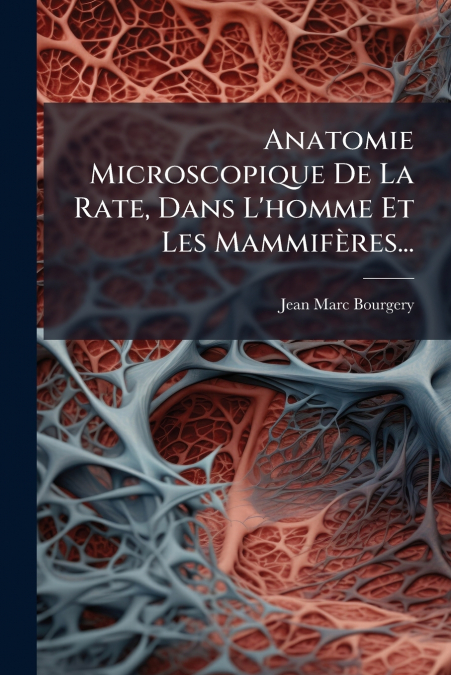
Anatomie Microscopique De La Rate, Dans L’homme Et Les Mammifères... offre une exploration détaillée de la structure microscopique de la rate chez l’homme et divers mammifères. Écrit par Jean Marc Bourgery, cet ouvrage constitue une ressource précieuse pour les étudiants et les chercheurs en médecine et en biologie. Le texte, en français, présente une analyse approfondie de l’histologie de la rate, fournissant des informations essentielles sur sa composition cellulaire et tissulaire. Ce livre est indispensable pour ceux qui s’intéressent à l’anatomie comparée et à la physiologie des organes lymphoïdes. Il détaille les aspects microscopiques qui sont cruciaux pour comprendre la fonction de la rate dans le système immunitaire et la filtration sanguine. Son contenu précis et sa langue soignée en font un document de référence important dans le domaine de l’anatomie microscopique.This work has been selected by scholars as being culturally important, and is part of the knowledge base of civilization as we know it. This work was reproduced from the original artifact, and remains as true to the original work as possible. Therefore, you will see the original copyright references, library stamps (as most of these works have been housed in our most important libraries around the world), and other notations in the work.This work is in the public domain in the United States of America, and possibly other nations. Within the United States, you may freely copy and distribute this work, as no entity (individual or corporate) has a copyright on the body of the work.As a reproduction of a historical artifact, this work may contain missing or blurred pages, poor pictures, errant marks, etc. Scholars believe, and we concur, that this work is important enough to be preserved, reproduced, and made generally available to the public. We appreciate your support of the preservation process, and thank you for being an important part of keeping this knowledge alive and relevant.





