Inicio > Humanidades > Historia > Anarchists and Communists in Brazil, 1900-1935
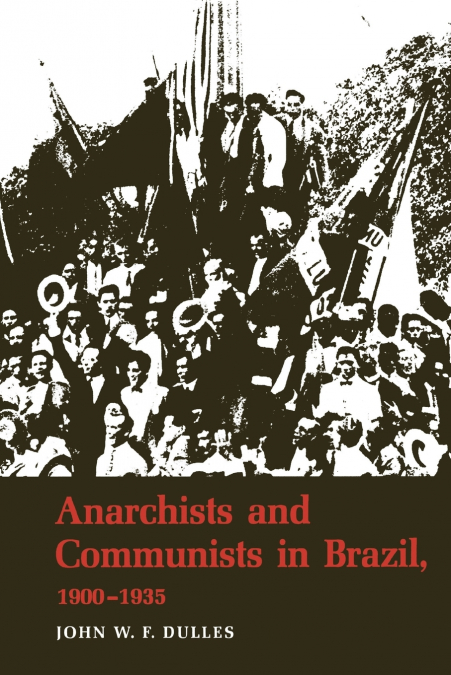
Anarchists and Communists in Brazil, 1900-1935

Anarchists and Communists in Brazil, 1900-1935

John W. F. Dulles / John WFDulles

80,35 €
IVA incluido
Disponible
Editorial:
Univ of Chicago behalf of University of Texas
Año de edición:
1974
Materia
Historia
ISBN:
9780292740761
80,35 €
IVA incluido
Disponible

Selecciona una librería:

  • Librería Samer Atenea
  • Librería Aciertas (Toledo)
  • Kálamo Books
  • Librería Perelló (Valencia)
  • Librería Elías (Asturias)
  • Donde los libros
  • Librería Kolima (Madrid)
  • Librería Proteo (Málaga)

In providing a detailed account of the leftist opposition and its bloody repression in Brazil during the Old Republic and the early years of the Vargas regime, John W. F. Dulles gives considerable attention to the labor movement, generally neglected by historians. This study focuses on the formation and activities of anarchists and Communists, the two most important radical groups working within Brazilian labor. Relying on a wide variety of sources, including interviews and personal papers, Dulles supplies information that for the most part is unavailable in English and not easily accessible in Portuguese. The struggles of Brazilian workers-usually against an alliance of company owners, state and federal troops, and state and federal governments-suffered reverses in 1920 and 1921. These setbacks were cited by Astrogildo Pereira and other admirers of Bolshevism as reasons for the proletariat to forsake anarchism and adhere to the Communist Party, Brazilian Section of the Communist International. Anarchists and Communists, struggling against each other in the labor unions in the mid 1920’s, joined opposition journalists and politicians in supporting military rebels in a romantic uprising marked by adventure and suffering, jailbreaks and long marches, and death in the backlands. Slowly, Brazilian Communism gained strength during the latter part of the 1920’s, but 1930 brought the beginnings of failure. Worse for the Party than the government crackdown and the Trotskyite dissidence was the growing attraction of the Aliança Liberal, the oppositionist political movement that brought Getúlio Vargas to power. While workers and Party members flocked to the Aliança in defiance of Party orders, sectarian edicts from Moscow resulted in the expulsion or demotion of the Party’s former leaders and in the condemnation of intellectuals. Luís Carlos Prestes, 'the Cavalier of Hope' who had led the military rebels in the mid-1920’s, turned to Communism-only to find himself not welcome in the Party. Taken to Russia by the Communist International in 1931, he was finally accepted into the Brazilian Party in absentia in 1934. Later that year, misled in Moscow by optimistic reports brought by Brazilian Communists, he agreed to lead a rebellion in Brazil. That decision and its consequences in 1935 were disastrous to Brazilian Communism. The struggles among anarchists, Stalinists, and Trotskyites in Brazil were reflections of a worldwide struggle. This study discloses and assesses the effects of Moscow policy changes on Communism in Brazil and contributes to an understanding of Moscow’s policies throughout Latin America during this period.
Artículos relacionados

  • Raising Freedom's Banner
    Paul Harris
    World wide history of peaceful street demonstrations from their earliest beginning in eighteenth century England to their use throughout the world in the twenty-first century. Describes why some demonstration movements succeeded and others failed. Contrasts demonstrations within the law with civil disobedience demonstrations. Describes Peterloo, the Chartists, the Suffragettes,...
    Disponible

    23,59 €

  • Waipi’o Valley
    Jeffrey L. Gross
    Waipi’o Valley: A Polynesian Journey from Eden to Eden recounts the remarkable migrations of the Polynesians across a third of the circumference of the earth. Their amazing journey began from Kalana i Hau’ola, the biblical “Garden of Eden” located along the shore of the Persian Gulf, extended to the Indus River Valley of ancient Vedic India, to Egypt where some ancestors of the...
  • Floralia
    June Rainsford Butler
    A century characterized by a growing interest in science, the opportunity for travel, and leisure for gardening furnishes the setting for Butler’s book. The rise of landscape gardening in England is traced, and the origin and history of its most famous gardens are given. The close relation between England and America in the field of horticulture is also discussed.Originally pub...
    Disponible

    61,20 €

  • President Wilson’s Addresses
    Woodrow Wilson
    'These addresses of President Woodrow Wilson are almost entirely concerned with political affairs, and more specifically with defining Americanism. Yet they also show that even as he moved from academia to the heights of politics, Wilson retained something of the teacher’s interest in showing the relation between specific instances and the general forms of thought or action of ...
  • The Story of my Life
    John Albert Macy
    The Story of My Life, is Helen Keller’s autobiography detailing her early life, especially her experiences with Anne Sullivan. The book is dedicated to inventor Alexander Graham Bell. The dedication reads, 'To ALEXANDER GRAHAM BELL Who has taught the deaf to speak and enabled the listening ear to hear speech from the Atlantic to the Rockies, I dedicate this Story of My Life.' ...
  • The Story of My Life Vol. 6 Spanish Passions
    Giacomo Casanova
    Casanova was an Italian adventurer and author from the Republic of Venice. His autobiography, Histoire de ma vie (Story of My Life), is regarded as one of the most authentic sources of the customs and norms of European social life during the 18th century. He has become so famous for his often complicated and elaborate affairs with women that his name is now synonymous with 'wom...

Otros libros del autor

  • Carlos Lacerda, Brazilian Crusader
    John W. F. Dulles / John WFDulles
    Playwright, journalist, and spectacularly successful governor, Carlos Lacerda was Brazil’s foremost orator in the 20th century and its most controversial politician. He might have become president in the 1960s had not the military taken over. In the words of eminent historian José Honório Rodrigues, 'No one person influenced the Brazilian historical process as much as Carlos La...
    Disponible

    66,96 €

  • Resisting Brazil’s Military Regime
    John W. F. Dulles / John WFDulles
    Praised by his many admirers as a 'courageous and fearless' defender of human rights, Heráclito Fontoura Sobral Pinto (1893-1991) was the most consistently forceful opponent of the regime of Brazilian dictator Getúlio Vargas. John W. F. Dulles chronicled Sobral’s battles with the Vargas government in Sobral Pinto, 'The Conscience of Brazil': Leading the Attack against Vargas (...
    Disponible

    44,30 €

  • Sobral Pinto, 'The Conscience of Brazil'
    John W. F. Dulles / John WFDulles
    Praised by his admirers as 'one of those rare heroic figures out of Plutarch' and as 'an intrepid Don Quixote,' Brazilian lawyer Heráclito Fontoura Sobral Pinto (1893-1991) was the most consistently forceful opponent of dictator Getúlio Vargas. Through legal cases, activism in Catholic and lawyers’ associations, newspaper polemics, and a voluminous correspondence, Sobral Pinto ...
    Disponible

    53,63 €

  • Carlos Lacerda, Brazilian Crusader
    John W. F. Dulles / John WFDulles
    From reviews of Volume I: 'Brazilian Crusader is no doubt the best biography yet produced on Lacerda and the second volume . . . is certainly worth waiting for.' -Luso-Brazilian Review Journalist and spectacularly successful governor, Carlos Lacerda was Brazil’s foremost orator in the 20th century and its most controversial politician. He might have become president in the 1960...
    Disponible

    93,62 €

  • The São Paulo Law School and the Anti-Vargas Resistance (1938-1945)
    John W. F. Dulles / John WFDulles
    The São Paulo Law School, the oldest institution of higher learning in Brazil, has long been the chief training center for that country’s leadership. For the members of the school’s secret Burschenschaft society, the training consisted principally in leading demonstrations for liberal causes, such as the abolition of slavery and the overthrow of the monarchy. During the Old Rep...
    Disponible

    37,55 €

  • Brazilian Communism, 1935-1945
    John W. F. Dulles / John WFDulles
    The Brazilian Communist Party was one of the largest Communist parties in Latin America until its split and dissolution in the 1990s. Although not granted legal status as a political party of Brazil until 1985, the Partido Comunista Brasileiro (PCB) has been tolerated by that country’s regime. Such governmental tolerance of the PCB was not always the case. In the past, the regi...
    Disponible

    40,21 €