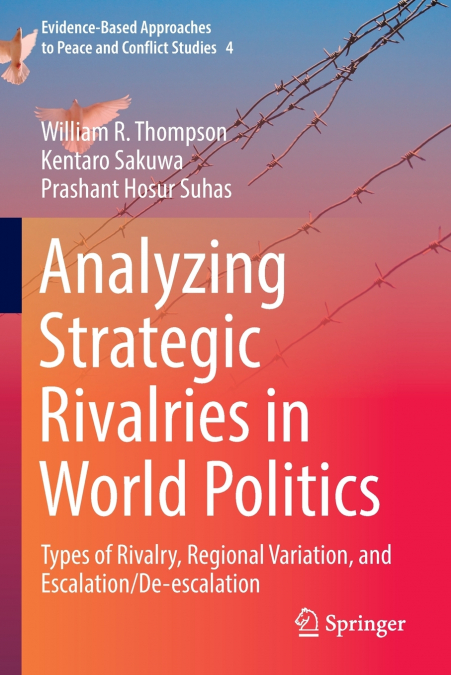
Analyzing Strategic Rivalries in World Politics

Analyzing Strategic Rivalries in World Politics

Kentaro Sakuwa / Prashant Hosur Suhas / William R. Thompson

136,29 €
IVA incluido
Disponible
Editorial:
Springer Nature B.V.
Año de edición:
2022
Materia
Relaciones internacionales
ISBN:
9789811666735
136,29 €
IVA incluido
Disponible

Selecciona una librería:

  • Librería Samer Atenea
  • Librería Aciertas (Toledo)
  • Kálamo Books
  • Librería Perelló (Valencia)
  • Librería Elías (Asturias)
  • Donde los libros
  • Librería Kolima (Madrid)
  • Librería Proteo (Málaga)

Strategic rivalries are contests between states that view one another as threatening competitors and treat each other as enemies. A disproportionate amount of interstate conflict is generated by a relatively small number of these pairs of states engaged in rivalries that can persist for years. Thus, to understand interstate peace and conflict, it is useful to know how rivalries work in general and more specifically. In the past two decades, a strenuous effort has been mounted to introduce the concept of rivalry and demonstrate its utility in unraveling conflict situations. Yet all rivalries are not exactly alike. We need to move to a more rewarding differentiation of how they differ in general. Principal rivalries are those antagonisms that are most significant to the decision makers in a state. The main distinction on issues about which rivals dispute are positional and spatial concerns. Positional rivalries contend over regional and global influence. Spatial rivals contend over which state deserves to control disputed territory. Interventionary rivalries predominate in sub-Saharan Africa. Their primary focus involves neighboring states attempting to influence who rules and how co-ethnics are treated. This book updates the inventory of strategic rivalries from 1816 to 2020. Principal rivalries are identified for the first time and cover the same period. A theory stressing the two main types of rivalry (positional and spatial) is elaborated and tested. Regional variations on the origins and terminations of spatial rivalry are explored and interpreted. In addition, attention is paid to fluctuations in the intensity of positional rivalries by examining the working of the contemporary major power triangle (United States, Soviet Union/Russia, and China) and, more generally, the dynamics of regional power that are rising in terms of their relative capability and status in the system. Variations in cooperation and termination dynamics both in general and according to rivalry type are also examined.  Overall, the emphases of the book are split between demonstrating the utility of distinguishing among rivalry types and examining selected rivalry dynamics.

Artículos relacionados

  • Realism in Practice
    The purpose of this book is to appraise the current relevance and validity of realism as an interpretative tool in contemporary International Relations. All chapters of the book are animated by a theoretical effort to define the conceptual aspects of realism and attempt to establish whether the tradition still provides the necessary conceptual tools to scholars.The chapters add...
    Disponible

    20,36 €

  • Predicting gender violence in India
    Shritha K Vasudevan
    In this provocative new book, Shritha Vasudevan argues that feminist international relations (IR) theory has inadvertently resulted in a biased worldview, the very opposite of what feminist IR set out to try to rectify. This book contests theoretical presumptions of Western feminist IR and attempts to reformulate it in contexts of non-Western cultures. Vasudevan deftly utilizes...
    Disponible

    230,65 €

  • Contemporary security issues in Africa
    Isiaka Alani Badmus / Lere Amusan
    In volume, an emerging generation of African scholars examines specific states in Africa where instability is the order of the day. Considerations of African instability are highly relevant in today’s world, where one examines the types of regimes that were put in place after the Cold War and their effects on Africa. Multiparty systems introduced in Africa, rather than bringing...
    Disponible

    274,45 €

  • Chronicles of the first and second chechen wars
    Ilya Milyukov
    Presented by Russian author and attorney Ilya Milyukov, Chronicles of the First and Second Chechen War presents the main events of the First (1994-1996) and Second (1999-2009) Wars in Chechnya, Russia’s deadliest conflicts since World War II. The First War began in December 1994 and lasted for one year and nine months, ending in August 1996. There were two major urban battles -...
    Disponible

    291,94 €

  • Political instability in Africa
    Isiaka Alani Badmus / Lere Amusan
    This book offers broad-gauged analyses of the causes, nature, and changing patterns of armed conflict in Africa as well as the reasons for these patterns. It also situates conflicts that have been haunting the African continent since the time of decolonization within the various theoretical schools such as 'new war,' 'economic war,' 'neo-patrimonial,' and 'globalization.' It be...
    Disponible

    274,70 €

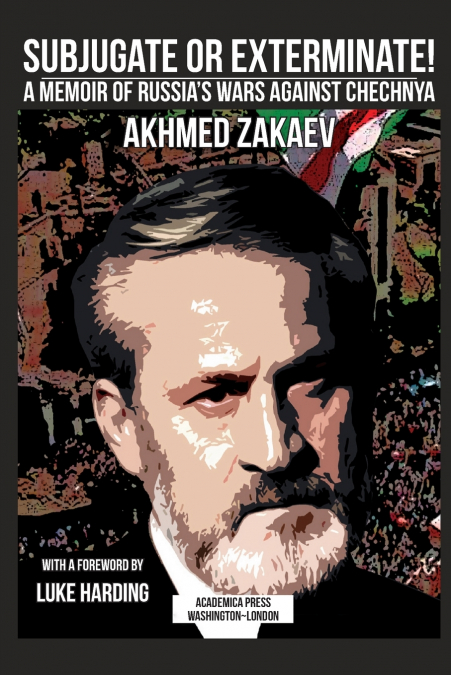
  • Subjugate or exterminate!
    Akhmed Zakaev / Arch Tait
    Foreword by Luke HardingAkhmed Zakaev is a symbol of the indomitable will of the Chechen nation. In this important memoir, he tells the story of the Chechen struggle as he experienced it, describing the conflict in human terms and providing a detailed documentary record of little known or badly understood events that will be of benefit to historians for generations to come.- Da...
    Disponible

    41,63 €