 Librería Samer Atenea
 Kálamo Books
 Librería Elías (Asturias)
 Librería Kolima (Madrid)
 Librería Proteo (Málaga)
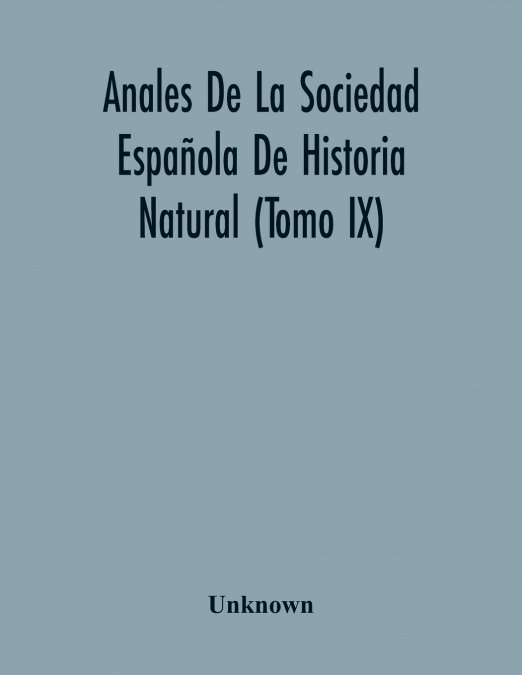
A window onto Spain’s natural past. Rare, rigorous and quietly enthralling.Essential reading for nature enthusiasts.Anales de la Sociedad Espanola de Historia Natural (Tomo IX) stands as a commanding instance of a natural history journal and Spanish scientific publication. Published under the auspices of a Madrid scientific society, this academic periodical collection reads as a scientific anthology: measured reports and focused notes that advance zoology and botany studies and sketch the variety of Iberian Peninsula fauna. Its pages show the methodical curiosity of nineteenth century science, a time when careful observation and classification set the terms for modern biodiversity research in Spain.Entries from European naturalists sit beside local observers, producing a layered record that rewards both casual perusal and close study. As a scholarly reference work, the volume helps researchers and historians track taxonomic choices, shifting field methods and historical baselines for species and habitats. The language and tone offer a living sense of the era: scientific enquiry rendered in clear, purposeful prose, where description and debate coexist. For librarians, curators and anyone assembling a library of scientific texts, this Tomo IX supplies texture and authority. Collectors and bibliophiles will appreciate its place within the broader sweep of European naturalism, while students of culture can trace the meeting-place of science, exploration and metropolitan institutions. The volume’s mix of local observation and international exchange makes clear how the Madrid scientific society participated in a continental conversation about nature.Republished by Alpha Editions in a careful modern edition, this volume preserves the spirit of the original while making it effortless to enjoy today - a heritage title prepared for readers and collectors alike. Casual readers drawn to nineteenth century curiosity and classic-literature collectors seeking primary sources of scientific culture will find equal reward here. Conservationists and scholars engaged in biodiversity research may also find the historical perspective indispensable: patterns recorded decades ago often illuminate contemporary questions of species distribution, nomenclature and the slow history of European naturalists.