 Librería Samer Atenea
 Kálamo Books
 Librería Elías (Asturias)
 Librería Kolima (Madrid)
 Librería Proteo (Málaga)
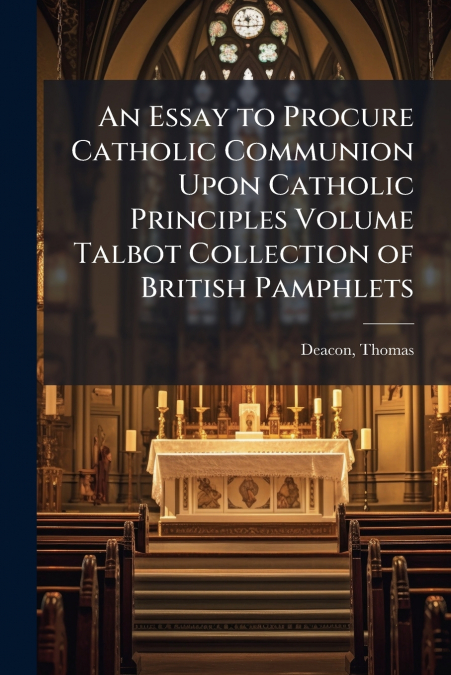
An Essay to Procure Catholic Communion Upon Catholic Principles, penned by Thomas Deacon (1697-1753), delves into the intricacies of Catholic theology and explores pathways toward greater communion within the Catholic Church. Originally published in the 18th century, this essay remains a significant contribution to the discourse on ecumenism and religious unity. Deacon’s work, part of the Talbot Collection of British Pamphlets, provides valuable insight into the religious and intellectual landscape of his time. He argues for Catholic communion based on core Catholic principles, seeking to bridge divides and foster understanding among various factions within the faith. This essay serves as a historical document reflecting the ongoing quest for unity and theological harmony within Christianity. Its enduring relevance lies in its thoughtful consideration of foundational Catholic tenets and its passionate plea for a more cohesive religious community.This work has been selected by scholars as being culturally important, and is part of the knowledge base of civilization as we know it. This work was reproduced from the original artifact, and remains as true to the original work as possible. Therefore, you will see the original copyright references, library stamps (as most of these works have been housed in our most important libraries around the world), and other notations in the work.This work is in the public domain in the United States of America, and possibly other nations. Within the United States, you may freely copy and distribute this work, as no entity (individual or corporate) has a copyright on the body of the work.As a reproduction of a historical artifact, this work may contain missing or blurred pages, poor pictures, errant marks, etc. Scholars believe, and we concur, that this work is important enough to be preserved, reproduced, and made generally available to the public. We appreciate your support of the preservation process, and thank you for being an important part of keeping this knowledge alive and relevant.