
Inicio > Humanidades > Filosofía > Ética y filosofía moral > An Essay on the Principle of Population
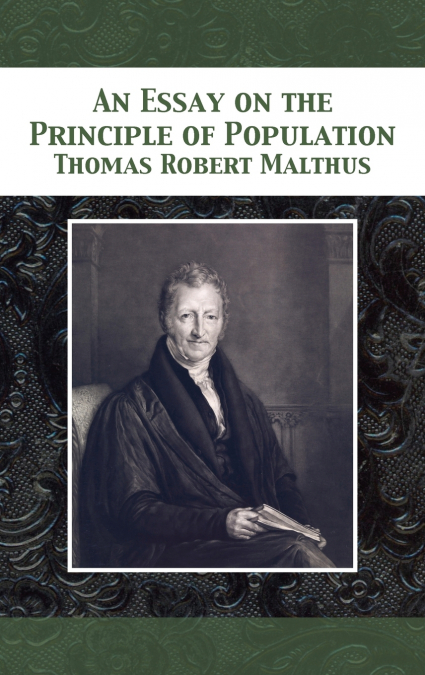
An Essay on the Principle of Population

An Essay on the Principle of Population

An Essay on the Principle of Population

Thomas Robert Malthus

15,52 €
IVA incluido
Consulta disponibilidad
Editorial:
12th Media Services
Año de edición:
1798
Materia
Ética y filosofía moral
ISBN:
9781680922592

Selecciona una librería:

  • Librería Samer Atenea
  • Librería Aciertas (Toledo)
  • Kálamo Books
  • Librería Perelló (Valencia)
  • Librería Elías (Asturias)
  • Donde los libros
  • Librería Kolima (Madrid)
  • Librería Proteo (Málaga)

The book An Essay on the Principle of Population was first published anonymously in 1798, but the author was soon identified as Thomas Robert Malthus. The book predicted a grim future, as population would increase geometrically, doubling every 25 years, but food production would only grow arithmetically, which would result in famine and starvation, unless births were controlled.While it was not the first book on population, it was revised for over 28 years and has been acknowledged as the most influential work of its era. Malthus's book fuelled debate about the size of the population in the Kingdom of Great Britain and contributed to the passing of the Census Act 1800. This Act enabled the holding of a national census in England, Wales and Scotland, starting in 1801 and continuing every ten years to the present. The book's 6th edition (1826) was independently cited as a key influence by both Charles Darwin and Alfred Russel Wallace in developing the theory of natural selection.A key portion of the book was dedicated to what is now known as Malthus' Iron Law of Population. This name itself is retrospective, based on the iron law of wages, which is the reformulation of Malthus' position by Ferdinand Lassalle, who in turn derived the name from Goethe's "great, eternal iron laws" in Das Göttliche. This theory suggested that growing population rates would contribute to a rising supply of labour that would inevitably lower wages. In essence, Malthus feared that continued population growth would lend itself to poverty and famine.In 1803, Malthus published, under the same title, a heavily revised second edition of his work. His final version, the 6th edition, was published in 1826. In 1830, 32 years after the first edition, Malthus published a condensed version entitled A Summary View on the Principle of Population, which included responses to criticisms of the larger work. Source: Wikipedia 

Artículos relacionados

  • Ka Ab Ba Building The Lighted Temple
    Dr Terri R. Nelson / Dr Terri RNelson
    The book KaAbBa Building The Lighted Temple/Metaphysical Keys to the Tree of Life draws a circle that is inclusive of the Afrikan origin of the Ancient Kemetic/Egyptian wisdom. It reveals the undeniable root and link of Ancient Africa to all the religious systems that would develop worldwide. This book is explosive in its power to convey the meaning of KaAbBa, the Medu Neter  (...
    Disponible

    37,41 €

  • Technoethics and the Evolving Knowledge Society
    Rocci Luppicini
    Recently, there has been a major push to rediscover the ethical dimension of technology across the sciences, social sciences, and humanities. Technoethics and the Evolving Knowledge Society: Ethical Issues in Technological Design, Research, Development, and Innovation examines human processes and practices connected to technology embedded within social, political, and moral sph...
  • Kant
    Immanuel Kant
    Kant’s Groundwork of the Metaphysics of Morals is one of the most important works in modern moral philosophy. It belongs beside Plato, Aristotle, Machiavelli, and Hobbes. Here Kant sets out to articulate and defend the Categorical Imperative - the fundamental principle that underlies moral reasoning - and to lay the foundation for a comprehensive account of justice and human vi...
  • On the Duty of Civil Disobedience
    HENRY DAVID THOREAU
    Civil Disobedience argues that citizens should not permit their governments to overrule their consciences, and that they have a duty to avoid allowing their acquiescence to enable the government to make them the agents of injustice. Thoreau was motivated in part by his disgust with slavery and the Mexican-American War, but the sentiments he expresses here are just as pertinent ...
  • Beyond Good and Evil
    Friedrich Nietzsche
    Nietzsche, though primarily a philosopher, wrote widely on art, philology, history, religion, tragedy, culture, and science.  In 1886, at the height of his powers, he published Beyond Good and Evil.  Here he examines much of the best of human thought--dogmatic philosophy, Judeo-Christian morality, science and democracy – and finds it lacking.  Rejecting “slave-morality” he pres...
  • Beyond Good and Evil
    Friedrich Nietzsche
    Nietzsche, though primarily a philosopher, wrote widely on art, philology, history, religion, tragedy, culture, and science.  In 1886, at the height of his powers, he published Beyond Good and Evil.  Here he examines much of the best of human thought--dogmatic philosophy, Judeo-Christian morality, science and democracy – and finds it lacking.  Rejecting “slave-morality” he pres...
    Disponible

    9,99 €

Otros libros del autor

  • An Essay on the Principle of Population [1798]
    Thomas Robert Malthus
    Reprint of the Very Rare First EditionOne of the most influential works of political economy, this book had a profound effect on social policy during the nineteenth century. Malthus’s central thesis is that population increases geometrically while food supplies increase arithmetically, a dynamic which will eventually lead to starvation and disease in the poorest sections of the...
  • An Essay On The Principle Of Population
    Thomas Robert Malthus
    An Essay On The Principle Of Population: As It Affects The Future Improvement Of Society With Remarks On The Speculations Of Mr. Godwin, M. Condorcet, And Other Writers.This book is a result of an effort made by us towards making a contribution to the preservation and repair of original classic literature.In an attempt to preserve, improve and recreate the original content, we ...
    Disponible

    12,26 €

  • An Essay on the Principle of Population
    Thomas Robert Malthus
    The seminal essay on population growth by Thomas Robert Malthus is published here anew, complete and unabridged.Although wrong in its prediction of mass famine owing to population growth outpacing the growth in production of food, this essay became very influential among scientific and economic thinkers. Evolutionary science in particular appreciated the efforts of Malthus, wit...
    Disponible

    12,69 €

  • An Essay on the Principle of Population (Hardcover)
    Thomas Robert Malthus
    The seminal essay on population growth by Thomas Robert Malthus is published here anew, complete and unabridged.Although wrong in its prediction of mass famine owing to population growth outpacing the growth in production of food, this essay became very influential among scientific and economic thinkers. Evolutionary science in particular appreciated the efforts of Malthus, wit...
  • An Essay on the Principle of Population, as It Affects the Future Improvement of Society
    Thomas Robert Malthus
    ...
    Disponible

    58,58 €

  • An Essay on the Principle of Population, Volume I
    Thomas Robert Malthus
    Around 1796, Mr. Malthus, an English gentleman, had finished reading a book that confidently predicted human life would continue to grow richer, more comfortable and more secure, and that nothing could stop the march of progress. He discussed this theme with his son, Thomas, and Thomas ardently disagreed with both his father and the book he had been reading, along with the enti...