 Librería Samer Atenea
 Kálamo Books
 Librería Elías (Asturias)
 Librería Kolima (Madrid)
 Librería Proteo (Málaga)
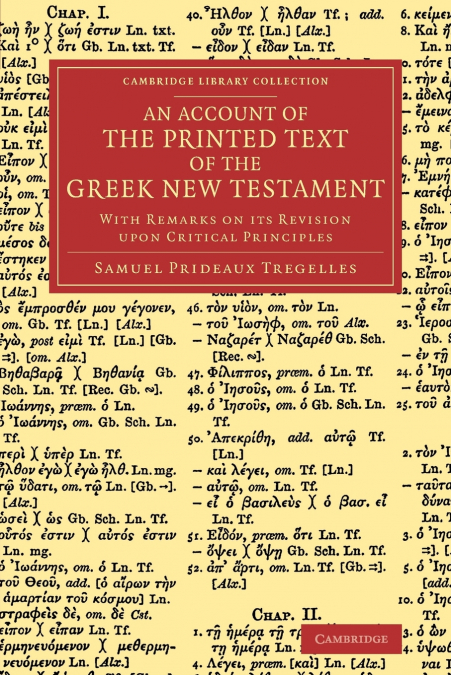
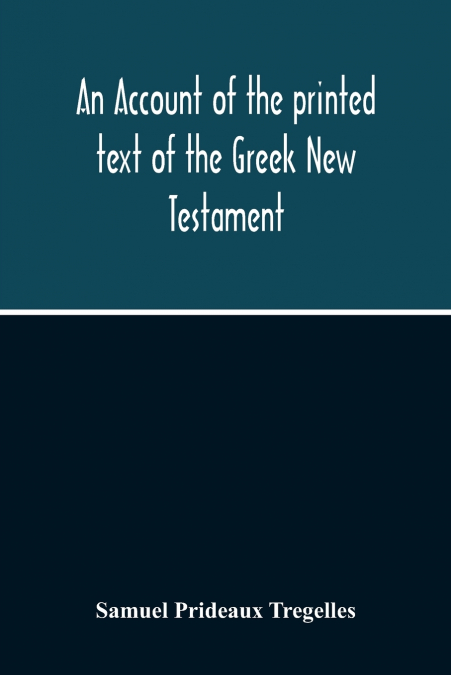
How did the printed Greek New Testament take its shape? Samuel Prideaux Tregelles answers with forensic clarity. Textual foundations are laid bare. In lucid, measured prose Tregelles assembles a systematic collation of the critical texts of Griesbach, Scholz, Lachmann and Tischendorf against the text then in common circulation. The result functions both as a practical manuscript collation reference and as a forensic study of editorial method: variant readings are recorded, editorial tendencies exposed, and scripture revision principles of the era are analysed with care. Those working in Greek New Testament studies or in broader biblical textual criticism will find a rare convergence of method and readable argument; advanced theology students and scholarly bible researchers will value the disciplined apparatus, while curious readers gain a clear map of how scholarly method alters and fixes sacred text. Tregelles’s prose keeps complex argument intelligible: technical terms are used precisely and the evidence is marshalled so questions of provenance, copying error and editorial preference become readable rather than mystifying. For anyone conducting academic bible comparison, the book’s comparisons remain a trustworthy point of departure.Its literary and historical significance is plain. As a cornerstone of nineteenth century biblical scholarship, the work traces the history of Bible text at a pivotal moment in the development of critical editions, and it supplies an indispensable aid to academic bible comparison within any critical edition collection of historical religious texts. Out of print for decades and now republished by Alpha Editions. Restored for today’s and future generations. More than a reprint, a collector’s item and a cultural treasure. Equally at home on the shelf of casual readers and classic-literature collectors, this edition preserves the original’s precision while making its insights accessible and usable for modern study. Librarians and private collectors of historical religious texts will recognise its value as both reference and readable history, and the volume remains a durable resource for those tracing editorial practice across the great nineteenth-century names in textual criticism.