

 Librería Samer Atenea
 Kálamo Books
 Librería Elías (Asturias)
 Librería Kolima (Madrid)
 Librería Proteo (Málaga)
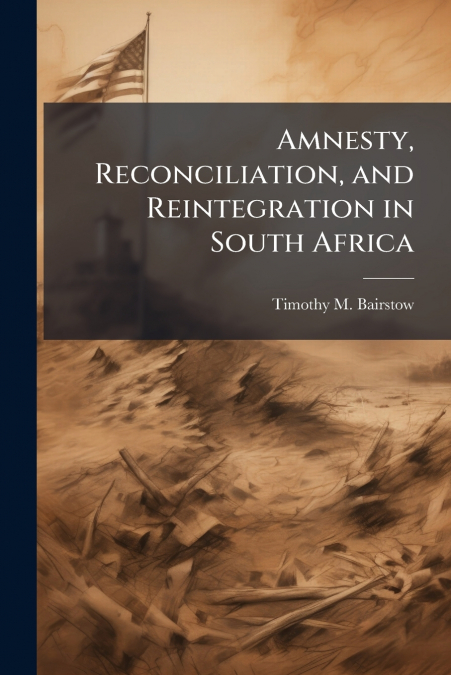
The process of amnesty, reconciliation, and reintegration (AR2) is typically regarded as a post-conflict process. In South Africa AR2 occurred before hostilities between government security forces and opposition groups developed into a civil war. This makes the South African case of AR2 a distinct, but not unique case. During the transition from apartheid to democracy in the 1990’s, civil war was averted in South Africa due to a combination of the political compromise between the National Party and the African National Congress, the pressures placed upon the South African economy, and the military’s acquiescence to the transition. The reconciliation process in South Africa was instigated by economic factors. South Africa had, in the African National Congress (ANC) and other groups, a significant opposition movement for almost eight decades before the country moved towards reforming the apartheid system. For almost half of that time the ANC and other groups used violence against the state. But it was not until apartheid became too expensive for South Africa’s business interests that any viable attempts were made to reconcile the ANC and the National Party. South African politicians on both sides of the conflict did their part to avoid war by recognizing the need for a national reconciliation process and building the structures necessary for reconciliation to occur in a relatively fast, efficient, and very public way. The primary contributors to the process of AR2 in the political sphere were the negotiations between the ANC and the National Party, the Truth and Reconciliation Commission, and local 'peace councils' which mitigated conflicts at the village and regional level. While it may seem surprising that South African security forces acquiesced to this process, they did so due to their traditions of subservience to civilian authority, their limited political, and their relatively small size.This work has been selected by scholars as being culturally important, and is part of the knowledge base of civilization as we know it. This work was reproduced from the original artifact, and remains as true to the original work as possible. Therefore, you will see the original copyright references, library stamps (as most of these works have been housed in our most important libraries around the world), and other notations in the work.This work is in the public domain in the United States of America, and possibly other nations. Within the United States, you may freely copy and distribute this work, as no entity (individual or corporate) has a copyright on the body of the work.As a reproduction of a historical artifact, this work may contain missing or blurred pages, poor pictures, errant marks, etc. Scholars believe, and we concur, that this work is important enough to be preserved, reproduced, and made generally available to the public. We appreciate your support of the preservation process, and thank you for being an important part of keeping this knowledge alive and relevant.





