

 Librería Samer Atenea
 Kálamo Books
 Librería Elías (Asturias)
 Librería Kolima (Madrid)
 Librería Proteo (Málaga)
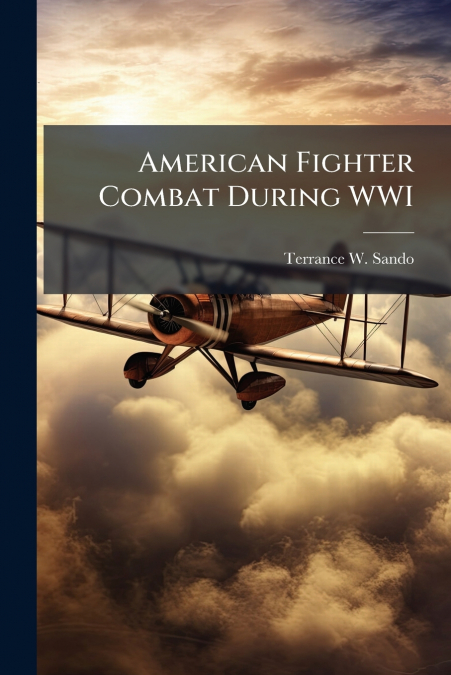
It has been over three quarters of a century since the American Air Service began operations in Europe during the Great War. Its service there during the final days of World War I, except for a few volunteers, only covered seven short months. Even though war was declared a year earlier in the spring of 1917, it took a year to get a force organized for air combat in Europe. But, finally, high above the ruined landscape of the trench warfare, American airpower made its debut. It was here that America’s young warriors without parachutes and in bitter cold open cockpits made their contributions. Their battles took place high over Toul, Chateau-Thierry, St. Mihiel, and the Meuse-Argonne. I will examine training, leadership, and the adaptation of formation tactics of the infant United States air arm. You will see that as a combat force, the Air Service made tremendous strides from its cautious beginnings in April 1918. At this time the force only consisted of a single observation squadron flying obsolete aircraft and two pursuit units flying unarmed Nieuports.This work has been selected by scholars as being culturally important, and is part of the knowledge base of civilization as we know it. This work was reproduced from the original artifact, and remains as true to the original work as possible. Therefore, you will see the original copyright references, library stamps (as most of these works have been housed in our most important libraries around the world), and other notations in the work.This work is in the public domain in the United States of America, and possibly other nations. Within the United States, you may freely copy and distribute this work, as no entity (individual or corporate) has a copyright on the body of the work.As a reproduction of a historical artifact, this work may contain missing or blurred pages, poor pictures, errant marks, etc. Scholars believe, and we concur, that this work is important enough to be preserved, reproduced, and made generally available to the public. We appreciate your support of the preservation process, and thank you for being an important part of keeping this knowledge alive and relevant.





