 Librería Samer Atenea
 Kálamo Books
 Librería Elías (Asturias)
 Librería Kolima (Madrid)
 Librería Proteo (Málaga)
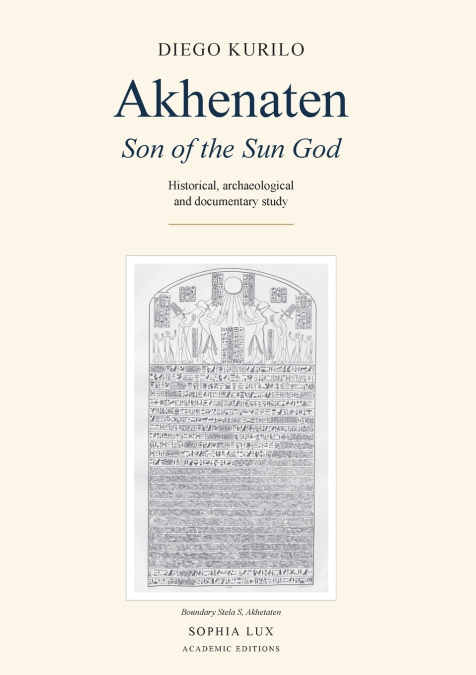
The reign of Amenhotep IV-Akhenaten and the experience of Akhetaten continue to occupy a unique place in Egyptology. Few periods of the New Kingdom have generated so many reconstructions, debates, and temptations of interpretation. Precisely for this reason, this book adopts a deliberately restrictive position: it prioritizes archaeological, epigraphic, and documentary evidence over symbolic, philosophical, or comparative readings that do not derive from Egyptian sources of the fourteenth century BCE. This work does not attempt to resolve all the open questions of the Amarna period. Its objective is more modest yet more exacting: to offer a clear, readable, and methodologically transparent historical reconstruction, consistently distinguishing between what the sources allow us to affirm with confidence, what can be reasonably inferred, and what remains a historiographical hypothesis. In this sense, the volume is aimed at both the specialist reader and the advanced student seeking a rigorous and up-to- date synthesis. Abstract This book offers a historical reconstruction of the reign of Amenhotep IV-Akhenaten and the development of the city of Akhetaten, modern-day Tell el-Amarna, based on available archaeological, epigraphic, and documentary sources. The study examines the context of the Eighteenth Dynasty, the final years of Amenhotep III’s reign, the earliest evidence of the Aten cult at Karnak, the king’s name change, the founding of the new royal residence, the urban organization of Amarna, state administration, diplomatic correspondence, the art of the period, the royal family, the succession, and the subsequent restoration under Tutankhamun, Ay, and Horemheb. The work adopts a historical method. It studies the Amarna period as a series of events, institutional decisions, and cultic practices unevenly documented. Where the sources allow for a firm assertion, the text formulates it clearly; where the evidence is fragmentary, it presents the main hypotheses of modern Egyptology without turning them into narrative certainty.