
After Universalism

After Universalism

Naim Tahir Baig

70,53 €
IVA incluido
Disponible
Editorial:
Institute of Geo-Strategic Studies
Año de edición:
2026
Materia
Relaciones internacionales
ISBN:
9798235663015
70,53 €
IVA incluido
Disponible

Selecciona una librería:

  • Librería Samer Atenea

  • Kálamo Books
  • Librería Elías (Asturias)
  • Librería Kolima (Madrid)
  • Librería Proteo (Málaga)

After UniversalismModular Multilateralism for a Post-Convergence WorldDr Naim Tahir BaigBook DescriptionThe convergence wager of liberal internationalism has lost. The bet placed in 1945 - that the institutions built after the war would, over time, spread democratic governance, market economics, and human rights norms until the world’s major powers shared enough common values to make the postwar rules look self-evident - is now twenty years past its sell-by date. Freedom House counts twenty consecutive years of global democratic decline. The V-Dem Institute records the first moment in more than two decades when autocracies outnumbered democracies. The Nuclear Non-Proliferation Treaty Review Conferences of 2015 and 2022 ended without agreement. The WHO Pandemic Agreement, adopted after more than three years of negotiation, could not be opened for signature because its most consequential provision had to be deferred. The institutions of the postwar order are not weathering a passing crisis. They are failing in the specific ways that institutions designed around an assumption fail when the assumption proves false.After Universalism is the most rigorous account yet written of what to do about it. Dr. Naim Tahir Baig argues that the failure is not only empirical but structural: the universalist self-understanding of the postwar order, once a source of legitimacy and ambition, has now become a source of damage. Imperial drift, procedural overreach, membership extended without genuine buy-in, and the corrosive practice of selective enforcement have produced a legitimacy deficit that revisionists did not create but have learned to exploit. The institutions can be defended only by being redesigned.The book offers that redesign. Across thirteen chapters and six detailed case studies - climate, pandemics, trade, human rights, security, and financial governance - Baig develops the framework he calls modular multilateralism: an architecture for cooperation organised around specific public goods rather than around comprehensive visions of world order. Five design rules anchor the proposal. Decompose cooperation by good and sequence the decomposition. Keep shared commitments calibrated to what an honestly specified universal kernel can bear, not to what the contested agenda aspires to. Tie variable participation to verifiable indicators rather than to self-declared categories. Permit overlapping institutions, disciplined by precise scope statements rather than by exclusive membership. Make exit cheap and re-entry conditional on demonstrated compliance with the floor.What follows from these rules is an institutional vision both more modest and more durable than the universalist inheritance it replaces. A modular WHO with five distinct modules - universal surveillance as the mandatory floor, capacity-building, manufacturing access, pathogen access and benefit-sharing, and outbreak financing - each negotiated separately and capable of operating independently. A modular WTO architecture above the MFN floor, with critical-mass and exclusive plurilaterals adapted to specific sectors and the MPIA model extended as the template for plurilateral dispute settlement. A five-pillar rights architecture that concentrates universal enforcement on the atrocity floor while devolving contested rights to opt-in protocols and regional mechanisms. An Indo-Pacific security latticework already operating as modular architecture in practice, paired with a European NATO-plus-EU configuration that the case study reads as a working illustration rather than as an aberration. A financial governance system the book treats as the longest-running experiment in modular cooperation, with implications for both state and non-state actors.After Universalism is the constructive proposal the present moment requires. Its argument is finished. Its work is not.
Artículos relacionados

  • Realism in Practice
    The purpose of this book is to appraise the current relevance and validity of realism as an interpretative tool in contemporary International Relations. All chapters of the book are animated by a theoretical effort to define the conceptual aspects of realism and attempt to establish whether the tradition still provides the necessary conceptual tools to scholars.The chapters add...
    Disponible

    20,36 €

  • Predicting gender violence in India
    Shritha K Vasudevan
    In this provocative new book, Shritha Vasudevan argues that feminist international relations (IR) theory has inadvertently resulted in a biased worldview, the very opposite of what feminist IR set out to try to rectify. This book contests theoretical presumptions of Western feminist IR and attempts to reformulate it in contexts of non-Western cultures. Vasudevan deftly utilizes...
  • Contemporary security issues in Africa
    Isiaka Alani Badmus / Lere Amusan
    In volume, an emerging generation of African scholars examines specific states in Africa where instability is the order of the day. Considerations of African instability are highly relevant in today’s world, where one examines the types of regimes that were put in place after the Cold War and their effects on Africa. Multiparty systems introduced in Africa, rather than bringing...
  • Chronicles of the first and second chechen wars
    Ilya Milyukov
    Presented by Russian author and attorney Ilya Milyukov, Chronicles of the First and Second Chechen War presents the main events of the First (1994-1996) and Second (1999-2009) Wars in Chechnya, Russia’s deadliest conflicts since World War II. The First War began in December 1994 and lasted for one year and nine months, ending in August 1996. There were two major urban battles -...
  • Political instability in Africa
    Isiaka Alani Badmus / Lere Amusan
    This book offers broad-gauged analyses of the causes, nature, and changing patterns of armed conflict in Africa as well as the reasons for these patterns. It also situates conflicts that have been haunting the African continent since the time of decolonization within the various theoretical schools such as 'new war,' 'economic war,' 'neo-patrimonial,' and 'globalization.' It be...
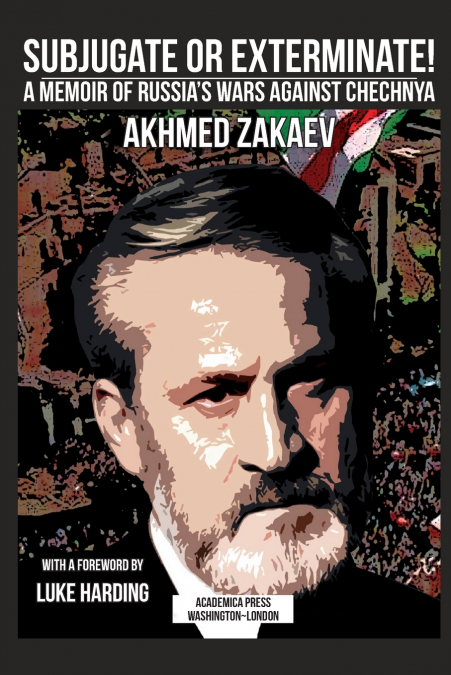
  • Subjugate or exterminate!
    Akhmed Zakaev / Arch Tait
    Foreword by Luke HardingAkhmed Zakaev is a symbol of the indomitable will of the Chechen nation. In this important memoir, he tells the story of the Chechen struggle as he experienced it, describing the conflict in human terms and providing a detailed documentary record of little known or badly understood events that will be of benefit to historians for generations to come.- Da...
    Disponible

    41,63 €

Otros libros del autor

  • The Orbit After Ambiguity
    Naim Tahir Baig
    SPACE SECURITY & ARMS CONTROLThe Orbit After AmbiguityHow the US Admitted It Has Weapons in SpaceThe first narrative account of what changed when the United States stopped keeping its space weapons secret.On September 14, 2026, the Secretary of the Air Force told a Washington audience that the United States 'has on-orbit space control weapons capable of defending the joint forc...
    Disponible

    73,95 €

  • The Stilwell Bypass
    Naim Tahir Baig
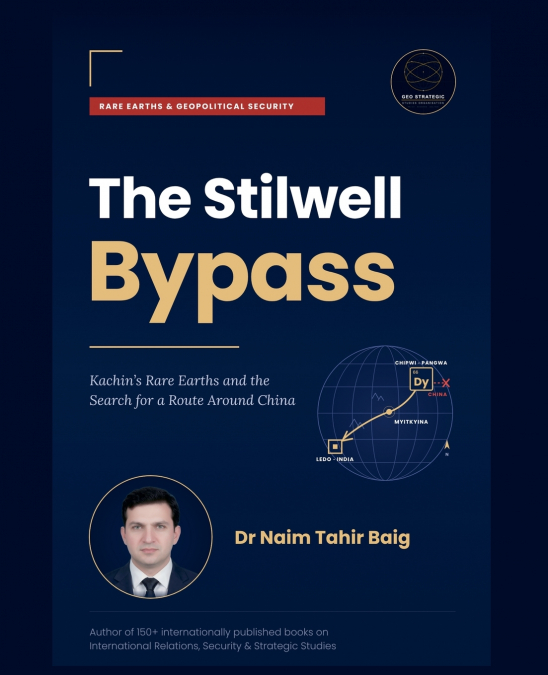
    In 1942 the United States Army pushed a road out of Ledo, in Assam, toward China. More than eighty years later, a question hangs over the same ground: could a different cargo travel part of that route, heavy rare earths dug from the clay hills of Kachin State in northern Myanmar and carried not east into China, as they are now, but west, toward India and toward separation plant...
    Disponible

    74,68 €

  • Extinction by Extraction?
    Naim Tahir Baig
    What we choose when we choose our mineralsEvery wind turbine, electric vehicle, guided missile and smartphone depends on a group of metals most people have never heard of. Rare earth elements make the modern world’s energy, defense and computing systems possible. They also come from some of the most toxic, concentrated and politically contested supply chains on Earth.Extinction...
    Disponible

    73,62 €

  • Theory in the Interregnum
    Naim Tahir Baig
    Theory in the InterregnumWhich International Relations Theory Explains What in a World of Fraying RulesBy Naim Tahir BaigThe liberal international order is fraying, and every school of International Relations claims to have seen it coming. Theory in the Interregnum asks a sharper question: which theory explains what? Dr Naim Tahir Baig argues that no new grand theory has displa...
    Disponible

    70,52 €

  • Rules of the Strong, Rules of the Many
    Naim Tahir Baig
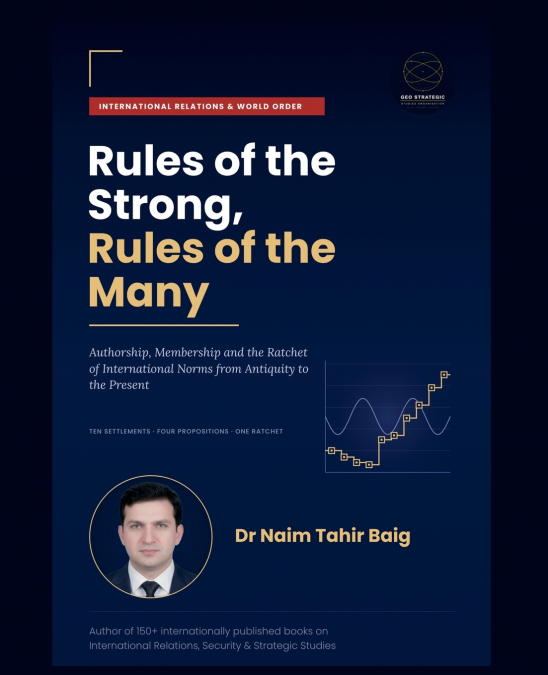
    Rules of the Strong, Rules of the ManyAuthorship, Membership and the Ratchet of International Norms from Antiquity to the PresentBy Dr Naim Tahir BaigWho writes the rules of international order, and who do those rules protect? Rules of the Strong, Rules of the Many argues that international norms move in two rhythms at once. Authorship, meaning who writes and interprets the rul...
    Disponible

    75,59 €

  • Custody
    Naim Tahir Baig
    CustodyHow States Compete to Govern the Making of PersonsBy Dr Naim Tahir Baig States everywhere are claiming a new kind of authority: the right to act as guardian over how their citizens are formed. A South Korean subsidy to raise the birth rate, an Australian ban on social media for under-16s, a Brazilian court order against a platform and a Chinese rule for generative AI loo...
    Disponible

    75,54 €