

 Librería Samer Atenea
 Kálamo Books
 Librería Elías (Asturias)
 Librería Kolima (Madrid)
 Librería Proteo (Málaga)
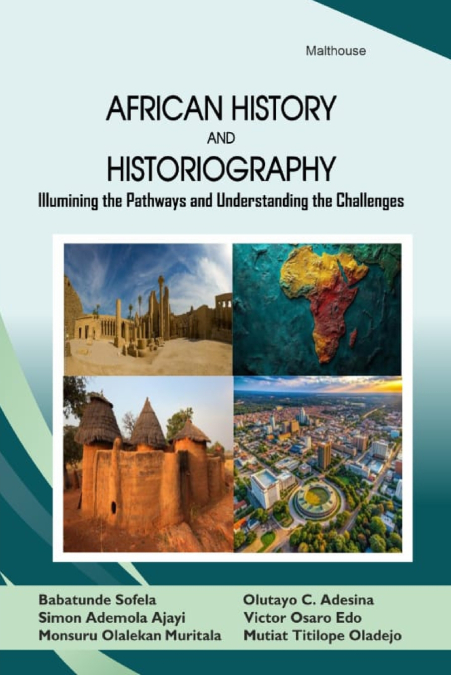
This book emanated from the international conference convened in 2019 by the Department of History, University of Ibadan, Nigeria. Professor Emeritus J. F. Ade Ajayi made significant contributions to the development of African history and historiography. He was an exemplary intellectual, a highly-respected teacher, institution builder, a man of letters, and icon of the famous Ibadan School of History. He was the flag-bearer of a generation that fostered a renewed understanding of African history and succeeded in a veritable way in adding verve to the major currents of historical scholarship on Africa. - Babatunde Sofela & Olutayo C. Adesina, University of IbadanAfrican History and African Historiography: Illumining the Pathway and Understanding the Challenges is the product of an international colloquium of the same title, elegantly put together, in collaboration with the honouree’s illustrious family, by the Department of History, University of Ibadan, in memory of Jacob Festus Adeniyi Ajayi, more popularly, J. F. Ade Ajayi., at the University’s Conference Centre in 2019... This evidently historic and incontestably the most monumental commemorative publication about a man who, though he came almost a decade behind Kenneth Onwuka Dike and Saburi Oladeni Biobaku as vanguards, did more than any other known individual in establishing African historical scholarship as a global experience. - Professor Anthony I. Asiwaju, mfr, fnal, fhsnThere are five sections serving as pillars around which the analyses in this volume are structured. The five sections espouse an interesting figure of the five fingers which our late mentor, Emeritus Professor J.F. Ade Ajayi beautifully employed to pen the numerous works of scholarship that made him an outstanding and remarkable trailblazer of an historian. The five sections accommodate 26 chapters with this arithmetic beauty of content. Section 1 has six chapters, Section 2 has five chapters, Section 3 has six chapters, Section 4 has four chapters and Section 5 contains the remaining five chapters in the volume. It is interesting to note that a central theme runs through these five sections and 26 chapters that make the volume a coherent unit of high-grade historical scholarship. That central notion can be conceptualised into a formulae History cum J.F. Ade Ajayi cum African History and Historiography... - Babatunde Sofela





