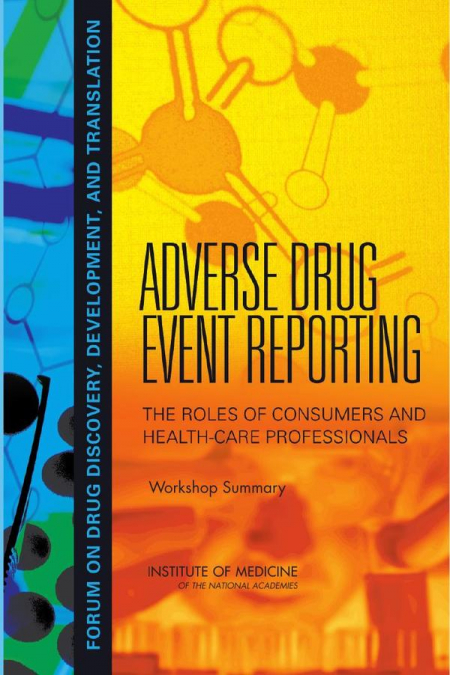

Adverse Drug Event Reporting

Adverse Drug Event Reporting

AA.VV

26,52 €
IVA incluido
Disponible
Editorial:
National Academies Press
Año de edición:
2007
ISBN:
9780309102766
26,52 €
IVA incluido
Disponible

Selecciona una librería:

  • Librería Samer Atenea
  • Librería Aciertas (Toledo)
  • Kálamo Books
  • Librería Perelló (Valencia)
  • Librería Elías (Asturias)
  • Donde los libros
  • Librería Kolima (Madrid)
  • Librería Proteo (Málaga)

Recent concerns about the unexpected adverse effects of marketed drugs, such as COX-2 (cyclooxygenase-2) inhibitors or specific statins, raise concerns not only about reporting these events during premarket studies, but also about the responsibility for ongoing surveillance of drugs once they are on the market. Sometimes serious adverse drug reactions are fully appreciated only after a drug has been on the market for years. Therefore, when a drug is approved and released to the market, large numbers of patients will be exposed before all the potential adverse effects have been identified and thoroughly studied. Currently, there is no clearly defined process for addressing safety questions about drugs after premarketing research has occurred.In November 2005, the Institute of Medicine’s Forum on Drug Discovery, Development, and Translation convened a workshop to explore issues associated with the reporting of ADEs. The workshop addressed the following questions: How can ADEs be effectively identified, particularly when the adverse effects are rare? How can the direct, causal effects of drugs be distinguished from simple associations? How can health-care professionals and their patients’ aid in the identification of drug-related adverse events? How can knowledge of ADEs be more effectively used in clinical practice?Adverse Drug Event Reporting reviews current sources of information on adverse drug events, including the FDA’s MedWatch program and the AERS, institutional review boards, and the CMS. This report considers the ways that consumers and advocacy groups can be involved in reporting adverse events, and discusses drug interactions, problems with current databases for capturing and evaluating interactions, and difficulties in communicating information about adverse drug interactions. This report also describes new requirements for information contained on drug labels and how labels can be used to communicate information about risks and drug interactions to consumers and practitioners.

Artículos relacionados

  • Geographic Information Systems and Public Health
    Andrew Curtis
    ...
  • Cases on Healthcare Information Technology for Patient Care Management
    Health care organizations have made investments in health information technologies such as electronic health records, health information exchanges, and many more, which have increased the importance of Health Information Technology studies. Cases on Healthcare Information Technology for Patient Care Management highlights the importance of understanding the potential challenges ...
  • Healthcare Information Technology Innovation and Sustainability
    Joseph Tan
    Healthcare Information Technology Innovation and Sustainability: Frontiers and Adoption presents research in the emerging field on information systems and informatics in the healthcare industry. By addressing innovative concepts and critical issues through case studies and experimental research, this reference source is useful for practitioners, researchers and academics aiming...
  • Social, Economic, and Political Perspectives on Public Health Policy-Making
    Presently, the healthcare industry is grappling with many challenges both nationally and globally, including escalating costs, a move to a preventative care environment and a technology savvy patient with high expectations. To accommodate the changing health demands of the current global population, public healthcare policy must undergo a critical analysis. Social, Economic, an...
  • Modern Concepts and Practices in Cardiothoracic Critical Care
    Adam S Evans / Gregory E Kerr / Insung Chung
    With an increase in admission to intensive care units, medical professionals must search for the best practices and procedures to provide efficient medical care to each patient. Despite medical advances, there is still a need for well-trained cardiovascular intensivists to meet the needs of patients. Modern Concepts and Practices in Cardiothoracic Critical Care brings together ...
  • Reshaping Medical Practice and Care with Health Information Systems
    Ashish Dwivedi
    Technology has become an integral part of our daily interactions, even within the hospitals and healthcare facilities we rely on in times of illness and injury. New technologies and systems are being developed every day, advancing the ways that we treat and maintain the health and wellbeing of diverse populations. Reshaping Medical Practice and Care with Health Information Syst...