 Librería Samer Atenea
 Kálamo Books
 Librería Elías (Asturias)
 Librería Kolima (Madrid)
 Librería Proteo (Málaga)
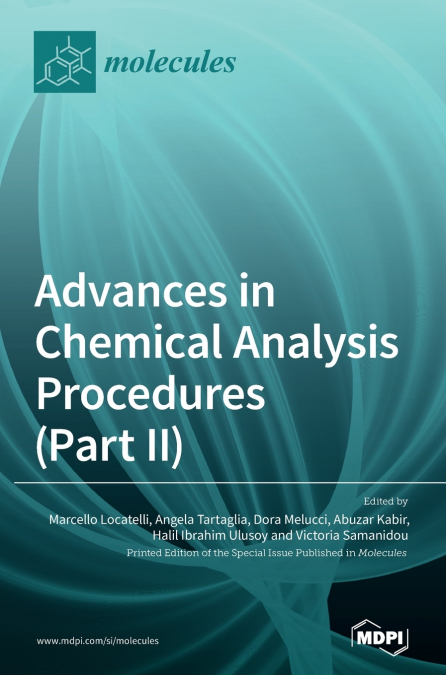
In the field of Analytical Chemistry and, in particular, whenever a quali-quantitative analysis is required, until a few years ago, reference was made exclusively to instrumental methods (more or less hyphenated) which, once validated, were able to provide the answers to the questions present, even if only in a limited way to analytical targets. Nowadays, the landscape has become considerably complicated (natural adulterants, assessment of geographical origin, sophistication, need for non-destructive analysis, search for often unknown compounds), and new procedures for processing data have greatly increased the potential of analyses that are conducted (even routinely) in the laboratory. In this scenario, chemometrics is master, able to manage and process a huge amount of information based both on data relating only to the analytes of interest, but also by applying 'general' procedures to process raw untargeted analysis data. It is within this strand of analysis that many of the works reported in this Special Issue fall. In the succession of works in this printed version, the criterion that guided us was to highlight how-starting exclusively from chromatographic techniques (HPLC and GC) with conventional detectors and moving to exclusively spectroscopic techniques (MS, FT-IR and Raman)-it is possible arrive at extremely powerful coupled techniques and procedures (HPLC and FT-IR) able to meet research needs. Finally, at the end of the printed volume, there are two reviews that surveying the state of the art regarding the assessment of authenticity through qualitative analyses and the application of chemometrics in the pharmaceutical field in the study of forced drug degradation products. From the succession of works (and, above all, from the various application fields) it can immediately be seen how the application of chemometrics and its procedures to both raw and processed data is a powerful means of obtaining robust, reproducible, and predictive information. In this manner, it is possible to create models able to explain and respond to the original problem in a much more detailed way. , and Honghe through Fourier transform mid infrared (FT-MIR) spectra combined with partial least squares discriminant analysis (PLS-DA), random forest (RF), and hierarchical cluster analysis (HCA) methods. Melucci and collaborators apply chemometric approaches to non-destructive analysis of ATR-FT-IR for the determination of biosilica content. This value was directly evaluated in sediment samples, without any chemical alteration, using attenuated total reflection Fourier transform infrared (ATR-FTIR) spectroscopy, and the quantification was performed by combining the multivariate standard addition method (MSAM) with the net analyte signal (NAS) procedure to solve the strong matrix effect of sediment samples. Still in the food and food supplements field, Anguebes-Franseschi and collaborators report an article where 10 chemometric models based on Raman spectroscopy were applied to predict the physicochemical properties of honey produced in the state of Campeche, Mexico.