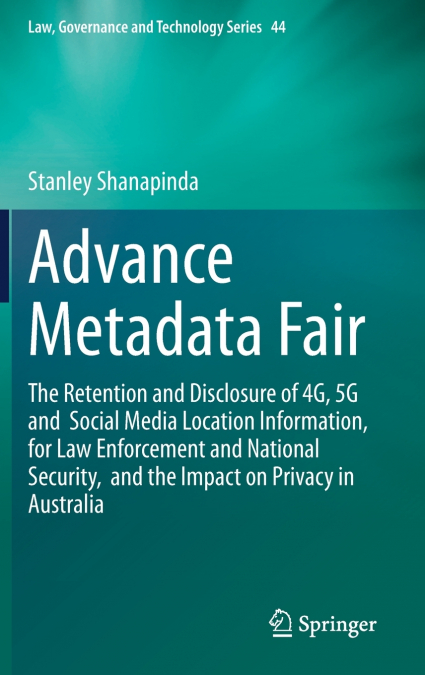

Advance Metadata Fair

Advance Metadata Fair

Stanley Shanapinda

194,28 €
IVA incluido
Consulta disponibilidad
Editorial:
Springer Nature B.V.
Año de edición:
2020
Materia
Teoría general del derecho
ISBN:
9783030502546

Selecciona una librería:

  • Librería Samer Atenea
  • Librería Aciertas (Toledo)
  • Kálamo Books
  • Librería Perelló (Valencia)
  • Librería Elías (Asturias)
  • Donde los libros
  • Librería Kolima (Madrid)
  • Librería Proteo (Málaga)

This book outlines the legal powers of a major Western nation - Australia - to collect and use location information. Mobile service and social media service providers now have the ability to track, record and store more precise location information. Unlike 4G, 5G mobile communications require that cell towers and antennas be in much closer proximity; as a result, the location data can reveal more personal and sensitive information about individual citizens. Despite this aspect, service providers are required to disclose the data to the authorities, without the need for a judicial warrant. This book was written from the perspective of big location data software analytics, a capability that makes it possible to combine various location data points to create a profile on a given individual’s movements, habits, and political, religious and ideological orientation.In this regard, privacy is poorly protected. The rationale used to justify the powers was enforcing serious crimes - terrorism offences. Location data can now be retained for at least two years and be collected to investigate even minor offences. This can be done without the person being reasonably suspected of a criminal offence - when the individual is simply determined to be a person of interest. This poses legal risks to vulnerable communities. And yet, such investigative techniques are deemed lawful and reasonable. At a time when national security is so broadly defined to include economic issues, which in turn overlap with climate change and environmental protection, these legal powers should be reassessed. The book clarifies the complex rules that every citizen must know in order to have agency. Further, it calls upon authorities to reflect and to self-regulate, by making the conscious decision to surrender some of their powers to review by the independent judiciary. Without the requirement for a judicial warrant or judicial review, the powers are unfairly broad. The book pursues an interdisciplinary approach to assess the functionality of mobile telecommunications in direct relation to law enforcement powers and existing judicial precedents. Further, it offers a unifying techno-legal perspective on a complex issue touching on modern privacy law and communications technologies.
Artículos relacionados

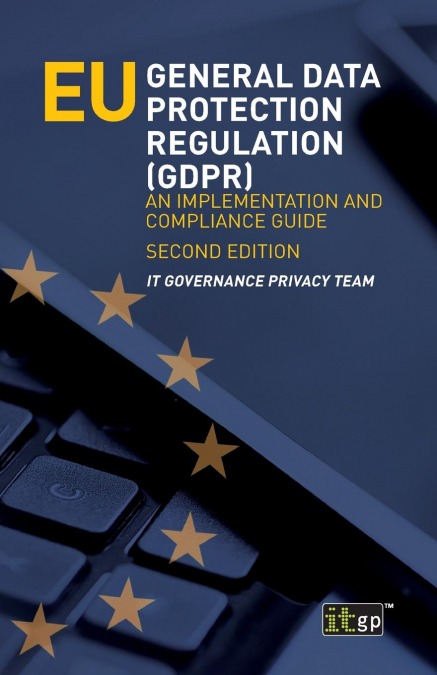
  • EU General Data Protection Regulation (GDPR)
    IT Governance Privacy Team
    An in-depth guide to complying with the EU GDPR.Now in its second edition, EU GDPR – An Implementation and Compliance Guide is a clear and comprehensive guide to this new data protection law, providing a detailed commentary on the Regulation, and setting out the obligations of data  processors and controllers in clear and comprehensible terms.Read this book to learn: How the ...
    Disponible

    30,10 €

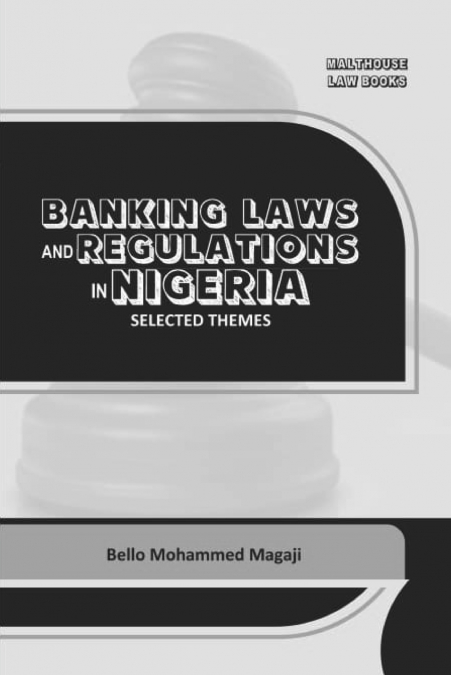
  • Banking Laws and Regulations in Nigeria
    Bello Mohammed Magaji
    Banking Law and Regulations in Nigeria: Selected Themes essentially deals with the laid down rules or code of conduct meant to control and set standards for banking business. Indeed, the main aim of the ongoing banking reforms in Nigeria, started in 2004, is to ensure banks’ conformity to the laid down banking rules and regulations. The eleven-chapter book contains vital and ri...
    Disponible

    41,17 €

  • States and the Interpretation of Treaties
    Dimitris Liakopoulos
    States and the Interpretation of Treaties opens with a provocative reconsideration of a debate on the subject of comparative international legal obligations by the United Nations’s International Law Commission. In this book, distinguished Tufts University legal scholar Dimitris Liakopoulos identifies and explores relevant considerations in the work of the Commission and offers ...
  • The role of customs in international treaties
    Dimitris Liakopoulos
    The Role of Customs in International Treaties concentrates on issues of friction between member states of the United Nations. In view of the role played by the United Nations in resolving international disputes, Dimitris Liakopoulos hypothesizes that 'practical guides' based on custom often catalyze the positions taken by states, courts, scholars, and other actors, constituting...
  • Debtor protection in American and European Union bankruptcy law
    Dimitris Liakopoulos
    In Debtor Protection in American and European Union Bankruptcy Law, international law scholar Dimitris Liakopulos raises a delicate issue at the foundations of the modern banking system by analyzing US bankruptcy law with a focus on the concept of automatic stay. His work identifies legal sources and authorities having repercussions in terms of operational protection. It then e...
  • Capital punishment in American courts
    James Biser Whisker / Kevin Spiker
    In the 400 years since the first known execution was carried out for treason in Virginia, American jurisdictions have debated both the appropriateness and methods of capital punishment. Over that time, courts have placed varying restrictions on its application, excluding categories of citizens (for example the insane or the underaged) and evaluating and excluding methods of exe...

Otros libros del autor

  • Advance Metadata Fair
    Stanley Shanapinda
    This book outlines the legal powers of a major Western nation - Australia - to collect and use location information. Mobile service and social media service providers now have the ability to track, record and store more precise location information. Unlike 4G, 5G mobile communications require that cell towers and antennas be in much closer proximity; as a result, the location d...
    Disponible

    195,63 €