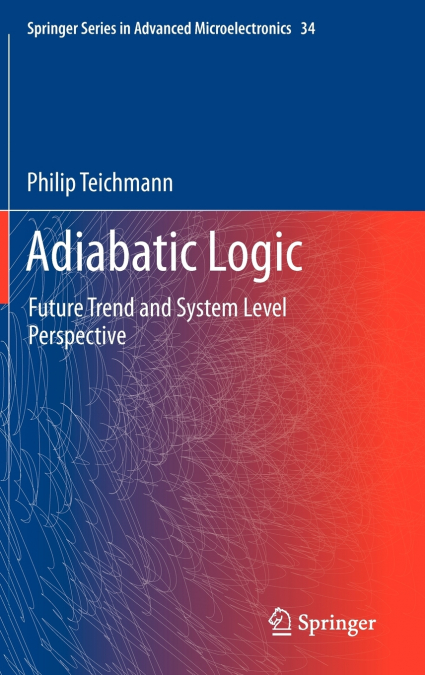
Adiabatic Logic

Adiabatic Logic

Philip Teichmann

134,41 €
IVA incluido
Disponible
Editorial:
Springer Nature B.V.
Año de edición:
2013
ISBN:
9789400737273
134,41 €
IVA incluido
Disponible

Selecciona una librería:

  • Librería Samer Atenea
  • Librería Aciertas (Toledo)
  • Kálamo Books
  • Librería Perelló (Valencia)
  • Librería Elías (Asturias)
  • Donde los libros
  • Librería Kolima (Madrid)
  • Librería Proteo (Málaga)

Adiabatic logic is a potential successor for static CMOS circuit design when it comes to ultra-low-power energy consumption. Future development like the evolutionary shrinking of the minimum feature size as well as revolutionary novel transistor concepts will change the gate level savings gained by adiabatic logic. In addition, the impact of worsening degradation effects has to be considered in the design of adiabatic circuits. The impact of the technology trends on the figures of merit of adiabatic logic, energy saving potential and optimum operating frequency, are investigated, as well as degradation related issues. Adiabatic logic benefits from future devices, is not susceptible to Hot Carrier Injection, and shows less impact of Bias Temperature Instability than static CMOS circuits. Major interest also lies on the efficient generation of the applied power-clock signal. This oscillating power supply can be used to save energy in short idle times by disconnecting circuits. An efficient way to generate the power-clock is by means of the synchronous 2N2P LC oscillator, which is also robust with respect to pattern-induced capacitive variations. An easy to implement but powerful power-clock gating supplement is proposed by gating the synchronization signals. Diverse implementations to shut down the system are presented and rated for their applicability and other aspects like energy reduction capability and data retention. Advantageous usage of adiabatic logic requires compact and efficient arithmetic structures. A broad variety of adder structures and a Coordinate Rotation Digital Computer are compared and rated according to energy consumption and area usage, and the resulting energy saving potential against static CMOS proves the ultra-low-power capability of adiabatic logic. In the end, a new circuit topology has to compete with static CMOS also in productivity. On a 130nm test chip, a large scale test vehicle containing an FIR filter was implemented in adiabatic logic, utilizing a standard, library-based design flow, fabricated, measured and compared to simulations of a static CMOS counterpart, with measured saving factors compliant to the values gained by simulation. This leads to the conclusion that adiabatic logic is ready for productive design due to compatibility not only to CMOS technology, but also to electronic design automation (EDA) tools developed for static CMOS system design.

Artículos relacionados

  • CLOUD TO EDGEWARE
    BROOKS TYSON T / TYSON T BROOKS
    This comprehensive book presents a new approach to dynamic distributed virtual systems. Wireless grids edgeware promises new cloud to edge secure architectures with mobile security for the Internet of Things (IoT). The scope covers framworks and models for wireless grids edgeware, as well as open specifications and new applications called gridlets and wiglets.The book also high...
  • Solutions Architect’s Handbook - Third Edition
    Neelanjali Srivastav / Saurabh Shrivastava
    From fundamentals and design patterns to the latest techniques such as generative AI, machine learning and cloud native architecture, gain all you need to be a pro Solutions Architect crafting secure and reliable AWS architecture.Key Features:- Hits all the key areas -Rajesh Sheth, VP, Elastic Block Store, AWS- Offers the knowledge you need to succeed in the evolving landscape ...
    Disponible

    84,87 €

  • Generative AI for Cloud Solutions
    Anurag Karuparti / Paul Singh
    Explore Generative AI, the engine behind ChatGPT, and delve into topics like LLM-infused frameworks, autonomous agents, and responsible innovation, to gain valuable insights into the future of AI Key FeaturesGain foundational GenAI knowledge and understand how to scale GenAI/ChatGPT in the cloudUnderstand advanced techniques for customizing LLMs for organizations via fine-tunin...
    Disponible

    75,16 €

  • Segurança De Serviços Em Nuvem Na Prática
    Hélio Watanabe
    Segurança de Serviços em Nuvem na Prática: utilizando a ISO 27017 em empresas no Brasilé um guia prático voltado para a implementação de medidas de segurança da informação em serviços de nuvem, com foco nas particularidades do mercado brasileiro.O livro aborda a importância crescente da computação em nuvem e os desafios associados à sua segurança, introduzindo a norma ISO/IEC 2...
    Disponible

    9,88 €

  • The Habits of Great Developers
    Tom Henricksen
    Developers want great results and must focus on the small habits.Don’t you wish someone asked great developers how they do it? Tom Henricksen has reached out to leading coders and compiled their advice into one place.Here are some of the people whom he worked with:David FarleyWoody ZuillDoc NortonGeePaw HillDavid NealAndrew StellmanLuca RossiTom has distilled down the small ste...
    Disponible

    17,79 €

  • Enterprise Architects
    Svyatoslav Kotusev
    Enterprise architects are specialized industry professionals responsible for leading joint business and IT planning in organizations, thereby enabling the success of their digital transformation efforts. Despite their immediate relevance to today’s ubiquitous digitalization tendencies, the very presence of enterprise architects, as unique organizational characters, is largely u...
    Disponible

    85,82 €

Otros libros del autor

  • Adiabatic Logic
    Philip Teichmann
    1 Introduction. 1.1 Motivation for this work. 1.2 A brief history of reversible computation and Adiabatic Logic. 2 Fundamentals of Adiabatic Logic. 2.1 Charging process in AL compared to static CMOS. 2.2 An adiabatic system. 2.3 Loss mechanisms in Adiabatic Logic. 2.4 Voltage scaling ­ A comparison of static CMOS and AL. 2.5 Properties and design considerations in AL. 2.6 Gen...