

Jacques de Bourges / Thierry Ruolz
 Librería Samer Atenea
 Kálamo Books
 Librería Elías (Asturias)
 Librería Kolima (Madrid)
 Librería Proteo (Málaga)
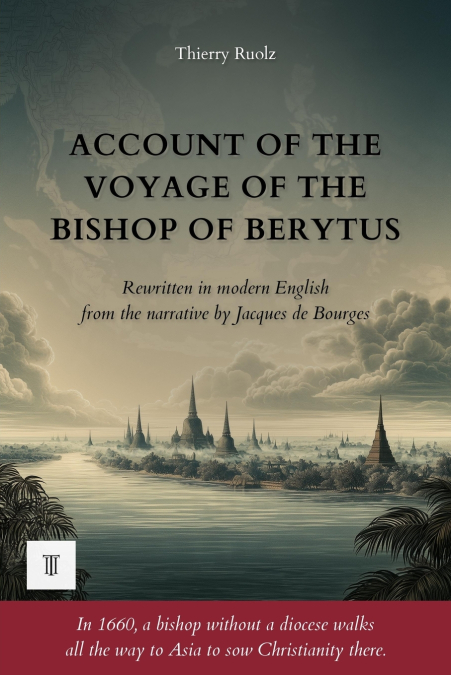
In July 1660, Pierre Lambert de la Motte, Bishop of Berytus for five weeks and Vicar Apostolic of a kingdom no Frenchman has ever set foot in, leaves Paris at dawn, without a farewell, to reach Asia by the only route still open: the land. The Portuguese refuse their passports, the Dutch will carry only their own servants, and the one French ship about to sail has just gone down in a winter storm.Two years on the road in Turkish dress take the bishop and his companions from Aleppo to Baghdad through the desert, amid Arabs and lions prowling around the tents, then down the Tigris to the Persian Gulf, over the mountains of Persia crossed by night to Isfahan, from the customs house at Surat to the ox-carts of the Mughal empire crossing Golconda and its diamond mine, all the way to the shores of Siam. Caravans, heat, famine at Masulipatnam where children are sold, a shipwreck narrowly escaped in a canoe, tigers and elephants mark a route no French missionary had yet described in such vivid detail.At Ayutthaya, capital of a kingdom where every religion is tolerated, the travellers discover a refined civilization: its gilded pagodas and idols, its Buddhist scholars with whom the bishop debates theology, its rice and fruits unknown in Europe, its tea, its writing, its coinage, and the welcome it extends to foreigners of every nation. This encounter, recorded with great care, will soon nourish the founding of the Paris Foreign Missions Society, one of the most enduring missionary institutions in the history of the Church of France.Written by Jacques de Bourges, the bishop’s travelling companion, this 1666 account ranks among the very first French narratives of the overland route to the Far East, predating the great Jesuit journeys to China. It bears witness as much to the geography and commerce of the seventeenth century, its ports and its currencies, as to the tensions among the Portuguese, Dutch and English colonial powers, of which the French missionaries, lacking any official protection, must remain wary throughout the journey.The first complete modern rewriting for today’s reader, one that makes this account accessible without betraying any part of the voyage. Twenty original illustrations and ten redrawn maps bring the itinerary to life, while an apparatus of reference material - glossary, chronology, index, further reading, the original text side by side, an editor’s note, an afterword and credits - along with selected passages from the original text, illuminate the reading.





