

 Librería Samer Atenea
 Kálamo Books
 Librería Elías (Asturias)
 Librería Kolima (Madrid)
 Librería Proteo (Málaga)
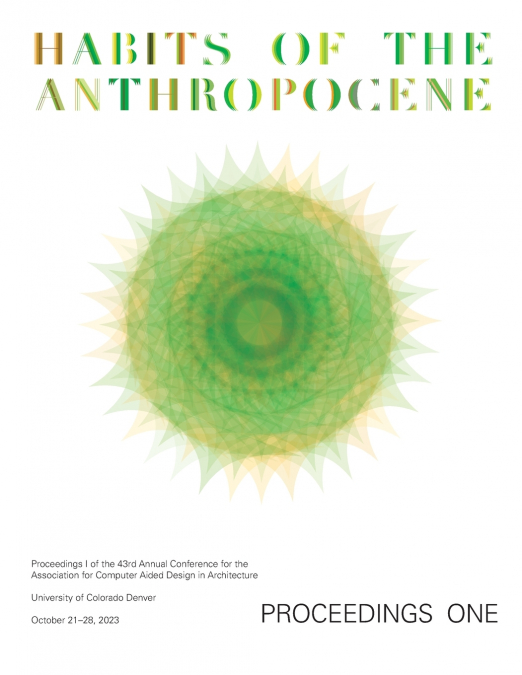
HABITS OF THE ANTHROPOCENE: SCARCITY AND ABUNDANCE IN A POST-MATERIAL ECONOMYPROCEEDINGS OF THE 43RD ANNUAL CONFERENCE OF THE ASSOCIATIONFOR COMPUTER AIDED DESIGN IN ARCHITECTUREVOLUME II: PROCEEDINGS BOOK ONE Volume II of the ACADIA 2023 Conference Proceedings collects fifty-two peer-reviewed papers presented at the 43rd Annual Conference of the Association for Computer Aided Design in Architecture, held October 26-28, 2023 at the Jake Jabs Event Center and hosted by the University of Colorado Denver. This is the research volume of the set. Where Volume I documents built projects, the papers here argue: each was submitted to rigorous peer review by panels of experts appointed by designated chairs, and together they map what computational design was actually doing in 2023 across materials, fabrication, machine learning and extended reality. The papers are organised in twelve sections. FROM SCARCITY TO ABUNDANCE opens on material stock and waste, with frameworks for turning demolition waste into CAD geometry and for representing building material stock at territorial scale. LEARNED ASSEMBLIES and FABRICATED INTELLIGENCE take up robotic reconfiguration through deep multi-agent reinforcement learning, gestural making, ultra-thin additively manufactured formwork, carbon-optimised CharCrete, and rebar layouts traced along principal stress directions. GROWING MATERIALS and LIVING MATERIALS carry the conference theme furthest: biopolymer composites for an unstable architecture, robotic 3D-printed biodegradable wood formwork, a hanging myco-structure, engineered living fabrication combining hardware, wetware and software, knitting as a strategy for mycelium biofabrication, bioreceptive clay modules colonised by lichen, and bacteria-driven form exploration through aeration scaffolding. MATERIAL EMERGENCE gathers thermal clay tiles, dynamic slip casting, willow-earth hybrid construction. EXTENDING REALITIES and AUTONOMOUS ASSEMBLIES cover multi-user social mixed reality, augmented-reality tube bending, responsive robotic assembly with unprocessed wood, rover printing of large-scale pneumatic structures, liquid metal printing, and robotic die-extrusion for architectural ceramics. INTERFACING DATA, CRAFTING THE DIGITAL, LEARNED ECOLOGIES and GESTURED SEQUENCES turn to computation itself: spectral daylight simulation for controlled environment agriculture, neural radiance fields, generative frameworks using large language models, binder jet monitoring, a BCI interactive architectural interface, deep-learning surrogate models for annual daylight, urban archetype generation through self-supervised learning, and text-to-image and sketch-to-model approaches to generative design. The conference carried a post-pandemic focus, addressing the traumas, disruptions and potentials arising from the global lockdown. It was a collaborative endeavour involving academics from North America and Europe working across architecture, landscape architecture and computer science, and it placed significant emphasis on fostering diversity through a meticulous and rigorous peer review process. A global livestream made the conference freely accessible to students worldwide. With a foreword by Shelby Elizabeth Doyle, a conference introduction by Assia Crawford and a projects introduction by Nancy Diniz. Volume I collects the projects; Volume II collects the peer-reviewed papers; Volume III records the field notes, keynotes, workshops and awards. Edited by Assia Crawford, Nancy Diniz, Richard Beckett, Jamie Vanucchi, and Marc Swackhamer. Published by the Association for Computer Aided Design in Architecture (ACADIA).





