Inicio > Humanidades > Filosofía > Academic Skepticism in Seventeenth-Century French Philosophy
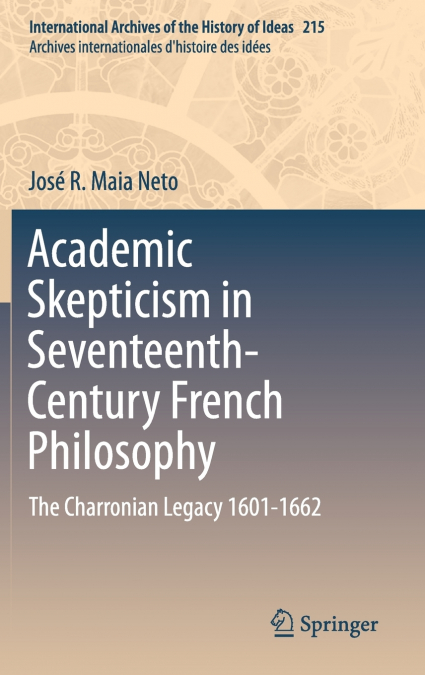
Academic Skepticism in Seventeenth-Century French Philosophy

Academic Skepticism in Seventeenth-Century French Philosophy

José R. Maia Neto / José RMaia Neto

65,46 €
IVA incluido
Consulta disponibilidad
Editorial:
Springer Nature B.V.
Año de edición:
2014
Materia
Filosofía
ISBN:
9783319073583

Selecciona una librería:

  • Librería Samer Atenea
  • Librería Aciertas (Toledo)
  • Kálamo Books
  • Librería Perelló (Valencia)
  • Librería Elías (Asturias)
  • Donde los libros
  • Librería Kolima (Madrid)
  • Librería Proteo (Málaga)

This book is the first systematic account of Pierre Charron’s influence among the major French philosophers in the period (1601-1662). It shows that Charron’s Wisdom was one of the main sources of inspiration of Pierre Gassendi’s first published book, the Exercitationes adversus aristoteleos. It sheds new light on La Mothe Le Vayer, who is usually viewed as a major free thinker. By showing that he was a follower of Charron, La Mothe emerges neither as a skeptical apologist nor as a disguised libertine, as combatting superstition but not as irreligious. The book shows the close presence of Charron in the preambles of Descartes’ philosophy and that the cogito is mainly based on the moral Academic self-assurance of Charron’s wise man. This interpretation reverses the standard view of Descartes’ relation to skepticism. Once this skepticism is recognized to be Charron’s Academic one, it is seen not as the target but as the source of the cogito. Pascal is the last major philosopher for whom Charron’s wisdom is crucially relevant. Montaigne and Descartes influenced, respectively, Pascal’s view of the Pyrrhonian skeptic and of the skeptical main arguments. The book shows that Charron’s Academic skeptical wise man is one of the main targets of his projected apology for Christianity, since he considered him as a threat and counter-example of the kind of Christian view of human beings he believed. By restoring the historical philosophical relevance of Charron in early modern philosophy and arguing for the relevance of Academic skepticism in the period, this book opens a new research program to early modern scholars and will be valuable for those interested in the history of philosophy, French literature and religion.

Artículos relacionados

  • Introduction to a Future Way of Thought
    Kostas Axelos / Kenneth Mills
    'Technologists only change the world in various ways in generalized indifference; the point is to think the world and interpret the changes in its unfathomability, to perceive and experience the difference binding being to the nothing.'Anticipating the age of planetary technology Kostas Axelos, a Greek-French philosopher, approaches the technological question in this book, firs...
    Disponible

    18,58 €

  • Capsule
    John Kenneth Press
    Join John and Adam as they wander the mean streets of Japan on a psychedelic fueled search for identity. While fun for the average reader, this book could also serve as a philosphy textbook because of its ordered exploration of sources of identity. Ultimately this trip through nationalist attacks, sex, and drugs, will take you to a better understanding of yourself and your pl...
    Disponible

    11,51 €

  • If you look at it long enough...
    Paul Hallam
    Originally written for an academic journal, If you look at it long enough... is primarily a personal account of Paul Hallam’s recollections of “self-abuse” through the consumption of porn over several decades. Challenging the familiar form of an “academic essay,” this autobiographical narrative raises several questions in relation to our contemporary morals related to sex in ge...
    Disponible

    11,30 €

  • The Teachers of Gurdjieff
    Rafael Lafort / Rafael Lefort
    When The Teachers of Gurdjieff was first published more than 50 years ago, it made a considerable stir. George Ivanovich Gurdjieff had been one of the most famous mystics in the West in the first half of the 20th century - a teaching master who had many fashionable and influential pupils. He had a striking appearance and manner of teaching, and his teaching proved to be very in...
    Disponible

    20,45 €

  • Manifesto of the Communist Party
    Karl Marx
    The Communist Manifesto was first published on February 21, and it is one of the world’s most influential political tracts. Commissioned by the Communist League and written by communist theorists Karl Marx and Friedrich Engels, it laid out the League’s purposes and program. The Manifesto suggested a course of action for a proletarian (working class) revolution to overthrow the ...
  • The Art of Literature
    Arthur Schopenhauer
    Collected here are eight short essays, On Authorship, On Style, On the Study of Latin, On Men of Learning, On Thinking for Ones Self, On Criticism, On Reputation, On Genius, by the world renowned philosopher Arthur Achopenhauer. ...