 Librería Samer Atenea
 Kálamo Books
 Librería Elías (Asturias)
 Librería Kolima (Madrid)
 Librería Proteo (Málaga)
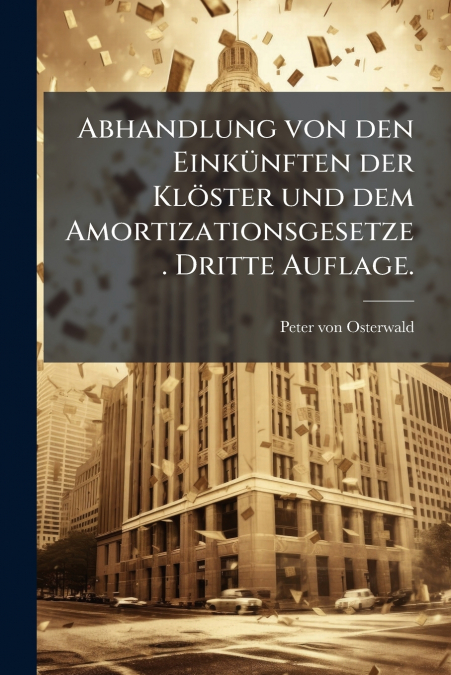
Die dritte Auflage von Peter von Osterwalds 'Abhandlung von den Einkünften der Klöster und dem Amortizationsgesetze' untersucht detailliert die Einkommensquellen von Klöstern und das zugehörige Amortisationsgesetz. Diese Abhandlung bietet Einblicke in die finanziellen Aspekte des Klosterlebens und die rechtlichen Rahmenbedingungen, die deren wirtschaftliche Aktivitäten regelten. Es ist ein wichtiges Werk für alle, die sich mit Kirchengeschichte, Wirtschaftsgeschichte und Recht befassen. This third edition of Peter von Osterwald’s 'Abhandlung von den Einkünften der Klöster und dem Amortizationsgesetze' delves into the sources of income for monasteries and the laws governing amortization. This treatise offers valuable insights into the financial aspects of monastic life and the legal frameworks regulating their economic activities. It is an essential resource for anyone studying church history, economic history, and law.This work has been selected by scholars as being culturally important, and is part of the knowledge base of civilization as we know it. This work was reproduced from the original artifact, and remains as true to the original work as possible. Therefore, you will see the original copyright references, library stamps (as most of these works have been housed in our most important libraries around the world), and other notations in the work.This work is in the public domain in the United States of America, and possibly other nations. Within the United States, you may freely copy and distribute this work, as no entity (individual or corporate) has a copyright on the body of the work.As a reproduction of a historical artifact, this work may contain missing or blurred pages, poor pictures, errant marks, etc. Scholars believe, and we concur, that this work is important enough to be preserved, reproduced, and made generally available to the public. We appreciate your support of the preservation process, and thank you for being an important part of keeping this knowledge alive and relevant.