
Inicio > Humanidades > Historia > Abductions in the American Revolution
Abductions in the American Revolution

Abductions in the American Revolution

Christian McBurney

42,85 €
IVA incluido
Disponible
Editorial:
McFarland and Company, Inc.
Año de edición:
2016
Materia
Historia
ISBN:
9781476663647
42,85 €
IVA incluido
Disponible

Selecciona una librería:

  • Librería Samer Atenea
  • Librería Aciertas (Toledo)
  • Kálamo Books
  • Librería Perelló (Valencia)
  • Librería Elías (Asturias)
  • Donde los libros
  • Librería Kolima (Madrid)
  • Librería Proteo (Málaga)

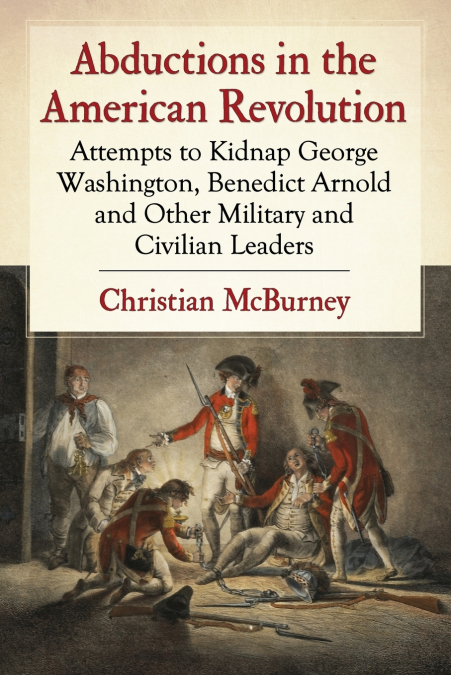
The tactic of kidnapping enemy leaders, used in the recent wars in Iraq and Afghanistan, dates to the American Revolution. George Washington called such efforts 'honorable' and supported attempts to kidnap the British commander-in-chief (twice), Benedict Arnold (after he turned traitor) and Prince William Henry (a future king of Great Britain). Washington in turn was targeted at his Morristown winter headquarters by British dragoons who crossed the frozen Hudson River. New Jersey Governor William Livingston performed a patriotic service by going to considerable lengths to avoid being abducted by the Loyalist raider James Moody. Sometimes these operations succeeded, as with the spectacular captures of Major General Charles Lee, Major General Richard Prescott, Brigadier General Gold Selleck Silliman, and North Carolina’s governor Thomas Burke. Sometimes they barely failed, as with the violent attempt by British secret service operatives against Major General Philip Schuyler and the mission by British dragoons against Thomas Jefferson. Some of the abducted, such as signer of the Declaration of Independence Richard Stockton and Delaware’s governor John McKinly, suffered damage to their reputations. The kidnapper risked all--if caught, he could be hanged. This book covers more than thirty major attempted and successful abductions of military and civilian leaders from 1775 to 1783, from Maine to Georgia, and including two in Great Britain.

Artículos relacionados

  • Raising Freedom's Banner
    Paul Harris
    World wide history of peaceful street demonstrations from their earliest beginning in eighteenth century England to their use throughout the world in the twenty-first century. Describes why some demonstration movements succeeded and others failed. Contrasts demonstrations within the law with civil disobedience demonstrations. Describes Peterloo, the Chartists, the Suffragettes,...
    Disponible

    23,59 €

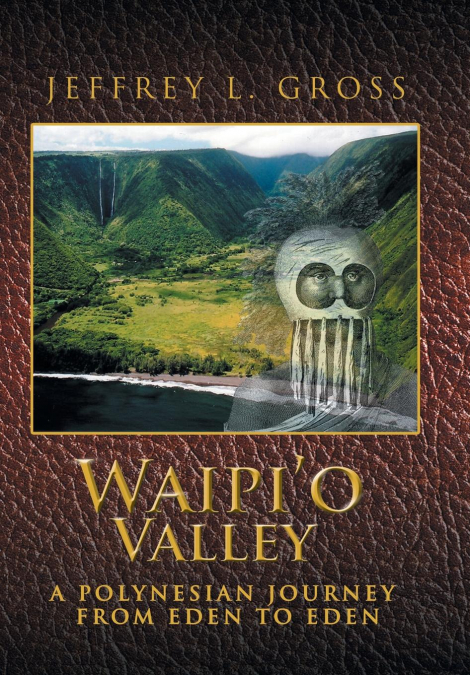
  • Waipi’o Valley
    Jeffrey L. Gross
    Waipi’o Valley: A Polynesian Journey from Eden to Eden recounts the remarkable migrations of the Polynesians across a third of the circumference of the earth. Their amazing journey began from Kalana i Hau’ola, the biblical “Garden of Eden” located along the shore of the Persian Gulf, extended to the Indus River Valley of ancient Vedic India, to Egypt where some ancestors of the...
  • Floralia
    June Rainsford Butler
    A century characterized by a growing interest in science, the opportunity for travel, and leisure for gardening furnishes the setting for Butler’s book. The rise of landscape gardening in England is traced, and the origin and history of its most famous gardens are given. The close relation between England and America in the field of horticulture is also discussed.Originally pub...
    Disponible

    61,20 €

  • President Wilson’s Addresses
    Woodrow Wilson
    'These addresses of President Woodrow Wilson are almost entirely concerned with political affairs, and more specifically with defining Americanism. Yet they also show that even as he moved from academia to the heights of politics, Wilson retained something of the teacher’s interest in showing the relation between specific instances and the general forms of thought or action of ...
  • The Story of my Life
    John Albert Macy
    The Story of My Life, is Helen Keller’s autobiography detailing her early life, especially her experiences with Anne Sullivan. The book is dedicated to inventor Alexander Graham Bell. The dedication reads, 'To ALEXANDER GRAHAM BELL Who has taught the deaf to speak and enabled the listening ear to hear speech from the Atlantic to the Rockies, I dedicate this Story of My Life.' ...
  • The Story of My Life Vol. 6 Spanish Passions
    Giacomo Casanova
    Casanova was an Italian adventurer and author from the Republic of Venice. His autobiography, Histoire de ma vie (Story of My Life), is regarded as one of the most authentic sources of the customs and norms of European social life during the 18th century. He has become so famous for his often complicated and elaborate affairs with women that his name is now synonymous with 'wom...