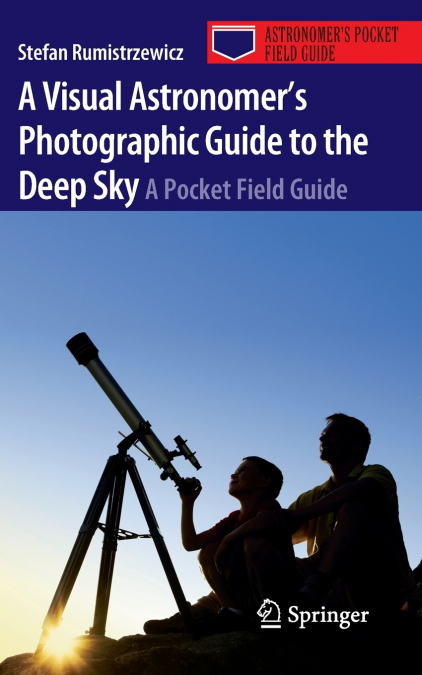

Inicio > Matemáticas y ciencia > Astronomía, espacio y tiempo > A Visual Astronomer’s Photographic Guide to the Deep Sky
A Visual Astronomer’s Photographic Guide to the Deep Sky

A Visual Astronomer’s Photographic Guide to the Deep Sky

Stefan Rumistrzewicz

56,86 €
IVA incluido
Disponible
Editorial:
Springer Nature B.V.
Año de edición:
2010
Materia
Astronomía, espacio y tiempo
ISBN:
9781441972415
56,86 €
IVA incluido
Disponible

Selecciona una librería:

  • Librería Samer Atenea
  • Librería Aciertas (Toledo)
  • Kálamo Books
  • Librería Perelló (Valencia)
  • Librería Elías (Asturias)
  • Donde los libros
  • Librería Kolima (Madrid)
  • Librería Proteo (Málaga)

Over the last 15 years or so there has been a huge increase in the popularity of astrophotography with the advent of digital SLR cameras and CCD imagers. These have enabled astronomers to take many images and, indeed, check images as they scan the skies. Processing techniques using computer software have also made ’developing’ these images more accessible to those of us who are ’chemically challenged!’ And let’s face it - some of the pictures you see these days in magazines, books, and on popular web forums are, frankly, amazing! So, why bother looking through the eyepiece you ask? Well, for one thing, setting up the equipment is quicker. You just take your ’scope out of the garage or, if you’re lucky enough to own one, open the roof of your observatory, align the ’scope and off you go. If you have an equatorial mount, you’ll still need to roughly polar align, but this really takes only a few moments. The ’imager’ would most likely need to spend more time setting up. This would include very accurate polar alignment (for equatorial mounts), then finding a guide star using his or her finder, checking the software is functioning properly, and c- tinuous monitoring to make sure the alignment is absolutely precise throu- out the imaging run. That said, an imager with a snug ’obsy’ at the end of the garden will have a quicker time setting up, but then again so will the ’visual’ observer.

Artículos relacionados

  • 50 Targets for the Mid-Sized Telescope
    John Read
    Written as a follow up to 50 Things to See with a Small Telescope, containing virtually no overlap in content, 50 Targets for the Mid-Sized Telescope introduces the beginner stargazer to an assortment of astronomical wonders. With easy-to-follow star maps, unique for each target, the budding astronomer will explore the universe like never before.Each target has been carefully c...
  • Climate Change and Global Warming - Exposed
    Andrew Johnson
    The weather is something which affects all of us, every day of our lives. It dictates our long and short-term plans. In the UK, the weather is the "default topic" of conversation for strangers and friends alike. Though it has obvious and far reaching importance, most people don't know very much about the weather. These days, they don't take time to observe it and probab...
    Disponible

    13,82 €

  • Archaeoastronomy in East Asia
    Until now, important research on the historical records of comets and meteor showers from China, Japan, and Korea has remained the exclusive preserve of those with expertise in the relevant languages. With a compilation like the present volume the authors hope to ameliorate that situation. Applying the same rigorous selection criteria and style of presentation as in the previou...
  • Night Vision
    Pippa Goldschmidt
    In Night Vision Pippa Goldschmidt writes about outer space and explores its multiple meanings as a place of awe and wonder to a more materialistic site in which scientific ideas are formulated and tested. This book explores space as a location of potential capital where commerce is being developed, leading to a new threatened ’enclosure of the commons’. Goldschmidt posits that ...
    Disponible

    11,26 €

  • Heaven’s Touch
    James B. Kaler
    A breathtaking account of how the surrounding cosmos impacts life on EarthDid you know that as you read these words showers of high-speed particles from exploding stars are raining down on you? As you gaze into the starry sky, you might feel isolated from the Universe around you-but you’re not. This book reveals the startling ways life on Earth is touched by our cosmic environm...
  • The Galactic Supermassive Black Hole
    Fulvio Melia
    Here, one of the world’s leading astrophysicists provides the first comprehensive and logically structured overview of the many ideas and discoveries pertaining to the supermassive black hole at the galactic center known as Sagittarius A*. By far the closest galactic nucleus in the universe, Sagittarius A* alone can provide us with a realistic expectation of learning about the ...
    Disponible

    118,87 €