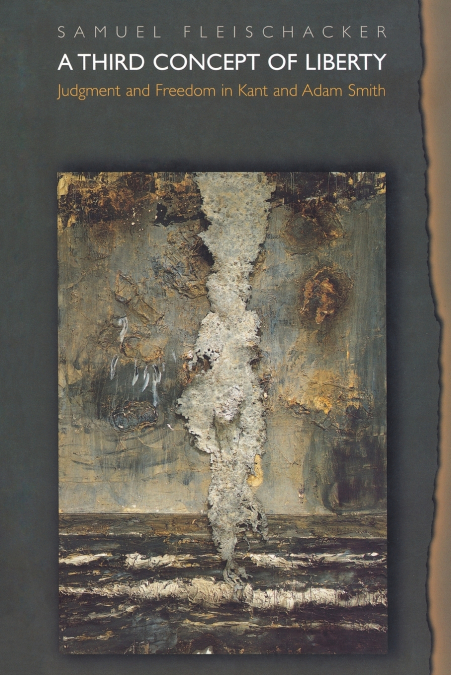

A Third Concept of Liberty

A Third Concept of Liberty

Samuel Fleischacker

89,91 €
IVA incluido
Disponible
Editorial:
Princeton University Press
Año de edición:
1999
Materia
Ética y filosofía moral
ISBN:
9780691004464
89,91 €
IVA incluido
Disponible

Selecciona una librería:

  • Librería Samer Atenea
  • Librería Aciertas (Toledo)
  • Kálamo Books
  • Librería Perelló (Valencia)
  • Librería Elías (Asturias)
  • Donde los libros
  • Librería Kolima (Madrid)
  • Librería Proteo (Málaga)

Taking the title of his book from Isaiah Berlin’s famous essay distinguishing a negative concept of liberty connoting lack of interference by others from a positive concept involving participation in the political realm, Samuel Fleischacker explores a third definition of liberty that lies between the first two. In Fleischacker’s view, Kant and Adam Smith think of liberty as a matter of acting on our capacity for judgment, thereby differing both from those who tie it to the satisfaction of our desires and those who translate it as action in accordance with reason or 'will.' Integrating the thought of Kant and Smith, and developing his own stand through readings of the Critique of Judgment and The Wealth of Nations, Fleischacker shows how different acting on one’s best judgment is from acting on one’s desires--how, in particular, good judgment, as opposed to mere desire, can flourish only in favorable social and political conditions. At the same time, exercising judgment is something every individual must do for him- or herself, hence not something that philosophers and politicians who reason better than the rest of us can do in our stead. For this reason advocates of a liberty based on judgment are likely to be more concerned than are libertarians to make sure that government provides people with conditions for the use of their liberty--for example, excellent standards of education, health care, and unemployment insurance--while at the same time promoting a less paternalistic view of government than most of the movements associated for the past thirty years with the political left.
Artículos relacionados

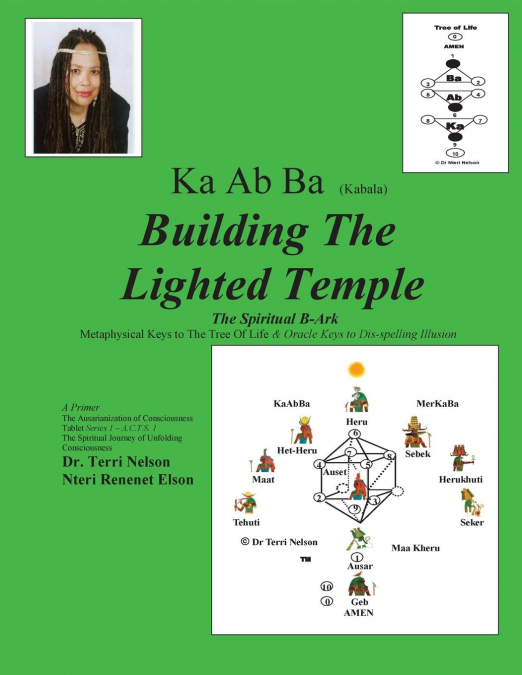
  • Ka Ab Ba Building The Lighted Temple
    Dr Terri R. Nelson / Dr Terri RNelson
    The book KaAbBa Building The Lighted Temple/Metaphysical Keys to the Tree of Life draws a circle that is inclusive of the Afrikan origin of the Ancient Kemetic/Egyptian wisdom. It reveals the undeniable root and link of Ancient Africa to all the religious systems that would develop worldwide. This book is explosive in its power to convey the meaning of KaAbBa, the Medu Neter  (...
    Disponible

    37,41 €

  • Technoethics and the Evolving Knowledge Society
    Rocci Luppicini
    Recently, there has been a major push to rediscover the ethical dimension of technology across the sciences, social sciences, and humanities. Technoethics and the Evolving Knowledge Society: Ethical Issues in Technological Design, Research, Development, and Innovation examines human processes and practices connected to technology embedded within social, political, and moral sph...
  • Kant
    Immanuel Kant
    Kant’s Groundwork of the Metaphysics of Morals is one of the most important works in modern moral philosophy. It belongs beside Plato, Aristotle, Machiavelli, and Hobbes. Here Kant sets out to articulate and defend the Categorical Imperative - the fundamental principle that underlies moral reasoning - and to lay the foundation for a comprehensive account of justice and human vi...
  • On the Duty of Civil Disobedience
    HENRY DAVID THOREAU
    Civil Disobedience argues that citizens should not permit their governments to overrule their consciences, and that they have a duty to avoid allowing their acquiescence to enable the government to make them the agents of injustice. Thoreau was motivated in part by his disgust with slavery and the Mexican-American War, but the sentiments he expresses here are just as pertinent ...
  • Beyond Good and Evil
    Friedrich Nietzsche
    Nietzsche, though primarily a philosopher, wrote widely on art, philology, history, religion, tragedy, culture, and science.  In 1886, at the height of his powers, he published Beyond Good and Evil.  Here he examines much of the best of human thought--dogmatic philosophy, Judeo-Christian morality, science and democracy – and finds it lacking.  Rejecting “slave-morality” he pres...
  • Beyond Good and Evil
    Friedrich Nietzsche
    Nietzsche, though primarily a philosopher, wrote widely on art, philology, history, religion, tragedy, culture, and science.  In 1886, at the height of his powers, he published Beyond Good and Evil.  Here he examines much of the best of human thought--dogmatic philosophy, Judeo-Christian morality, science and democracy – and finds it lacking.  Rejecting “slave-morality” he pres...
    Disponible

    9,99 €

Otros libros del autor

  • Adam Smith
    Samuel Fleischacker
    Adam Smith is essential reading for those studying ethics, political philosophy, the history of philosophy, and the Enlightenment, as well as those reading Smith in related disciplines such as economics, law and religion. ...
  • Adam Smith
    Samuel Fleischacker
    Adam Smith is essential reading for those studying ethics, political philosophy, the history of philosophy, and the Enlightenment, as well as those reading Smith in related disciplines such as economics, law and religion. ...
    Disponible

    48,27 €

  • Divine Teaching and the Way of the World
    Samuel Fleischacker
    ...
    Disponible

    79,66 €

  • What is Enlightenment?
    Samuel Fleischacker
    This engaging and lucid book explains and assesses Kant’s philosophy of Enlightenment. Including helpful chapter summaries and guides to further reading, it is ideal for anyone studying Kant or the Enlightenment, as well students of politics, history and religious studies. ...
    Disponible

    74,58 €

  • What is Enlightenment?
    Samuel Fleischacker
    This engaging and lucid book explains and assesses Kant’s philosophy of Enlightenment. Including helpful chapter summaries and guides to further reading, it is ideal for anyone studying Kant or the Enlightenment, as well students of politics, history and religious studies. ...
  • Divine Teaching and the Way of the World
    Samuel Fleischacker
    Samuel Fleischacker defends what the Enlightenment called ’revealed religion’: religions that regard a certain text or oral teaching as sacred, as wholly authoritative over one’s life. At the same time, he maintains that revealed religions stand in danger of corruption or fanaticism unless they are combined with secular scientific practices and a secular morality. The first two...