
Inicio > Derecho > Teoría general del derecho > A Theory of Precedent From Analytical Positivism to a Post-Analytical Philosophy of Law
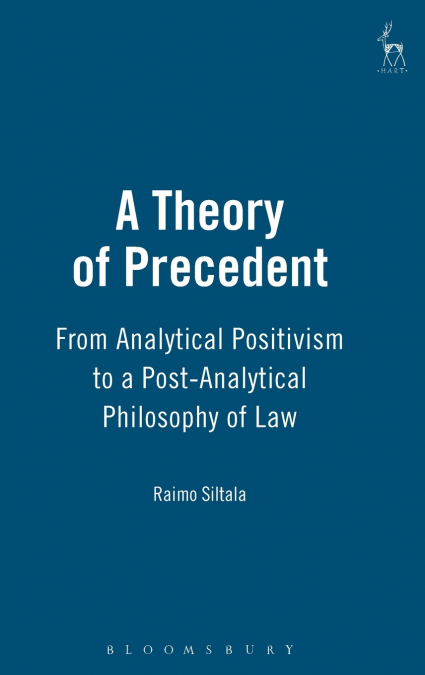
A Theory of Precedent From Analytical Positivism to a Post-Analytical Philosophy of Law

A Theory of Precedent From Analytical Positivism to a Post-Analytical Philosophy of Law

Raimo Siltala

225,88 €
IVA incluido
Consulta disponibilidad
Editorial:
Bloomsbury Publishing plc
Año de edición:
2000
Materia
Teoría general del derecho
ISBN:
9781841131238

Selecciona una librería:

  • Librería Samer Atenea
  • Librería Aciertas (Toledo)
  • Kálamo Books
  • Librería Perelló (Valencia)
  • Librería Elías (Asturias)
  • Donde los libros
  • Librería Kolima (Madrid)
  • Librería Proteo (Málaga)

Analytical jurisprudence has been mostly silent on the role of precedent in legal adjudication. What is the content of a judge’s precedent ideology,or the rule of precedent-recognition, by means of which the ratio of a case is to be distinguished from mere dicta? In this study, the author identifies six types of judicial precedent-ideology, among them judicial legislation, systemic construction of the underlying reasons of law in the Dworkinian sense, and a radical re-evaluation of the merits of a prior case in later adjudication, as envisioned by the American Realists. These competing models are tested against judicial experiences in the UK, US, France, Italy, Germany and Finland. By this means Lon Fuller’s famous ’internal morality of law’ is shown to function rather poorly in the context of precedents, and the author therefore suggests a redefinition of the rule which makes it work for precedent. This, in turn leads the author to confront fundamental questions about the normative nature of law. Is Kelsen’s grundnorm or Hart’s ultimate rule of recognition a valid rule, in the image of legal rules proper, or is it merely a social fact, observable only in the practices and behaviour of judges and other officials? The author claims that Hart is caught between Kelsen and J.L. Borges, the late Argentinian fabulist, in so far as the ontology and epistemology of the rule of recognition are concerned. This leads the author to the conclusion that the two predicaments affecting analytical positivism, namely the threat of endless self-referentiality, or infinite regress, can only be accounted for by means of recourse to the philosophy of deconstruction as posited by Jacques Derrida.


Artículos relacionados

  • EU General Data Protection Regulation (GDPR)
    IT Governance Privacy Team
    An in-depth guide to complying with the EU GDPR.Now in its second edition, EU GDPR – An Implementation and Compliance Guide is a clear and comprehensive guide to this new data protection law, providing a detailed commentary on the Regulation, and setting out the obligations of data  processors and controllers in clear and comprehensible terms.Read this book to learn: How the ...
    Disponible

    30,10 €

  • Banking Laws and Regulations in Nigeria
    Bello Mohammed Magaji
    Banking Law and Regulations in Nigeria: Selected Themes essentially deals with the laid down rules or code of conduct meant to control and set standards for banking business. Indeed, the main aim of the ongoing banking reforms in Nigeria, started in 2004, is to ensure banks’ conformity to the laid down banking rules and regulations. The eleven-chapter book contains vital and ri...
    Disponible

    41,17 €

  • States and the Interpretation of Treaties
    Dimitris Liakopoulos
    States and the Interpretation of Treaties opens with a provocative reconsideration of a debate on the subject of comparative international legal obligations by the United Nations’s International Law Commission. In this book, distinguished Tufts University legal scholar Dimitris Liakopoulos identifies and explores relevant considerations in the work of the Commission and offers ...
  • The role of customs in international treaties
    Dimitris Liakopoulos
    The Role of Customs in International Treaties concentrates on issues of friction between member states of the United Nations. In view of the role played by the United Nations in resolving international disputes, Dimitris Liakopoulos hypothesizes that 'practical guides' based on custom often catalyze the positions taken by states, courts, scholars, and other actors, constituting...
  • Debtor protection in American and European Union bankruptcy law
    Dimitris Liakopoulos
    In Debtor Protection in American and European Union Bankruptcy Law, international law scholar Dimitris Liakopulos raises a delicate issue at the foundations of the modern banking system by analyzing US bankruptcy law with a focus on the concept of automatic stay. His work identifies legal sources and authorities having repercussions in terms of operational protection. It then e...
  • Capital punishment in American courts
    James Biser Whisker / Kevin Spiker
    In the 400 years since the first known execution was carried out for treason in Virginia, American jurisdictions have debated both the appropriateness and methods of capital punishment. Over that time, courts have placed varying restrictions on its application, excluding categories of citizens (for example the insane or the underaged) and evaluating and excluding methods of exe...

Otros libros del autor

  • Law, Truth, and Reason
    Raimo Siltala
    This book is an innovative contribution to analytical jurisprudence.  It is mainly based on the distinct premises of linguistic philosophy and Carnapian semantics, but also addresses the issues of institutional philosophy, social pragmatism, and legal principles as envisioned by Dworkin, among others. Wróblewski´s three ideologies (bound/free/legal and rational) and Makkonen´s ...
    Disponible

    207,62 €

  • Law, Truth, and Reason
    Raimo Siltala
    1. Introduction.- 2. An Isomorphic Theory of Law: A Relation of Structural Similarity between the Two Fact-Constellations Compared.- 3. Coherence Theory of Law: Shared Congruence among Arguments Drawn from the Institutional and Societal Sources of Law.- 4. 'Between the Evident and the Irrational': The New Rhetoric and Legal Argumentation Theory.- 5. Philosophical Pragmatism: La...