

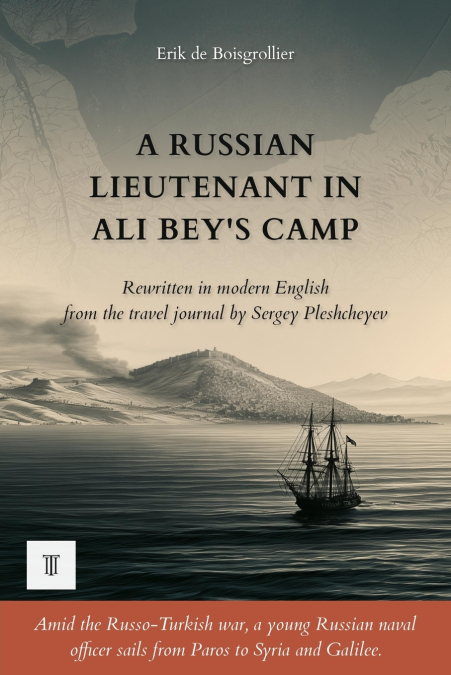
Erik de Boisgrollier / Pleshcheyev
 Librería Samer Atenea
 Kálamo Books
 Librería Elías (Asturias)
 Librería Kolima (Madrid)
 Librería Proteo (Málaga)
August 1772, in the midst of the Russo-Turkish war. On Paros, base of the Russian fleet in the Archipelago, Sergey Pleshcheyev, a lieutenant of twenty, boards the Tartar with Zulfigar Bey, envoy of Ali Bey, the Mamluk driven out of Cairo who is now besieging Jaffa.On board crowds a small cosmopolitan company: a Prussian Rittmeister, a French baron, a Greek monk from Cyprus, a Florentine physician, a Terek Cossack. A call at Acre, at the court of the old sheikh Zahir al-Umar, then Ali Bey’s camp beneath the walls of Jaffa. The young officer offers his advice, reconnoiters the lines under fire, prepares incendiary projectiles and watches an assault break against the ramparts. He will lose a friend there.Then come the fever and Galilee: Nazareth, Cana, the ruins of Sepphoris. On the way back, Acre holds its traps in store, along with its beatings and its amorous intrigues.An officer of the Enlightenment, curious about everything, Pleshcheyev looks at the Ottoman East with rare freedom, from the barbers of the camp to the beys and sheikhs. At last he gathers the story of Ali Bey, the Abkhaz slave who became master of Egypt. How does a man brought to Cairo to be sold come to defy the Sultan?The journal is the work of a firsthand witness. The European travelers of his day crossed the Holy Land as pilgrims or as consuls; Pleshcheyev, by contrast, dines in Ali Bey’s tent, measures the entrenchments of Jaffa, observes the city of Acre, its trade, its communities and the army of the old sheikh Zahir al-Umar, then follows the pilgrims’ road from Nazareth to Cana. Printed in Saint Petersburg in 1773, it takes the reader behind the scenes of a war that was also fought on the coasts of the Levant, amid the Russian fleet in the Archipelago, the ambitions of a former master of Egypt and the fragile balances of Galilee.The crossing runs from Paros to the coast of Syria, with calls at Naxos, Mount Carmel, Acre and Sidna Ali, before the long stay in front of Jaffa, from 7 to 25 September 1772, and then the return by way of Acre and Galilee to Paros on 5 November. Customs, meals, musicians, markets, prayers, beatings and court ruses are noted with the same curiosity as the soundings of the Bay of Haifa or the plan of a mine. Today’s reader finds here a rare document on Ottoman Palestine in the eighteenth century, written by a very young man who does not pretend to understand everything and looks very closely.This is the first complete modern rewriting for today’s reader, making the account readable without betraying anything of the journey. Twelve original illustrations and eight redrawn maps bring the itinerary into view, while a set of reference tools (glossary, chronology, index, editor’s note, afterword, original text, suggestions for further reading) and selected excerpts from the original text enrich the reading.





