

 Librería Samer Atenea
 Kálamo Books
 Librería Elías (Asturias)
 Librería Kolima (Madrid)
 Librería Proteo (Málaga)
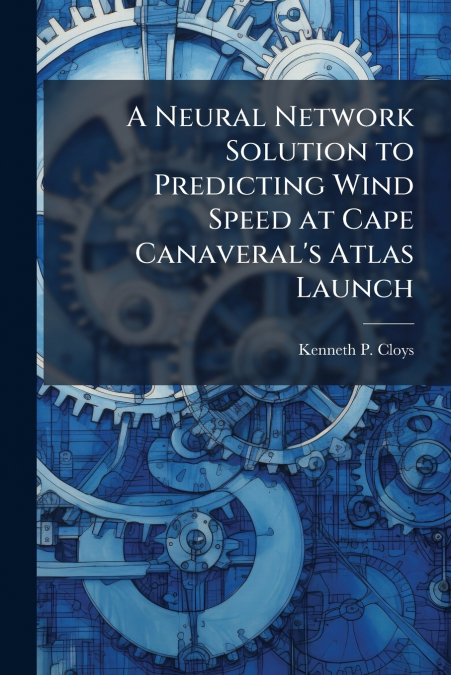
This thesis demonstrates the potential for using time-delay neural networks to provide Launch Weather Officers (LWOs) at 45th Weather Squadron (45 WS) with advance warning of wintertime (November-March) peak wind speeds at the Atlas launch pad. The 45 WS provides weather support to the United States space program at Cape Canaveral Air Station, NASA’s Kennedy Space Center, and Patrick Air Force Base. Due to the complex wintertime environment produced by the effects of friction and instability, 45 WS LWOs consider wintertime launch pad winds their toughest forecast challenge. Neural networks were developed, trained, and tested using observations of wintertime peak wind speed, wind direction, and directional deviation collected from March 1995 through March 1999 by 45th Space Wing’s Weather Information Network Display System. Using current and past values of the observed elements, the networks produced 16 forecasts of peak wind speed. The first forecast was valid for 30 minutes past forecast start time, the second for 1 hour past start time, etc., up to 8 hours past start time, for any start time. Network performance was compared to three other forecasting options: persistence, climatology, and randomly selecting wind speeds from a climatologically based distribution. For forecasts at the end of the forecast period, networks that were tested with data near in time to the networks` training data showed skill over the other forecasting options.This work has been selected by scholars as being culturally important, and is part of the knowledge base of civilization as we know it. This work was reproduced from the original artifact, and remains as true to the original work as possible. Therefore, you will see the original copyright references, library stamps (as most of these works have been housed in our most important libraries around the world), and other notations in the work.This work is in the public domain in the United States of America, and possibly other nations. Within the United States, you may freely copy and distribute this work, as no entity (individual or corporate) has a copyright on the body of the work.As a reproduction of a historical artifact, this work may contain missing or blurred pages, poor pictures, errant marks, etc. Scholars believe, and we concur, that this work is important enough to be preserved, reproduced, and made generally available to the public. We appreciate your support of the preservation process, and thank you for being an important part of keeping this knowledge alive and relevant.





