

 Librería Samer Atenea
 Kálamo Books
 Librería Elías (Asturias)
 Librería Kolima (Madrid)
 Librería Proteo (Málaga)
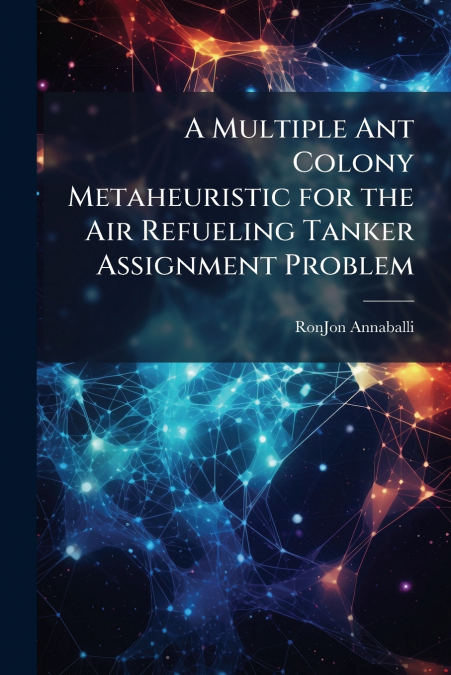
A key tenet to the Air Force’s vision of Global Vigilance, Reach, and Power is the ability to project power via the use of aerial refueling. Scheduling of limited tanker resources is a major concern for Air Mobility Command (AMC). Currently the Combined Mating and Ranging Planning System (CMARPS) is used to plan aerial refueling operations, however due to the complex nature of the program and the length of time needed to run a scenario, the need for a simple tool that runs in much shorter time is desired. Ant colony algorithms are recently developed heuristics for finding solutions to difficult optimization problems based on simulation the foraging behavior of ant colonies. They are distributive metaheuristics that combine an adaptive memory function with a local heuristic function to repeatedly construct possible solutions which can then be evaluated. Using multiple ant colony heuristics combined with a simple scheduling algorithm and modeling the Tanker Assignment Problem as a modified Multiple Depot Vehicle Routing Problem, an Excel based spreadsheet tool was developed which generates very good solutions in very short time.This work has been selected by scholars as being culturally important, and is part of the knowledge base of civilization as we know it. This work was reproduced from the original artifact, and remains as true to the original work as possible. Therefore, you will see the original copyright references, library stamps (as most of these works have been housed in our most important libraries around the world), and other notations in the work.This work is in the public domain in the United States of America, and possibly other nations. Within the United States, you may freely copy and distribute this work, as no entity (individual or corporate) has a copyright on the body of the work.As a reproduction of a historical artifact, this work may contain missing or blurred pages, poor pictures, errant marks, etc. Scholars believe, and we concur, that this work is important enough to be preserved, reproduced, and made generally available to the public. We appreciate your support of the preservation process, and thank you for being an important part of keeping this knowledge alive and relevant.





